


 Sep 21, 2015, 03:49 PM
Last edit by: IB Advertising
See related guides and technical advice from our community experts:
Browse all: General Overview
- Jeep Grand Cherokee WJ 1999 to 2004 Crash Test and Safety Ratings
Important Information to help you understand your Jeep Grand Cherokee.
Browse all: General Overview

XJ Ask the Question Thread
::CF Moderator::
Joined: Aug 2011
Posts: 43,971
Likes: 1,579
From: Prescott, Az
Year: 1990
Model: Cherokee (XJ)
Engine: 4.0

When the Jeep is off,
-turn key to run position (do not engage starter)
-turn key to off
-turn key to run
-turn key to off
-turn key to run and leave on... CEL will flash on left hand VIC display. Count the number of flashes and be sure to notate pauses which indicate a new number. ODBI codes are 2-digit numbers.
-turn key to run position (do not engage starter)
-turn key to off
-turn key to run
-turn key to off
-turn key to run and leave on... CEL will flash on left hand VIC display. Count the number of flashes and be sure to notate pauses which indicate a new number. ODBI codes are 2-digit numbers.
No, I don't lick fish.


Joined: Mar 2011
Posts: 11,169
Likes: 26
From: Northern Kentucky
Year: 1999
Model: Cherokee (XJ)
Engine: 4.0
I use this on OBD-1:
A dancing man on a stick - amazing african tribal dance - Zaouli Dance - YouTube
A dancing man on a stick - amazing african tribal dance - Zaouli Dance - YouTube

CF Veteran

Joined: Jul 2013
Posts: 1,154
Likes: 40
Year: 2000
Model: Cherokee (XJ)
Engine: 4.0
Air Conditioning question!
Had my AC compressor seize and I had a new one placed in an emergency as I was out of town and had to head back into town for work the following day. The shop that placed the new compressor made my jeep drivable but not AC-able. Curious as to if I can fix my system with the suggestions made by the shop as listed below, or if I'm in over my head. The new compressor was put in about 5 months ago and I've had zero problems since.
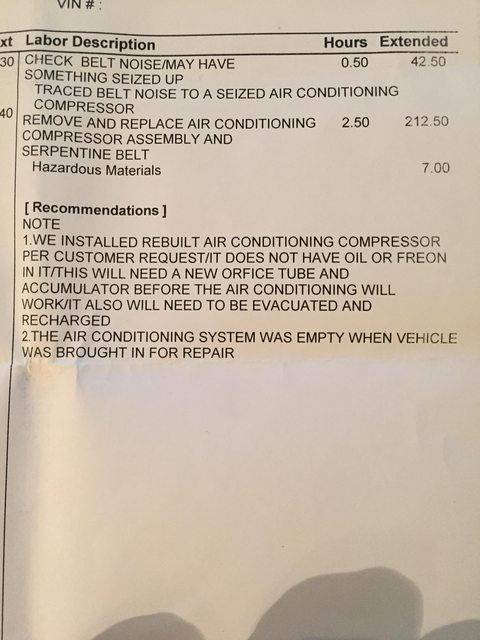
Any advice is much appreciated! its 105 degrees here!
2000 sport 4.0L
Had my AC compressor seize and I had a new one placed in an emergency as I was out of town and had to head back into town for work the following day. The shop that placed the new compressor made my jeep drivable but not AC-able. Curious as to if I can fix my system with the suggestions made by the shop as listed below, or if I'm in over my head. The new compressor was put in about 5 months ago and I've had zero problems since.
Any advice is much appreciated! its 105 degrees here!
2000 sport 4.0L


CF Veteran
Joined: Jan 2013
Posts: 19,219
Likes: 45
From: west chester, pa
Year: 1999
Engine: 4.0

Senior Member
Joined: Sep 2015
Posts: 940
Likes: 72
From: Abysmo, NJ
Year: 1999
Model: Cherokee
Engine: 4.0
Air Conditioning question!
Had my AC compressor seize and I had a new one placed in an emergency as I was out of town and had to head back into town for work the following day. The shop that placed the new compressor made my jeep drivable but not AC-able. Curious as to if I can fix my system with the suggestions made by the shop as listed below, or if I'm in over my head. The new compressor was put in about 5 months ago and I've had zero problems since.
Had my AC compressor seize and I had a new one placed in an emergency as I was out of town and had to head back into town for work the following day. The shop that placed the new compressor made my jeep drivable but not AC-able. Curious as to if I can fix my system with the suggestions made by the shop as listed below, or if I'm in over my head. The new compressor was put in about 5 months ago and I've had zero problems since.
When a compressor fails it typically sends metal shards into the system meaning you have to flush it out. Flushing kits that work with compressed air and flushing solvent are not expensive:
https://www.amazon.com/FJC-2710-Syst...c+flushing+kit
https://www.amazon.com/Four-Seasons-...WNBMXXXV2583T0
You'll also need a drier for the air from your shop compressor when using a kit like this. You don't want to be filling your AC system with moisture! The disposable desiccant type inline driers commonly used for painting will work. (The refrigerated or heated air drying systems used by pro shops cost big $$$$!)
http://www.northerntool.com/shop/too...9833_200319833
Unfortunately the parallel-flow condensers used in R134a systems cannot be reliably flushed out and should be replaced. The drier/accumulator and expansion valve will also need to be replaced.
There's a lot of discussion as to whether evaporators should be flushed or replaced. The issue is that it can be difficult to get all the flushing compound out. I've successfully done it but followed up the flush with dry compressed air for a while to make sure all the solvent is gone. (Really you should do this with all the flushed out parts.)
You don't flush compressor, drier, or expansion valve.
You'll need to add the amount and viscosity of PAG oil specified for the system just before buttoning it up. (The new compressor may have come with assembly oil which would have to be dumped out and replaced.) There will be a specification for how much the compressor is supposed to hold, the rest can be put into the drier. Oil should be put in just prior to closing up the system and pulling vacuum because it is extremely prone to absorbing atmospheric moisture. This moisture does not come out when you vacuum the system and will form acids with the refrigerant that eat small holes in metal parts such as the evaporator. Likewise the drier should be exposed to air for the minimum time possible.
I like to use Nylog sealer on the seals and fittings, makes it much less likely that there will be a leak.
https://www.amazon.com/Refrigeration...rds=nylog+blue
When you charge the system you may want to put some dye in for the purpose of tracing leaks. (Though if you're going to be doing your own AC work an electronic detector would be a good investment.)
NEVER put sealer into the system!! This stuff hardens on contact with the air and can really make a mess of things when the AC system is opened up for service later.
Last edited by Rambler65; Jun 30, 2016 at 09:33 AM.

Newbie
Joined: Jan 2016
Posts: 4
Likes: 0
Year: 1999
Model: Cherokee
I know most folks here do their own work, one day I hope to join that crowd. For now, lack of a garage, space, and knowledge hold me back (working on the knowledge part though). Since I don't know how to weld and don't have the space for big projects, what is the best way to go about replacing a floor pan? Basically the driver side floor pan on my 99 cherokee is, well, gone. If ya get under the jeep and poke, there's no metal. I've gone over sticks that have happened to pop up in just the right spot and push my foot up. Great for comic relief, not so great for life of the jeep. I'm new to all this kind of stuff so I'm curious what kind of shop is the best to take it to, or really, who in general does those kinds of repairs? Also, is it better to order the part myself and then take it to someone to put in or is that even a thing? Last question, what would be a fair price range I could expect for something like this?
CF Veteran
Joined: Aug 2015
Posts: 1,226
Likes: 11
From: Laurium, MI
Year: 1999
Model: Cherokee(XJ)
Engine: 4.0L
That's where I'm not seeing it...Call me blind, deaf and dumb(I should be a hockey ref then...:P) and we can leave it at that... But the way it seems is that the carrier transmits the power to the cross pin. The cross pin is fixed. On a turn the cross pin will initially push both inside gears bevels, which in turn pushes the teeth firmly into the pieces driving the axles. This locks them at the same speed. As you go around the turn the outer wheel will increase in speed rotating that side allowing the bevel to move away from the cross pin, now the internal peice can be pulled in by the springs and the tire can continue rotating forward at a faster rate than the other side. Yes if you floor it and break the inside tire loose everything will rotate the same speed. Am I missing something? 
google brings up the weirdest threads...works better then the cherokee forum search... i have a powertrax no slip in mine and the thing works wonders. and no it doesnt always unlock in a corner. as long as your foot is off of the gas pedal, it will unlock. if you hit the gas hard, it locks. if your easy on the gas, it will stay unlocked allowing the wheels to turn seperate speeds. biggest time i notice it is pulling into traffic from a side street. seems like left is worse then right. if you hit the gas hard to pull out into traffic, it does lock and you hear the tires chirping the whole time your turning. i personally enjoy the chirping. my tires might not, but i think its fun. works wonders when you climb over stuff or pushing through mud. currently running 33s on 29 spline

Edit: Still considering a rear lunchbox...can always upgrade and sell it right?:-P
Last edited by rcguymike; Jun 30, 2016 at 02:21 PM.

Junior Member
Joined: Apr 2016
Posts: 55
Likes: 0
From: NC
Year: 1999
Model: Cherokee
Engine: 4.0 Inline 6
I have stock differential voers on my 99 XJ. I have though about replacing them with aluminum covers..
But more importantly, I was was wondering why the stock covers require removal/scraping/acetone/RTV sealant..etc.
Are many people using the gaskets I've seen as an alternative to sealant and wouldn't it make more sense to have a cover that had a drain at the bottom and a fill cap at the top?
Sorry if this has already been answered.
But more importantly, I was was wondering why the stock covers require removal/scraping/acetone/RTV sealant..etc.
Are many people using the gaskets I've seen as an alternative to sealant and wouldn't it make more sense to have a cover that had a drain at the bottom and a fill cap at the top?
Sorry if this has already been answered.
Senior Member
Joined: Sep 2015
Posts: 940
Likes: 72
From: Abysmo, NJ
Year: 1999
Model: Cherokee
Engine: 4.0
Rod knock is the worst - engine self-destruct is not far away when you hear it. You can go a long way with the others.

Herp Derp Jerp
Joined: Nov 2011
Posts: 18,251
Likes: 17
From: Parham, ON
Year: 1999
Model: Cherokee
Engine: 4.0L OBD-II
I have stock differential voers on my 99 XJ. I have though about replacing them with aluminum covers..
But more importantly, I was was wondering why the stock covers require removal/scraping/acetone/RTV sealant..etc.
Are many people using the gaskets I've seen as an alternative to sealant and wouldn't it make more sense to have a cover that had a drain at the bottom and a fill cap at the top?
Sorry if this has already been answered.
But more importantly, I was was wondering why the stock covers require removal/scraping/acetone/RTV sealant..etc.
Are many people using the gaskets I've seen as an alternative to sealant and wouldn't it make more sense to have a cover that had a drain at the bottom and a fill cap at the top?
Sorry if this has already been answered.
They weren't designed for water fording.
Junior Member
Joined: Apr 2016
Posts: 55
Likes: 0
From: NC
Year: 1999
Model: Cherokee
Engine: 4.0 Inline 6
A few reasons I can think of. Cost is the most obvious one, single plug is cheap. RTV is also very reliable and cheap. There are some paper gaskets for these differentials out there, but generally require some product sprayed on, if not a small amount of RTV, and they require a flat sealing surface. You can peel a steel diff cover off, Hammer it mostly flat, and just seal it up again with RTV. (I've done this). Aside from cost, a drain plug is a vulnerability. Not good on an axle. Change interval isn't 3000 miles anyway. These things will fill up with little bits of metal sometimes and it's important to inspect your diff and clean it out properly.
They weren't designed for water fording.
They weren't designed for water fording.
I kinda figured if the differential gaskets are so great, why isn't everyone using them and posting that they're the only way to go.
I come from a background in motorcycles and builds/mods there so a lot of this is new to me. I appreciate all the good advice I get here.