


 Sep 21, 2015, 02:17 PM
Last edit by: IB Advertising
See related guides and technical advice from our community experts:
Browse all: Wheels and Tires
- Jeep Grand Cherokee ZJ 1993 to 1998 Tires General Information and Specs
Important information to help you understand your Jeep Grand Cherokee.
Browse all: Wheels and Tires

All Lift & Tire questions go here!!!

Newbie
Joined: Jun 2009
Posts: 15
Likes: 0
Year: 1997
Model: Cherokee
Engine: 4.0

i think youll be more than happy with a 3" lift kit with full leaf spring packs and 31" all terrain tires. if you get an add a leaf they will sag like crazy within a short amount of time. (ask me how i know). spend the money on a good full spring pack kit now and you wont regret it. especially for the uses youre looking to get out of it. plus it will look much better than you expected. here are some links of kits to check out. make sure you look at the full rear spring pack price, not the add a leaf price. the last one is a link for a rustys kit that includes everything you need in one shot including rims and tires. good luck man hope i helped 
http://roughcountry.com/jeep_xj_3.html
http://rubiconexpress.com/Products/D...px?part=RE6030
http://rustysoffroad.com/mm5/merchan..._Code=WHEELS10
http://roughcountry.com/jeep_xj_3.html
http://rubiconexpress.com/Products/D...px?part=RE6030
http://rustysoffroad.com/mm5/merchan..._Code=WHEELS10
Newbie
Joined: Jun 2009
Posts: 15
Likes: 0
Year: 1997
Model: Cherokee
Engine: 4.0
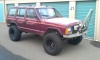
Ok, so i have a stock xj sport 4D 4WD and i was wondering what all do i need for a 2-3 inch lift. I plan on painting my stock rims black and buying some 31's-33's inch tires. I have seen lots of different prices of lifts and things. But what are ALL The components i will need for a lift kit??

CF Veteran
Joined: Sep 2009
Posts: 4,145
Likes: 0
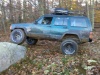
I want members' opinions on quality and best brand for the buck on a specific lift height. I have read many discussions about 3 inch lifts. Everyone has an opinion but not really expressed any input on why they like it, or why they think that brand is the way to go. I don't want to buy something cheaper and have crap just start breaking or bad quality. I just want to do it once and have a great DD. Thanks for any help. 
But I also don't want to buy the most expensive just cause its perty.
But I also don't want to buy the most expensive just cause its perty.
Senior Member
Joined: Mar 2009
Posts: 658
Likes: 0
Year: 1993
Model: Cherokee
Engine: 4.0 H/O I6
you can fit 30s on a stock suspension without issue.
DW has nothing to do with lift height. I've heard of people getting severe DW on stock suspension and tires. DW is caused by either steering components or suspension links wearing out.
They're generally all of similar quality. Rusty's, RC, RE all make good stuff. for 3" most vendors will have very very similar kits. RC will be the cheapest and they make good stuff. I'd only buy from the vendor directly or a surplus kit from car-part.com
DW has nothing to do with lift height. I've heard of people getting severe DW on stock suspension and tires. DW is caused by either steering components or suspension links wearing out.
They're generally all of similar quality. Rusty's, RC, RE all make good stuff. for 3" most vendors will have very very similar kits. RC will be the cheapest and they make good stuff. I'd only buy from the vendor directly or a surplus kit from car-part.com
Last edited by 93XJRay; Feb 25, 2010 at 01:08 PM.
Senior Member
Joined: Mar 2009
Posts: 658
Likes: 0
Year: 1993
Model: Cherokee
Engine: 4.0 H/O I6
just check out craigslist in your area or check around this site to see if anyone local to you has some. idk how many used tire sites are out there but i dont think too many. also check some tire shops in your area. they might have a cheap set for you.
Senior Member
Joined: Mar 2009
Posts: 658
Likes: 0
Year: 1993
Model: Cherokee
Engine: 4.0 H/O I6
I like Rusty's. There are several ways you could lift it 2 to 3 inches. You could go with a full lift kit which would be new spring packs in the rear and new coils in the front. this would probably include a drop pitman arm, new shocks, trac bar relocation bracket, sway bar extensions, and a transfer case lowering kit. You will not need an SYE or longer drive shafts for this lift. Now, keep in mind, this full lift kit has EVERYTHING that you MIGHT need. Now in reality, you probably do not need all of this for a 3" lift. You do not NEED the t-case lowering kit, sway bar extensions, or longer shocks, or even the drop pitman arm. And really you don't need a full leaf spring pack in the rear, you could use shackles or an add-a-leaf, (I don't recommend an add-a-leaf, it puts to much undue stress on the ends of the leaf pack and will sag after a while), and you culd use spacers in the front instead of new coils. Now, all of these things will help with the ride quality, but probably not enough to be noticeable. What I would recommend, since you are not going to do any serious off-roading would be this. Get 2" coil spacers for the front ($35 a pair from Rustys) and 2" greasable shackles for the rear. This will fit 31X10.50's on your stock rims. This is the ABSOLUTE minimum you need. The other stuff you can add later and I would say in this priority, 1. Trac bar relocation bracket 2. Drop Pitman arm 3. Longer shocks (you could just wait until your shocks go bad before doing this) Until you get to a 5" lift or more, you will not need to worry about your sway bar, or your transfer case, or an SYE or new drive shafts. Hope this helps.
CF Veteran
Joined: Sep 2009
Posts: 4,145
Likes: 0
haha oh it has NOTHING at all to do with lift height? go lift your jeep from stock to 4.5" or 6" and tell me you wont have dw. you belong in a tree, youre a nut if you think thats true. it might not be ONLY the lift, but it definitly contributes to it more so than some other things. he had no problems when it was stock and now that its up 3" hes having dw issues. clearly his swaybar links didnt wear out or fall of just from lifting it. im not trying to be a jerk but you honestly cant think that lift height has nothing to do with dw...
http://www.yuccaman.com/jeep/dw.html
Show me somewhere in there that death wobble is related to lift height.
Plain and simple: its NOT. If you put 33s on and lift 4.5" you should get an adjustable track bar and a new frame side mount. Going up to 6" won't make a difference.
most of the time death wobble has to do with steering components and overtaxing that already mediocre system with larger than stock tires.
Death wobble is mostly caused by one of three things: bad TREs or something steering related. A bad track bar or mount. OR a bad alignment.
Its not lift related other than that a lift allows larger tires that then cause death wobble.
Please don't call me a nut, i'm not in any sense of the word.
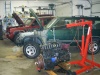
Bad swaybar end links won't cause death wobble. I'm running without a connected front and I have no issues. If someone got death wobble after lifting 3" I'd say that they either have a bad trac-bar, trac-bar mount or a bad link in their steering. The lift doesn't cause death wobble, but when you have bad parts and then go change the angle those parts being worn out becomes much more obvious.
Last edited by ZachsXJ; Feb 26, 2010 at 12:25 AM.
Senior Member
Joined: Apr 2009
Posts: 922
Likes: 2
From: Grand Haven, Michigan
Year: 1998, 1999
Model: Cherokee
Engine: 4.0
Quote from some where else...
Death Wobble explained…
Here's an engineering description of DW. I get tired of seeing people guessing at what's causing their DW, so here goes. Hope it helps someone.
First, you've got to realize that the front suspensions on our vehicles were marginally stable, at best, from the factory. DW is a fundamental dynamic response mode of the entire front end...as a system. Lift and larger tires change (increase) the 'gain' associated with what becomes (or even starts out as) a marginally stable dynamic system. The damping factor (lambda) is also affected by larger tires...it decreases as a function of sidewall height/thickness ratio. Hysteresis in any control path (loose tie rod, steering box, track bar bushing) reduces the ultimate stability margin further. The fundamental frequency of DW is determined by the superposition principle where all springs involved are resolved (frame, tire resilience, hub bending, bushing deflection, etc, etc.) into one global spring constant, and all damping factors associated with friction, elastic elements, viscous damping (steering damper and shocks) are resolved into one damping factor. The natural frequency, damped natural frequency, and damping coefficient are then known. Now, if the system is overdamped and the gain is low...no problems...no oscillation. Increase the gain without increasing the damping and you go toward the critically damped, and beyond, specturm of responses. Critically damped means that DW would only 'hint' at being there, but would die out on its own without going totally unstable. This is also known as a decaying response.
Once the system goes beyond critically damped, any excitation, be it an unbalanced tire, a bent wheel, bumps in the road, etc. can set it off and the response will not decay...it will grow in amplitude, quite quickly in some cases, and may be limited only be physical non-linearities like hard stops...or breakage. That's classic Death Wobble.
A truck suspension is designed to stay in the overdamped to critically damped range. That is generally why a truck rides "rough". A Cadillac, on the other hand, is designed to stay in the undersprung range. It just "floats" down the road. Any change in the basic design parameters that affect the gain (e.g., lift, tire size, wheel backspacing, etc.), damping (tire size, steering damper, steering box condition), and hysteresis (any wear point that creates any slop) can push it over the edge and create DW. ANY ONE OR TWO of the factors discussed can do that...which is why everybody then thinks that whatever problem THEY found and fixed is the cause of all DW; it is not. It is plain and simply a marginally stable system in its original form that is easily made unstable by any of the myriad causes discussed already.
If your front end is loose (bushings, bearings, etc.) then you have a situation where your stiffness is removed and any jarring sensation (potholes, unbalanced tires, misaligned wheels, etc.) will cause the suspension to go crazy. It is no longer functioning where it is designed. On the other hand, your suspension could be very tight but an imbalanced tire would be spinning at just the right speed to throw the suspension into a unstable situation.
So unfortunately there isn't only one root cause to the problem of DW. The underlying problem is instability in the front suspension, the root causes can be a multitude of things ranging from bad/loose bushings, to loose bearings, to caster angles, to imbalanced tires, etc.
OKAY, HERE'S THE REALLY USEFUL INFO:
A steering damper only hides (maybe) the effect; it does nothing to fix the root cause.
There are two types of DW. The first typically is speed related. Whenever you reach a certain speed, bam, you get DW, no matter what. This is a vibration/oscillation issue. Look into tire balance, alignment, steering joints, missing bushings (totally shot), loose steering box (either loose bolts or worn internals), etc.
The second is an impact initiated DW. For example, hitting a pothole above a certain speed will start DW. This is more likely a bushings, loosening mounts, flexing components, etc. issue. Basically, something is tight enough that in general straight driving, it is ok, but give it an impact force, whatever is getting loose starts sliding, rebounds and starts going nuts.
Here is how you can tell if the issue is steering related or trackbar related. You are gonna need some ***** for this, but stick with me. Once you have played around with the DW awhile you find you can control it a bit by feathering the brakes. So go find a straight, deserted, bumpy road. Get the truck up to speed and get the DW going. You had it happen a few times, you have already been frantically avoiding potholes, so now go find one, quit whining. At this point, the truck is somewhat violently shaking, and you can keep enough control using the brakes to keep it on the road. Roll down the window and stick your head out and look at the front tire. What is it doing?
1. The front of the tire and the back of the tire are moving approximately the same amount side to side. In this case, the axle is stationary, and the wheel is pivoting on the ball joint during the oscillation. Therefore the problem is likely in the steering. Something in the steering has enough give to allow the movement.
2. The back of the tire is moving MORE than the front of the tire in the side-to-side movement. In this case, the knuckle is pivoting on the steering links, and allowing the axle to move back and forth under the vehicle. The problem here is most likely in the trackbar system.
This doesn't really answer a question about what's causing YOUR DW, but it should give you something to think about in your search for the root cause(s). I'd check the trac bar bushings, make sure your wheel bearings are in spec, make sure your tires are balanced, make sure your alignment is in spec - especially caster, make sure your ball joints & TREs are tight, see if you have play in your steering box, etc.
Here's an engineering description of DW. I get tired of seeing people guessing at what's causing their DW, so here goes. Hope it helps someone.
First, you've got to realize that the front suspensions on our vehicles were marginally stable, at best, from the factory. DW is a fundamental dynamic response mode of the entire front end...as a system. Lift and larger tires change (increase) the 'gain' associated with what becomes (or even starts out as) a marginally stable dynamic system. The damping factor (lambda) is also affected by larger tires...it decreases as a function of sidewall height/thickness ratio. Hysteresis in any control path (loose tie rod, steering box, track bar bushing) reduces the ultimate stability margin further. The fundamental frequency of DW is determined by the superposition principle where all springs involved are resolved (frame, tire resilience, hub bending, bushing deflection, etc, etc.) into one global spring constant, and all damping factors associated with friction, elastic elements, viscous damping (steering damper and shocks) are resolved into one damping factor. The natural frequency, damped natural frequency, and damping coefficient are then known. Now, if the system is overdamped and the gain is low...no problems...no oscillation. Increase the gain without increasing the damping and you go toward the critically damped, and beyond, specturm of responses. Critically damped means that DW would only 'hint' at being there, but would die out on its own without going totally unstable. This is also known as a decaying response.
Once the system goes beyond critically damped, any excitation, be it an unbalanced tire, a bent wheel, bumps in the road, etc. can set it off and the response will not decay...it will grow in amplitude, quite quickly in some cases, and may be limited only be physical non-linearities like hard stops...or breakage. That's classic Death Wobble.
A truck suspension is designed to stay in the overdamped to critically damped range. That is generally why a truck rides "rough". A Cadillac, on the other hand, is designed to stay in the undersprung range. It just "floats" down the road. Any change in the basic design parameters that affect the gain (e.g., lift, tire size, wheel backspacing, etc.), damping (tire size, steering damper, steering box condition), and hysteresis (any wear point that creates any slop) can push it over the edge and create DW. ANY ONE OR TWO of the factors discussed can do that...which is why everybody then thinks that whatever problem THEY found and fixed is the cause of all DW; it is not. It is plain and simply a marginally stable system in its original form that is easily made unstable by any of the myriad causes discussed already.
If your front end is loose (bushings, bearings, etc.) then you have a situation where your stiffness is removed and any jarring sensation (potholes, unbalanced tires, misaligned wheels, etc.) will cause the suspension to go crazy. It is no longer functioning where it is designed. On the other hand, your suspension could be very tight but an imbalanced tire would be spinning at just the right speed to throw the suspension into a unstable situation.
So unfortunately there isn't only one root cause to the problem of DW. The underlying problem is instability in the front suspension, the root causes can be a multitude of things ranging from bad/loose bushings, to loose bearings, to caster angles, to imbalanced tires, etc.
OKAY, HERE'S THE REALLY USEFUL INFO:
A steering damper only hides (maybe) the effect; it does nothing to fix the root cause.
There are two types of DW. The first typically is speed related. Whenever you reach a certain speed, bam, you get DW, no matter what. This is a vibration/oscillation issue. Look into tire balance, alignment, steering joints, missing bushings (totally shot), loose steering box (either loose bolts or worn internals), etc.
The second is an impact initiated DW. For example, hitting a pothole above a certain speed will start DW. This is more likely a bushings, loosening mounts, flexing components, etc. issue. Basically, something is tight enough that in general straight driving, it is ok, but give it an impact force, whatever is getting loose starts sliding, rebounds and starts going nuts.
Here is how you can tell if the issue is steering related or trackbar related. You are gonna need some ***** for this, but stick with me. Once you have played around with the DW awhile you find you can control it a bit by feathering the brakes. So go find a straight, deserted, bumpy road. Get the truck up to speed and get the DW going. You had it happen a few times, you have already been frantically avoiding potholes, so now go find one, quit whining.
At this point, the truck is somewhat violently shaking, and you can keep enough control using the brakes to keep it on the road. Roll down the window and stick your head out and look at the front tire. What is it doing? 1. The front of the tire and the back of the tire are moving approximately the same amount side to side. In this case, the axle is stationary, and the wheel is pivoting on the ball joint during the oscillation. Therefore the problem is likely in the steering. Something in the steering has enough give to allow the movement.
2. The back of the tire is moving MORE than the front of the tire in the side-to-side movement. In this case, the knuckle is pivoting on the steering links, and allowing the axle to move back and forth under the vehicle. The problem here is most likely in the trackbar system.
This doesn't really answer a question about what's causing YOUR DW, but it should give you something to think about in your search for the root cause(s). I'd check the trac bar bushings, make sure your wheel bearings are in spec, make sure your tires are balanced, make sure your alignment is in spec - especially caster, make sure your ball joints & TREs are tight, see if you have play in your steering box, etc.
Seasoned Member
Joined: Feb 2010
Posts: 325
Likes: 0
From: Utah
Year: 1999
Model: Cherokee
Engine: 4.0
Hey 93XJRay, this is not a death wobble thread. This thread is to answer lift and tire questions. Take the death wobble tech to a different thread and let's all get back on topic.

Newbie
Joined: Feb 2010
Posts: 7
Likes: 0
From: Prosperity, SC
Year: 1999
Model: Cherokee
Engine: 4.0
31's
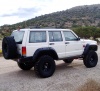
i'm getting some new 31's and i'm lookin for an aggressive A/t or a well mannered M/t that is cheap and performs. i need on-road handling as well b/c its my daily driver. i know it has probably already been put in this thread but i don't feel like reading 40 pages. any suggestions?
CF Veteran
Joined: Jan 2010
Posts: 1,062
Likes: 0
From: Fort lewis, wa/ university place, wa
Year: 1999
Model: Cherokee
Engine: 4.0L
I bought my rims and last weekend and Im going to put my kit on tommorow so i will be getting the tires put on tommorow.
My question is this. Everyone says get 4.5 backspacing. I asked the guy at the tire store what the backspacing was on the rim I ordered and he said 4.75. Is this better or worse for me?
My question is this. Everyone says get 4.5 backspacing. I asked the guy at the tire store what the backspacing was on the rim I ordered and he said 4.75. Is this better or worse for me?
Seasoned Member
Joined: Feb 2010
Posts: 325
Likes: 0
From: Utah
Year: 1999
Model: Cherokee
Engine: 4.0
I bought my rims and last weekend and Im going to put my kit on tommorow so i will be getting the tires put on tommorow.
My question is this. Everyone says get 4.5 backspacing. I asked the guy at the tire store what the backspacing was on the rim I ordered and he said 4.75. Is this better or worse for me?
My question is this. Everyone says get 4.5 backspacing. I asked the guy at the tire store what the backspacing was on the rim I ordered and he said 4.75. Is this better or worse for me?
Junior Member
Joined: Feb 2010
Posts: 39
Likes: 0
From: Hanover, MD
Year: 2000
Model: Cherokee
I never got a clear understanding of this. Does that mean that a 3 inch backspacing will stick the wheels out of the fender more or less than a 4.5 inch, for example? How is that measured?