When you click on links to various merchants on this site and make a purchase, this can result in this site earning a commission. Affiliate programs and affiliations include, but are not limited to, the eBay Partner Network.
North AtlanticMaine, New Hampshire, New York, Vermont, Massachusetts, Rhode Island, Connecticut, New Jersey, Delaware, Pennsylvania, Maryland, Washington DC
So I've been thinking about how people off road and came to the conclusion that everyone has their own way of 4wheeling. Along with this is the idea that I think everyone could benefit from getting some tips about different things to do for different circumstances when off roading, like keeping constant momentum (preferably in the desired direction) while mudding so you don't get stuck. Stuff like that.
It's just like life... Pick a good line and take your time, and it is much more practical to maneuver around obstacles than it is to drive over them with no real true need or purpose unless you have no other option. The important priority is getting back home at the end of the day in one piece.
It's just like life... Pick a good line and take your time, and it is much more practical to maneuver around obstacles than it is to drive over them with no real true need or purpose unless you have no other option. The important priority is getting back home at the end of the day in one piece.
Definitely agree with everything you said! Whenever I went off-roading with my Chevy I would always walk the trail before I drove on it and had to be really careful since it weighs 3 tons and has rwd. I made it through many times no problem where other 4wd trucks and even Jeep's got stuck. The wheelbase probably helped a bit too. Water fording in that was fun till it got up to the top of the wheel well and very briefly the top of the fenders. But didn't do anything to it
That really depends on the terrain you're wheelin which comes with experience. I wheel differently in the soft sand of NJ compared to the rocky trails of PA. Gotta keep momentum through sugar sand or you'll bog down. Slow and steady through the rocks of rausch creek otherwise you'll be dead on a trail and it's not easy to recover your rig from a rock garden.
That really depends on the terrain you're wheelin which comes with experience. I wheel differently in the soft sand of NJ compared to the rocky trails of PA. Gotta keep momentum through sugar sand or you'll bog down. Slow and steady through the rocks of rausch creek otherwise you'll be dead on a trail and it's not easy to recover your rig from a rock garden.
Absolutely! With the mud I just tried to keep the wheel speed down but still moving forward and tried to keep somewhat constant traction
Engine: 4.3L with headers and full 3" exhaust system
This thread will probably go on forever. The question is too broad I think. Everyone that wheels a lot has different techniques for broad categories of wheeling: mud, sand, rocks, trails, snow and the list could go on. Then throw in a real game changer, lockers and it all changes.
This thread will probably go on forever. The question is too broad I think. Everyone that wheels a lot has different techniques for broad categories of wheeling: mud, sand, rocks, trails, snow and the list could go on. Then throw in a real game changer, lockers and it all changes.
I was wondering if it was too broad a question sorry lol
Engine: 4.3L with headers and full 3" exhaust system
Well, here is a general tip you might not hear from anyone but me. Do not wheel with any tires labeled load range D or E. Regardless of type of terrain, you need a soft tire rather than a hard one. As tire manufacturers are getting away from tires for 15" rims, they are getting more expensive. Why? Because they are making them for the general market, which does not wheel. A load range D or E tire doesn't make a good footprint when you air them down. If you look at some Moab vids for example, the tires don't look like they have been aired down unless they are on a sharp rock. So they spin a lot. My rule of thumb is that when aired down, a tire should have a footprint about 10" long for any type of off road driving
Well, here is a general tip you might not hear from anyone but me. Do not wheel with any tires labeled load range D or E. Regardless of type of terrain, you need a soft tire rather than a hard one. As tire manufacturers are getting away from tires for 15" rims, they are getting more expensive. Why? Because they are making them for the general market, which does not wheel. A load range D or E tire doesn't make a good footprint when you air them down. If you look at some Moab vids for example, the tires don't look like they have been aired down unless they are on a sharp rock. So they spin a lot. My rule of thumb is that when aired down, a tire should have a footprint about 10" long for any type of off road driving
That way you get the most contact area right? Also thanks! I didn't know about the ratings having an affect on the offroadability
Well, here is a general tip you might not hear from anyone but me. Do not wheel with any tires labeled load range D or E. Regardless of type of terrain, you need a soft tire rather than a hard one. As tire manufacturers are getting away from tires for 15" rims, they are getting more expensive. Why? Because they are making them for the general market, which does not wheel. A load range D or E tire doesn't make a good footprint when you air them down. If you look at some Moab vids for example, the tires don't look like they have been aired down unless they are on a sharp rock. So they spin a lot. My rule of thumb is that when aired down, a tire should have a footprint about 10" long for any type of off road driving
I've passed along similar info to guys I've wheeled with that have load range E's. You simply cannot get them to flex. They're too stiff. I run 15" wheels with load range C tires for a reason. They're cheaper and work a helluva lot better than the D's and E's out there no matter how aggressive the tread.
Dont wheel alone if you dont have good recovery gear.
Dont wheel alone if you do.
Along with tools, a first aid kit is a good idea. If you live where its hot an ice chest is a great investment.
If your rig starts to get hot, pop the hood release and keep going. If it gets really hot, park it in the shade, open the hood, but let it keep running. Let the cooling system do its job.
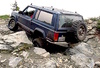
If you cant see the trail clearly, get out and walk it first. Lol, dont be this guy.
Dont wheel alone if you dont have good recovery gear.
Dont wheel alone if you do.
Along with tools, a first aid kit is a good idea. If you live where its hot an ice chest is a great investment.
If your rig starts to get hot, pop the hood release and keep going. If it gets really hot, park it in the shade, open the hood, but let it keep running. Let the cooling system do its job.
If you cant see the trail clearly, get out and walk it first. Lol, dont be this guy.
Dont wheel alone if you dont have good recovery gear.
Dont wheel alone if you do.
Along with tools, a first aid kit is a good idea. If you live where its hot an ice chest is a great investment.
If your rig starts to get hot, pop the hood release and keep going. If it gets really hot, park it in the shade, open the hood, but let it keep running. Let the cooling system do its job.
If you cant see the trail clearly, get out and walk it first. Lol, dont be this guy.
I always walk the trail first, it's just the right thing to do



 Off roading tips/ observations?