


 Sep 21, 2015, 03:49 PM
Last edit by: IB Advertising
See related guides and technical advice from our community experts:
Browse all: General Overview
- Jeep Grand Cherokee WJ 1999 to 2004 Crash Test and Safety Ratings
Important Information to help you understand your Jeep Grand Cherokee.
Browse all: General Overview

XJ Ask the Question Thread

Newbie
Joined: Aug 2015
Posts: 3
Likes: 0
From: Scarborough, ON
Year: 2000
Model: Cherokee
Engine: 4.0L Inline-6

That sucks dude. Check the oil - if it looks muddy, the head is done for.
Try Just Jeeps in the GTA. Also check out JeepKings.ca, I think there're a few threads on there.
If there is indeed coolant in the oil causing your low pressure, you're looking at replacing the engine.
A Kijiji special?
Try Just Jeeps in the GTA. Also check out JeepKings.ca, I think there're a few threads on there.
If there is indeed coolant in the oil causing your low pressure, you're looking at replacing the engine.
A Kijiji special?



Junior Member
Joined: Dec 2010
Posts: 84
Likes: 3
From: SOMERTON ARIZONA
Year: 2000
Model: Cherokee
Engine: 4.0
What do you guys use when you install led bulbs up front I'm currently running Sylvania 6k led bulbs and my cluster markers are slightly on which bugs me at night already tried 25 watt resistors which was what Sylvania recommended and made problem worse anybody had the same situation

Herp Derp Jerp

Joined: Nov 2011
Posts: 18,251
Likes: 17
From: Parham, ON
Year: 1999
Model: Cherokee
Engine: 4.0L OBD-II
Not real strong on the OBD-I stuff but the following sensors can cause problems when the engine is warmed up if they're reading wrong:
- O2 sensor
- Engine Coolant Temperature sensor
- Intake Air Temperature sensor
The O2 sensor is a regular maintenance item, and should be changed out every 60,000-80,000 miles or so. NTK is the OE brand.
As for the sensors, you can test them with a multimeter. Get the Jeep up to temperature, set a multimeter to resistance (or I guess use an ohmmeter), and compare to this chart:
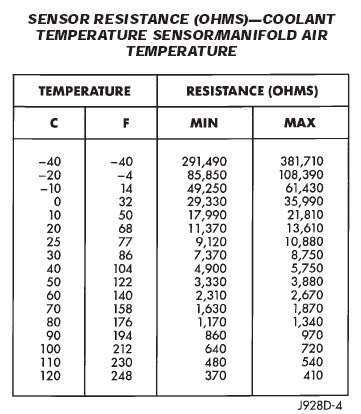
Note that the temperature gauge on your dash uses a separate probe from the computer.
If you haven't done it yet, now would be a good time to clean the connectors for all sensors and take a good look at the grounds.
All 4.0Ls purr, until they throw a rod. Then they don't make a very nice noise. lol. In the valve cover is not a good place to look as atmospheric moisture condenses and causes a milky look. You want to check the dipstick, or even better, drain a bit of oil for examination. If that stuff is milky you have a real problem.
Why would you do an engine flush? Do you have sludge?
- O2 sensor
- Engine Coolant Temperature sensor
- Intake Air Temperature sensor
The O2 sensor is a regular maintenance item, and should be changed out every 60,000-80,000 miles or so. NTK is the OE brand.
As for the sensors, you can test them with a multimeter. Get the Jeep up to temperature, set a multimeter to resistance (or I guess use an ohmmeter), and compare to this chart:
Note that the temperature gauge on your dash uses a separate probe from the computer.
If you haven't done it yet, now would be a good time to clean the connectors for all sensors and take a good look at the grounds.
Why would you do an engine flush? Do you have sludge?

Member
Joined: Oct 2015
Posts: 111
Likes: 0
From: Vegas
Year: 1990
Model: Cherokee
Engine: 4.0 Inline6
Hey all just wondering about some basic engine upkeep besides fluids what else should I check regularly under the hood(or elsewhere) to make sure all stays well? I've owned my Jeep 3 years now and I am ready to start taking care of everything or as much as I can myself. Feel free to PM instead of cluttering the thread if you want.
Herp Derp Jerp
Joined: Nov 2011
Posts: 18,251
Likes: 17
From: Parham, ON
Year: 1999
Model: Cherokee
Engine: 4.0L OBD-II

All filters, all fluids, and replaceable ignition components are a good start. Cleaning electrical connections (particularly grounds) and checking for vacuum leaks is also wise.
Hey all just wondering about some basic engine upkeep besides fluids what else should I check regularly under the hood(or elsewhere) to make sure all stays well? I've owned my Jeep 3 years now and I am ready to start taking care of everything or as much as I can myself. Feel free to PM instead of cluttering the thread if you want.
Member
Joined: Oct 2015
Posts: 111
Likes: 0
From: Vegas
Year: 1990
Model: Cherokee
Engine: 4.0 Inline6
All filters, all fluids, and replaceable ignition components are a good start. Cleaning electrical connections (particularly grounds) and checking for vacuum leaks is also wise.
Hoo boy. There's so much to say here. Have you tried searching? There are tons of maintenance things to do. Are you including the cooling system and transmission in your list of fluids? Greasing the steering and U joints?

Junior Member
Joined: Oct 2014
Posts: 58
Likes: 1
From: Mid Ohio
Year: 2000
Model: Cherokee
Engine: 4.0
2000 cherokee 4L. No heat. Hoses are hot, fan works fine, switches from
defrost to dash to floor ok.
This seems to be a Heater Control Valve but I cant find a replacement
anywhere.
There is a tag and check valve that says EVAP Service Port.1 psi max
Do I need to pressurize it??

defrost to dash to floor ok.
This seems to be a Heater Control Valve but I cant find a replacement
anywhere.
There is a tag and check valve that says EVAP Service Port.1 psi max
Do I need to pressurize it??

CF Veteran
Joined: Jan 2013
Posts: 19,219
Likes: 45
From: west chester, pa
Year: 1999
Engine: 4.0
2000 cherokee 4L. No heat. Hoses are hot, fan works fine, switches from defrost to dash to floor ok. This seems to be a Heater Control Valve but I cant find a replacement anywhere. There is a tag and check valve that says EVAP Service Port.1 psi max Do I need to pressurize it??
Junior Member
Joined: Oct 2014
Posts: 58
Likes: 1
From: Mid Ohio
Year: 2000
Model: Cherokee
Engine: 4.0
CF Veteran
Joined: Jan 2013
Posts: 19,219
Likes: 45
From: west chester, pa
Year: 1999
Engine: 4.0

CF Veteran

Joined: Jul 2013
Posts: 1,154
Likes: 40
Year: 2000
Model: Cherokee (XJ)
Engine: 4.0
Used the search button and found a thread that suggested this to check the valve on the intake manifold
"Take your check valve off.
Hold it how it in the orientation it was in while attatched to the engine.
Put the intake manifold side into your mouth, and suck. (giggity)
If it doesn't suck, it's either bad or the wrong way.
Repeat for the otherside.
Spit on ground multiple times to get nasty taste out of your mouth."
According to this my valve is good. not sure the reliability though. Still no cruise function.
How do i go about checking the seal on the rest of the vacuum hose?
"Take your check valve off.
Hold it how it in the orientation it was in while attatched to the engine.
Put the intake manifold side into your mouth, and suck. (giggity)
If it doesn't suck, it's either bad or the wrong way.
Repeat for the otherside.
Spit on ground multiple times to get nasty taste out of your mouth."
According to this my valve is good. not sure the reliability though. Still no cruise function.
How do i go about checking the seal on the rest of the vacuum hose?