


PO107 Code but engine running fine


Thread Starter
Newbie
Joined: Apr 2014
Posts: 7
Likes: 0
From: Broomfield, CO
Year: 1997
Model: Cherokee
Engine: V6
 PO107 Code but engine running fine
This is my first post but this forum has helped me a ton to fix my car. I'm kind of a newb to car repair and that's mainly why I bought the thing...to learn.
Anyway, I got this code yesterday while using my engine to slow down on a very steep downhill at about 9,000 feet. The car is running fine...I notice no difference in the engine running at speed or idle. Should I just clear it or is it an indicator that something is actually wrong?
Thanks!
Craig

Anyway, I got this code yesterday while using my engine to slow down on a very steep downhill at about 9,000 feet. The car is running fine...I notice no difference in the engine running at speed or idle. Should I just clear it or is it an indicator that something is actually wrong?
Thanks!
Craig


CF Veteran
Joined: Aug 2010
Posts: 8,357
Likes: 103
From: Canton, MI
Year: 1999
Model: Cherokee
Engine: 4.0
mentalbreakdown00 makes a good point. The MAP Sensor vacuum connector is a small rubber elbow under the MAP Sensor. It connects the MAP Sensor to the intake manifold.
The P0107 may only be that you were at a high altitude and the engine vacuum was high and the TPS showed a throttle plate closed condition.
Clear the code and see what happens.
Diagnostic Manual:
P0107-MAP SENSOR VOLTAGE TOO LOW
When Monitored: With the engine RPM above 416 but less than 1500, the TPS voltage
less than 1.13 volts, and battery voltage greater than 10.4 volts.
Set Condition: The MAP sensor signal voltage is below 0.1 volt for 2.0 seconds with the engine running.
POSSIBLE CAUSES:
POSSIBLE CAUSES
MAP SENSOR SIGNAL CIRCUIT SHORTED TO GROUND
INTERMITTENT CONDITION
5 VOLT SUPPLY CIRCUIT SHORTED TO GROUND
5 VOLT SUPPLY CIRCUIT OPEN
MAP SENSOR INTERNAL FAILURE
PCM 5 VOLT SUPPLY CIRCUIT
PCM MAP SENSOR SIGNAL
The P0107 may only be that you were at a high altitude and the engine vacuum was high and the TPS showed a throttle plate closed condition.
Clear the code and see what happens.
Diagnostic Manual:
P0107-MAP SENSOR VOLTAGE TOO LOW
When Monitored: With the engine RPM above 416 but less than 1500, the TPS voltage
less than 1.13 volts, and battery voltage greater than 10.4 volts.
Set Condition: The MAP sensor signal voltage is below 0.1 volt for 2.0 seconds with the engine running.
POSSIBLE CAUSES:
POSSIBLE CAUSES
MAP SENSOR SIGNAL CIRCUIT SHORTED TO GROUND
INTERMITTENT CONDITION
5 VOLT SUPPLY CIRCUIT SHORTED TO GROUND
5 VOLT SUPPLY CIRCUIT OPEN
MAP SENSOR INTERNAL FAILURE
PCM 5 VOLT SUPPLY CIRCUIT
PCM MAP SENSOR SIGNAL
Thread Starter
Newbie
Joined: Apr 2014
Posts: 7
Likes: 0
From: Broomfield, CO
Year: 1997
Model: Cherokee
Engine: V6
Just checked. Everything looks good as far as the connections. I'm thinking something happened when I downshifted. I was moving pretty fast (maybe 30) and I went to the low gear...then it caught and slowed me down. The engine rev'ed a bit and then the light came on. I think I'll just clear it and do something about it if it comes back on or I notice changed in my engine. Thanks for the reply.
Thread Starter
Newbie
Joined: Apr 2014
Posts: 7
Likes: 0
From: Broomfield, CO
Year: 1997
Model: Cherokee
Engine: V6
Strange behavior now...my battery died yesterday. It was nearing the end of it's life and was expected. I jumped my car at work but my car won't stay in idle. As soon as I let off the pedal it dies and I need another jump.
I drove it to Advance Auto where I had my battery waiting for me using both pedals and putting the car into neutral to stop. It's not easy to drive in stop and go traffic when you can never take your foot off the gas! Anyways, I put the new battery in, it starts right up, and the idle issue disappeared.
I purchased a new MAP sensor but didn't test my old one because I didn't have the right star wrench to take it off. I'll do that tonight to make sure the reference voltage is correct and the sensor is responding properly.
But everything seems to running great again. What would cause that idle issue? It's the only time it's ever happened. Was it related to the battery or some issue with the MAP sensor? Odd.
Thanks again for the help!
I drove it to Advance Auto where I had my battery waiting for me using both pedals and putting the car into neutral to stop. It's not easy to drive in stop and go traffic when you can never take your foot off the gas! Anyways, I put the new battery in, it starts right up, and the idle issue disappeared.
I purchased a new MAP sensor but didn't test my old one because I didn't have the right star wrench to take it off. I'll do that tonight to make sure the reference voltage is correct and the sensor is responding properly.
But everything seems to running great again. What would cause that idle issue? It's the only time it's ever happened. Was it related to the battery or some issue with the MAP sensor? Odd.
Thanks again for the help!
CF Veteran
Joined: Aug 2010
Posts: 8,357
Likes: 103
From: Canton, MI
Year: 1999
Model: Cherokee
Engine: 4.0
Hang on to that MAP Sensor you are removing. They rarely go bad.
My bet would be it was the battery. The PCM does not like low voltage inputs (9 volts or less).
Here's a MAP Sensor test:
Using a digital voltmeter, back probe the MAP sensor connector while it’s attached to the MAP sensor and take the following readings.
Test the MAP sensor output voltage at MAP sensor connector between terminals 1 (Brown/Yellow tracer wire) and 2 (Dark Green/Red tracer wire).
With ignition switch ON and engine OFF, output voltage should be 4-to-5 volts.
With engine running, the voltage should drop to 1.5- to-2.1 volts with a hot, neutral idle speed condition.
Here's a pic of backprobing the MAP Sensor using safety pins.
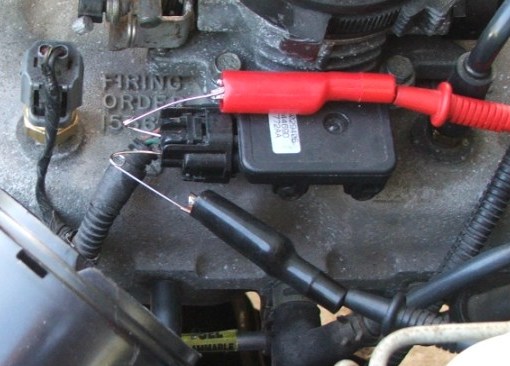
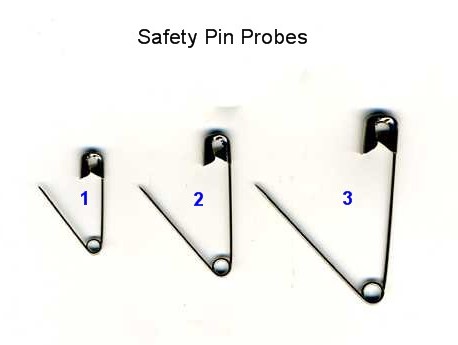
I use #3 safety pin for backprobing and the smaller ones for testing at connector pin cavities. You can get an assortment of safety pins at fabric stores or hardware stores.
My bet would be it was the battery. The PCM does not like low voltage inputs (9 volts or less).
Here's a MAP Sensor test:
Using a digital voltmeter, back probe the MAP sensor connector while it’s attached to the MAP sensor and take the following readings.
Test the MAP sensor output voltage at MAP sensor connector between terminals 1 (Brown/Yellow tracer wire) and 2 (Dark Green/Red tracer wire).
With ignition switch ON and engine OFF, output voltage should be 4-to-5 volts.
With engine running, the voltage should drop to 1.5- to-2.1 volts with a hot, neutral idle speed condition.
Here's a pic of backprobing the MAP Sensor using safety pins.
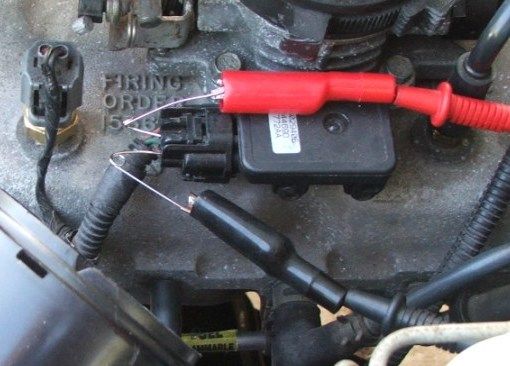
I use #3 safety pin for backprobing and the smaller ones for testing at connector pin cavities. You can get an assortment of safety pins at fabric stores or hardware stores.

Thread Starter
Newbie
Joined: Apr 2014
Posts: 7
Likes: 0
From: Broomfield, CO
Year: 1997
Model: Cherokee
Engine: V6
Thanks for the great instruction and pic! Worked perfectly. I get 3.8V with the car on and then 1.8V with the engine on. When I throttle, it jumps up so it seems to be responding. I had already returned the MAP sensor to get my $85 back. The 3.8V is low. Should I care about it or do anything about it?
Trending Topics
CF Veteran
Joined: Aug 2010
Posts: 8,357
Likes: 103
From: Canton, MI
Year: 1999
Model: Cherokee
Engine: 4.0
Thanks for the great instruction and pic! Worked perfectly. I get 3.8V with the car on and then 1.8V with the engine on. When I throttle, it jumps up so it seems to be responding. I had already returned the MAP sensor to get my $85 back. The 3.8V is low. Should I care about it or do anything about it?
If you get less than spec voltage, repeat the test at the TPS connector and/or the CPS connector. The orange wire 5 volt feed is common to the engine sensors.
Edit: If this voltage is within spec, examine the MAP connector pins and pin cavities for corrosion. Always 'wiggle check' wiring harnesses when troubleshooting problems.
Last edited by CCKen; Oct 12, 2014 at 07:16 AM.
Thread Starter
Newbie
Joined: Apr 2014
Posts: 7
Likes: 0
From: Broomfield, CO
Year: 1997
Model: Cherokee
Engine: V6
Thanks for the reply, CCKen. I get 5.1V at the orange wire on the connector. I wiggled it like crazy all along the cooectors back to the PCM and the connectors within the MAP look shiny clean. They 3.8V doesn't budge. I could go pick up the new MAP connector and check that, but everything seems to be running fine again.
CF Veteran
Joined: Aug 2010
Posts: 8,357
Likes: 103
From: Canton, MI
Year: 1999
Model: Cherokee
Engine: 4.0
Thanks for the reply, CCKen. I get 5.1V at the orange wire on the connector. I wiggled it like crazy all along the cooectors back to the PCM and the connectors within the MAP look shiny clean. They 3.8V doesn't budge. I could go pick up the new MAP connector and check that, but everything seems to be running fine again.
Carry on.
CF Veteran
Joined: Aug 2010
Posts: 8,357
Likes: 103
From: Canton, MI
Year: 1999
Model: Cherokee
Engine: 4.0
Thanks for the great instruction and pic! Worked perfectly. I get 3.8V with the car on and then 1.8V with the engine on. When I throttle, it jumps up so it seems to be responding. I had already returned the MAP sensor to get my $85 back. The 3.8V is low. Should I care about it or do anything about it?
Read this about the MAP Sensor. It will explain.
MANIFOLD ABSOLUTE PRESSURE (MAP) SENSOR—PCM INPUT
DESCRIPTION
The Manifold Absolute Pressure (MAP) sensor is attached to the side of the engine throttle body with 2 screws. The sensor is connected to the throttle body with a rubber L-shaped fitting.
OPERATION
The MAP sensor is used as an input to the Powertrain Control Module (PCM). It contains a silicon
based sensing unit to provide data on the manifold vacuum that draws the air/fuel mixture into the combustion chamber. The PCM requires this information to determine injector pulse width and spark advance. When manifold absolute pressure (MAP) equals Barometric pressure, the pulse width will be at maximum.
A 5 volt reference is supplied from the PCM and returns a voltage signal to the PCM that reflects manifold pressure. The zero pressure reading is 0.5V and full scale is 4.5V. For a pressure swing of 0–15 psi, the voltage changes 4.0V. To operate the sensor, it is supplied a regulated 4.8 to 5.1 volts. Ground is provided through the low-noise, sensor return circuit at the PCM.
The MAP sensor input is the number one contributor to fuel injector pulse width. The most important function of the MAP sensor is to determine barometric pressure. The PCM needs to know if the vehicle is at sea level or at a higher altitude, because the air density changes with altitude. It will also help to correct for varying barometric pressure. Barometric pressure and altitude have a direct inverse correlation; as altitude goes up, barometric goes down.
At key-on, the PCM powers up and looks at MAP voltage, and based upon the voltage it sees, it knows the current barometric pressure (relative to altitude). Once the engine starts, the PCM looks at the voltage again, continuously every 12 milliseconds, and compares the current voltage to what it was at key-on. The difference between current voltage and what it was at key-on, is manifold vacuum.
During key-on (engine not running) the sensor reads (updates) barometric pressure. A normal range can be obtained by monitoring a known good sensor.
As the altitude increases, the air becomes thinner (less oxygen). If a vehicle is started and driven to a very different altitude than where it was at key-on, the barometric pressure needs to be updated. Any time the PCM sees Wide Open Throttle (WOT), based upon Throttle Position Sensor (TPS) angle and RPM, it will update barometric pressure in the MAP memory cell. With periodic updates, the PCM can make its calculations more effectively.
The PCM uses the MAP sensor input to aid in calculating the following:
- Manifold pressure
- Barometric pressure
- Engine load
- Injector pulse-width
- Spark-advance programs
- Shift-point strategies (certain automatic transmissions only)
- Idle speed
- Decel fuel shutoff
The MAP sensor signal is provided from a single piezoresistive element located in the center of a diaphragm. The element and diaphragm are both made of silicone. As manifold pressure changes, the diaphragm moves causing the element to deflect, which stresses the silicone. When silicone is exposed to stress, its resistance changes. As manifold vacuum increases, the MAP sensor input voltage decreases proportionally. The sensor also contains electronics that condition the signal and provide temperature compensation.
The PCM recognizes a decrease in manifold pressure by monitoring a decrease in voltage from the reading stored in the barometric pressure memory cell. The MAP sensor is a linear sensor; meaning as pressure changes, voltage changes proportionately The range of voltage output from the sensor is usually between 4.6 volts at sea level to as low as 0.3 volts at 26 in. of Hg. Barometric pressure is the pressure exerted by the atmosphere upon an object. At sea level on a standard day, no storm, barometric pressure is approximately 29.92 in Hg. For every 100 feet of altitude, barometric pressure drops.10 in. Hg. If a storm goes through it can change barometric pressure from what should be present for that altitude. You should know what the average pressure and corresponding barometric pressure is for your area.
CF Veteran
Joined: Aug 2010
Posts: 8,357
Likes: 103
From: Canton, MI
Year: 1999
Model: Cherokee
Engine: 4.0
Strange behavior now...my battery died yesterday. It was nearing the end of it's life and was expected. I jumped my car at work but my car won't stay in idle. As soon as I let off the pedal it dies and I need another jump.
I drove it to Advance Auto where I had my battery waiting for me using both pedals and putting the car into neutral to stop. It's not easy to drive in stop and go traffic when you can never take your foot off the gas! Anyways, I put the new battery in, it starts right up, and the idle issue disappeared.
I purchased a new MAP sensor but didn't test my old one because I didn't have the right star wrench to take it off. I'll do that tonight to make sure the reference voltage is correct and the sensor is responding properly.
But everything seems to running great again. What would cause that idle issue? It's the only time it's ever happened. Was it related to the battery or some issue with the MAP sensor? Odd.
Thanks again for the help!
I drove it to Advance Auto where I had my battery waiting for me using both pedals and putting the car into neutral to stop. It's not easy to drive in stop and go traffic when you can never take your foot off the gas! Anyways, I put the new battery in, it starts right up, and the idle issue disappeared.
I purchased a new MAP sensor but didn't test my old one because I didn't have the right star wrench to take it off. I'll do that tonight to make sure the reference voltage is correct and the sensor is responding properly.
But everything seems to running great again. What would cause that idle issue? It's the only time it's ever happened. Was it related to the battery or some issue with the MAP sensor? Odd.
Thanks again for the help!
BATTERY VOLTAGE—PCM INPUT
OPERATION
The battery voltage input provides power to the Powertrain Control Module (PCM). It also informs the PCM what voltage level is supplied to the ignition coil and fuel injectors.
If battery voltage is low, the PCM will increase injector pulse width (period of time that the injector is energized). This is done to compensate for the reduced flow through injector caused by the lowered voltage.
This increse in injector pulse width can cause a rich mixture, which may be the reason you had to keep your foot on the gas (leaning out the mixture) to keep it running.
Thread Starter
Newbie
Joined: Apr 2014
Posts: 7
Likes: 0
From: Broomfield, CO
Year: 1997
Model: Cherokee
Engine: V6
Thanks. That's a great explanation of that instrument. Voltage is lower at my lower barometric pressure. The 3.8V makes sense and the two-pedal driving makes sense, too. Case closed!
While I was screwing with that I repaired my rear door latch and resoldered my rear defroster, though, so it wasn't all wasted time. Next up...heater core replacement to fix the puddle of antifreeze on my passenger floor mat. Although that job looks like a complete nightmare.
While I was screwing with that I repaired my rear door latch and resoldered my rear defroster, though, so it wasn't all wasted time. Next up...heater core replacement to fix the puddle of antifreeze on my passenger floor mat. Although that job looks like a complete nightmare.

Thread
Thread Starter
Forum
Replies
Last Post
Brill
Stock Grand Cherokee Tech. All ZJ/WJ/WK Non-modified/stock questions go here!
27
Feb 6, 2020 12:41 AM
Ye Ol' Cherokee
Stock XJ Cherokee Tech. All XJ Non-modified/stock questions go here
15
Sep 5, 2015 04:36 PM
JCIII
Stock Grand Cherokee Tech. All ZJ/WJ/WK Non-modified/stock questions go here!
7
Aug 30, 2015 08:40 AM
Kevin Icenhour
Stock XJ Cherokee Tech. All XJ Non-modified/stock questions go here
2
Aug 21, 2015 08:22 PM
hkb
Stock XJ Cherokee Tech. All XJ Non-modified/stock questions go here
4
Aug 21, 2015 05:48 AM
Currently Active Users Viewing This Thread: 1 (0 members and 1 guests)