


AW4 Issue


Thread Starter
Member
Joined: Jan 2011
Posts: 216
Likes: 0
From: Salem, IN
Year: 1998
Model: Cherokee
Engine: 4.0
 AW4 Issue
I just picked up a '98 Cherokee Classic with the 4.0 and AW4. The previous owner ran the transmission out of fluid because a cooler line had a hole in it. It sat for 2 years until I got it. I fixed the hole and filled it up and got it driving again.
The problem I'm having is that when the Jeep is first started the transmission shifts fine when it is in D. When it warms up, if I stop and take off it is like I'm starting out in 3rd gear. I can drop it down to 2 and it will take of like normal, then I upshift into D and all is fine until I stop again.
I don't know if it is related, but the back up lights don't come on when in R. The bulbs are new.
The problem I'm having is that when the Jeep is first started the transmission shifts fine when it is in D. When it warms up, if I stop and take off it is like I'm starting out in 3rd gear. I can drop it down to 2 and it will take of like normal, then I upshift into D and all is fine until I stop again.
I don't know if it is related, but the back up lights don't come on when in R. The bulbs are new.
CF Veteran
Joined: Mar 2010
Posts: 47,923
Likes: 38
From: Broward County Fl.
Year: 1989 xj sport 2dr
Model: Cherokee
Engine: 12 hole bosch Injectors
Sitting for 2 years is a long time might need a little time to get all the stickness worked out of it. At very least id install a new filter and clean out tranny pan then drive more.

CF Veteran
Joined: Jan 2012
Posts: 3,170
Likes: 312
From: Australia
Year: 1997 (RHD)
Model: Cherokee (XJ)
Engine: 4.0 ltr
Check your fluid level.
Check if fluid is now nice and red after that previous abuse.
Check manual shifting: if it shifts fine 'manually', than the problem is in the electrical part of things. You need to now, because the mechanical side of things in your case (with the trans running dry which is bad bad) could still have taken a kick in the n#ts.
If manually shifting gives no issues, next think to check would be solenoids.
Check if fluid is now nice and red after that previous abuse.
Check manual shifting: if it shifts fine 'manually', than the problem is in the electrical part of things. You need to now, because the mechanical side of things in your case (with the trans running dry which is bad bad) could still have taken a kick in the n#ts.
If manually shifting gives no issues, next think to check would be solenoids.

Senior Member
Joined: Mar 2012
Posts: 615
Likes: 0
From: FL.
Year: 2000
Model: Cherokee
Thread Starter
Member
Joined: Jan 2011
Posts: 216
Likes: 0
From: Salem, IN
Year: 1998
Model: Cherokee
Engine: 4.0
The fluid is clean and red. I just installed all new fluid to get it driving again.
Manually shifting works perfectly. Once I manually shift it out of "2", I shift directly into D and it shifts fine from there (skip the 3 selector).
I've disconnected the TCM and it shifts through each gear manually fine. The transmission does exactly what the link above says it should do with the TCM disconnected.
I've also noticed the backup lights don't function.
My PCM is also showing a P0700 code. Is there any way to read that code without a DRBII?
Manually shifting works perfectly. Once I manually shift it out of "2", I shift directly into D and it shifts fine from there (skip the 3 selector).
I've disconnected the TCM and it shifts through each gear manually fine. The transmission does exactly what the link above says it should do with the TCM disconnected.
I've also noticed the backup lights don't function.
My PCM is also showing a P0700 code. Is there any way to read that code without a DRBII?
Last edited by mjonesjr; Jan 31, 2014 at 11:14 PM.

CF Veteran
Joined: Aug 2011
Posts: 1,031
Likes: 4
From: Blue Springs, MO
Year: 1993
Model: Grand Cherokee
Engine: 4.0L Laredo
The reverse lights are controlled by the NSS. The grease in them gets thick and the contacts don't touch. Eventually you might also get a 'no start' in park or neutral. They're easy to rebuild. Here's a good 'how to'.
http://www.bc4x4.com/tech/2010/jeep-...ty-switch-nss/
http://www.bc4x4.com/tech/2010/jeep-...ty-switch-nss/

Trending Topics

CF Veteran
Joined: Apr 2012
Posts: 5,302
Likes: 23
From: Wisconsin
Model: Cherokee
The comments about the grease in the NSS and cleaning it are dead-on.
CF Veteran
Joined: Jan 2012
Posts: 3,170
Likes: 312
From: Australia
Year: 1997 (RHD)
Model: Cherokee (XJ)
Engine: 4.0 ltr
Thread Starter
Member
Joined: Jan 2011
Posts: 216
Likes: 0
From: Salem, IN
Year: 1998
Model: Cherokee
Engine: 4.0
I've checked all the fuses in the footwell fuse box and they are all good.
Is there any way to pull the transmission code without the fancy reader?
I'll most likely replace the NSS if that is the issue. Would the TCM code tell me it wasn't making contact? Every now and then it won't start in P. I have to shift it down to N to get it to start.
Is there any way to pull the transmission code without the fancy reader?
I'll most likely replace the NSS if that is the issue. Would the TCM code tell me it wasn't making contact? Every now and then it won't start in P. I have to shift it down to N to get it to start.

CF Veteran


Joined: May 2012
Posts: 7,965
Likes: 964
From: Lost in the wilds of Virginia
Year: 1998 Classic (I'll get it running soon....) and 02 Grand
Model: Cherokee (XJ)
Engine: 4.0
Most auto parts stores will read a code for you at no charge.
NSS ain't cheap, which is why some folks prefer to rebuild them.
NSS ain't cheap, which is why some folks prefer to rebuild them.
Thread Starter
Member
Joined: Jan 2011
Posts: 216
Likes: 0
From: Salem, IN
Year: 1998
Model: Cherokee
Engine: 4.0
I've got the same code reader as the auto parts stores. It won't pull the TCM code. All it will show is the P0700. I'll have to have someone with a DRBII reader pull it.
I'd rather replace the NSS. For the $100 the part will cost, I'd trust that more (already priced it through my account at O'Reilly).
I'd rather replace the NSS. For the $100 the part will cost, I'd trust that more (already priced it through my account at O'Reilly).
Member
Joined: May 2009
Posts: 247
Likes: 2
From: Northern Illinois
Year: 1997
Model: Cherokee
Engine: 4.0L
The fluid is clean and red. I just installed all new fluid to get it driving again.
Manually shifting works perfectly. Once I manually shift it out of "2", I shift directly into D and it shifts fine from there (skip the 3 selector).
I've disconnected the TCM and it shifts through each gear manually fine. The transmission does exactly what the link above says it should do with the TCM disconnected.
I've also noticed the backup lights don't function.
My PCM is also showing a P0700 code. Is there any way to read that code without a DRBII?
Manually shifting works perfectly. Once I manually shift it out of "2", I shift directly into D and it shifts fine from there (skip the 3 selector).
I've disconnected the TCM and it shifts through each gear manually fine. The transmission does exactly what the link above says it should do with the TCM disconnected.
I've also noticed the backup lights don't function.
My PCM is also showing a P0700 code. Is there any way to read that code without a DRBII?
There are other methods to check the resistance of the solenoids but the most accurate way is to pull the pan, unplug the connector and measure the resistance from the solenoid to the bracket.
Be careful removing/adjusting the NSS, they're expensive.

CF Veteran
Joined: Aug 2010
Posts: 8,357
Likes: 103
From: Canton, MI
Year: 1999
Model: Cherokee
Engine: 4.0
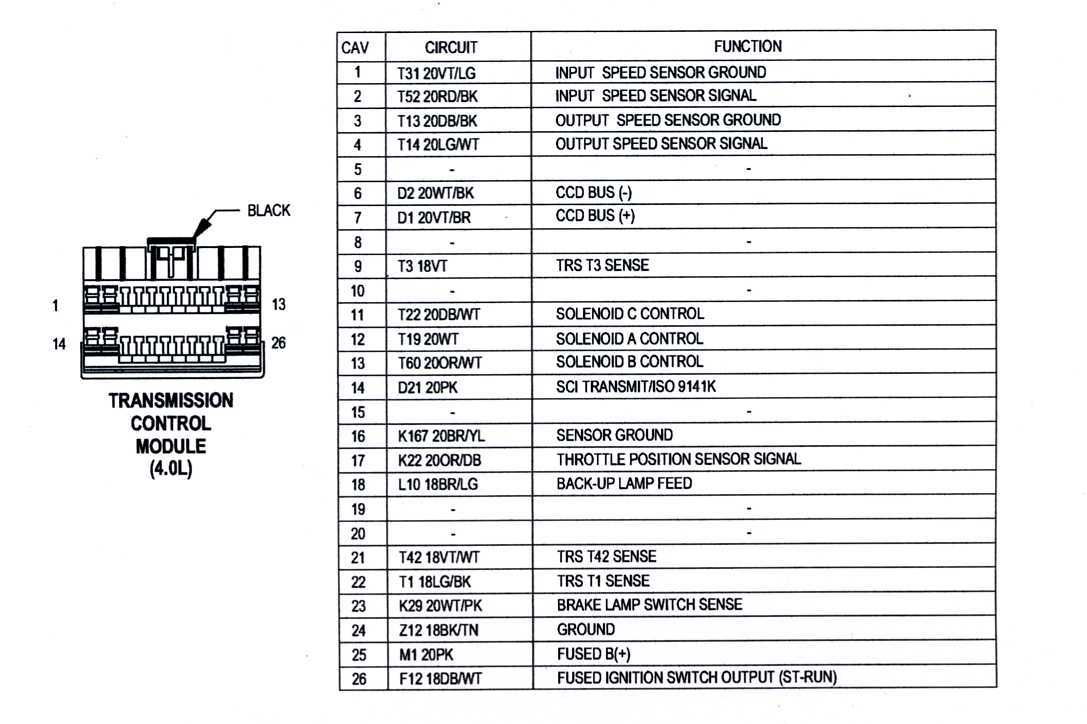
There are tests you can perform at the TCM connector to see if the Transmission Range Sensor (NSS) contacts are defective and to see if a solenoid is bad.
You'll need a digital Volt/Ohmmeter.
Refer to the TCM pinout below.
Turn the ignition to RUN, without cranking the engine.
Test the NSS contacts:
Use a Voltmeter.
Shift the trans to 1-2.
Read between pin cavity 21 and pin cav 24, you should see battery voltage.
Repeat voltage tests at pin cav 9 in shift select 3, pin cav 22 in shift select D, and pin cav 18 in shift select R.
If any one of these tests shows a low voltage or no voltage, suspect that the NSS needs to be rebuilt.
Test the Solenoids:
Use an Ohmmeter.
Ignition OFF/LOCK, disconnect battery negative post connector.
Read between pin cav 12 and pin cav 24 as ground. You should see between 11 and 15 Ohms. 1-2 and 3-4 solenoid (A).
Repeat tests at pin cav 13. 2-3 solenoid (B), and pin cav 11. Lock-Up solenoid (C).
If any one of these tests shows a solenoid with out of range resistance, suspect the respective solenoid is bad.
Note that pin cav 24 is the TCM ground at ground G101 on the engine. It's located at the ignition coil attach bracket studs.
You'll need a digital Volt/Ohmmeter.
Refer to the TCM pinout below.
Turn the ignition to RUN, without cranking the engine.
Test the NSS contacts:
Use a Voltmeter.
Shift the trans to 1-2.
Read between pin cavity 21 and pin cav 24, you should see battery voltage.
Repeat voltage tests at pin cav 9 in shift select 3, pin cav 22 in shift select D, and pin cav 18 in shift select R.
If any one of these tests shows a low voltage or no voltage, suspect that the NSS needs to be rebuilt.
Test the Solenoids:
Use an Ohmmeter.
Ignition OFF/LOCK, disconnect battery negative post connector.
Read between pin cav 12 and pin cav 24 as ground. You should see between 11 and 15 Ohms. 1-2 and 3-4 solenoid (A).
Repeat tests at pin cav 13. 2-3 solenoid (B), and pin cav 11. Lock-Up solenoid (C).
If any one of these tests shows a solenoid with out of range resistance, suspect the respective solenoid is bad.
Note that pin cav 24 is the TCM ground at ground G101 on the engine. It's located at the ignition coil attach bracket studs.
Last edited by CCKen; Feb 1, 2014 at 10:05 AM.
Thread Starter
Member
Joined: Jan 2011
Posts: 216
Likes: 0
From: Salem, IN
Year: 1998
Model: Cherokee
Engine: 4.0
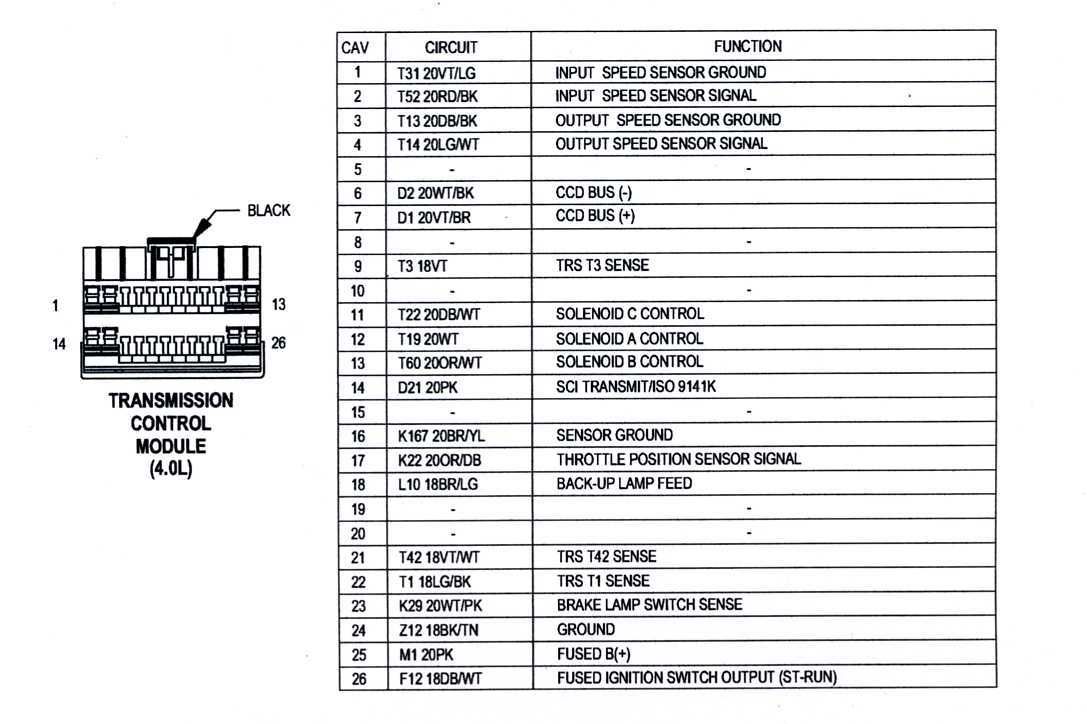
There are tests you can perform at the TCM connector to see if the Transmission Range Sensor (NSS) contacts are defective and to see if a solenoid is bad.
You'll need a digital Volt/Ohmmeter.
Refer to the TCM pinout below.
Turn the ignition to RUN, without cranking the engine.
Test the NSS contacts:
Use a Voltmeter.
Shift the trans to 1-2.
Read between pin cavity 21 and pin cav 24, you should see battery voltage.
Repeat voltage tests at pin cav 9 in shift select 3, pin cav 22 in shift select D, and pin cav 18 in shift select R.
If any one of these tests shows a low voltage or no voltage, suspect that the NSS needs to be rebuilt.
Test the Solenoids:
Use an Ohmmeter.
Ignition OFF/LOCK, disconnect battery negative post connector.
Read between pin cav 12 and pin cav 24 as ground. You should see between 11 and 15 Ohms. 1-2 and 3-4 solenoid (A).
Repeat tests at pin cav 13. 2-3 solenoid (B), and pin cav 11. Lock-Up solenoid (C).
If any one of these tests shows a solenoid with out of range resistance, suspect the respective solenoid is bad.
Note that pin cav 24 is the TCM ground at ground G101 on the engine. It's located at the ignition coil attach bracket studs.
You'll need a digital Volt/Ohmmeter.
Refer to the TCM pinout below.
Turn the ignition to RUN, without cranking the engine.
Test the NSS contacts:
Use a Voltmeter.
Shift the trans to 1-2.
Read between pin cavity 21 and pin cav 24, you should see battery voltage.
Repeat voltage tests at pin cav 9 in shift select 3, pin cav 22 in shift select D, and pin cav 18 in shift select R.
If any one of these tests shows a low voltage or no voltage, suspect that the NSS needs to be rebuilt.
Test the Solenoids:
Use an Ohmmeter.
Ignition OFF/LOCK, disconnect battery negative post connector.
Read between pin cav 12 and pin cav 24 as ground. You should see between 11 and 15 Ohms. 1-2 and 3-4 solenoid (A).
Repeat tests at pin cav 13. 2-3 solenoid (B), and pin cav 11. Lock-Up solenoid (C).
If any one of these tests shows a solenoid with out of range resistance, suspect the respective solenoid is bad.
Note that pin cav 24 is the TCM ground at ground G101 on the engine. It's located at the ignition coil attach bracket studs.
I ordered a NSS (I can send it back) that way if it is that I can change it out quick.