


Steps to improve performance.


Thread Starter
Senior Member
Joined: Feb 2012
Posts: 905
Likes: 8
From: New Hampshire
Year: 1998
Model: Cherokee
Engine: 4.0L I6
 Steps to improve performance.
If you haven't seen me kicking around here let me tell you this. I'm obviously fairly new. My experience in auto mechanics is average. I know how to do a few things here and there, though I'm sure I can continue to improve. So far I'm learning a lot just from these forums alone.
I've done a few things to the XJ here an there. Mostly just getting her up to speed. I crashed the local pick-n-pull yard. They have 4 or 5 XJ's laying around, some have been pretty stripped out. So far I've accumulated; A stock AM/FM CD player from a 2001, Rear stock speakers/bezels, dash bezel w/ AC vents. I ordered a blower motor resistor... I now have heat, and music source for when working on the XJ.
Now is when I'm going to be diving into building. Firstly, I will bring her back up to expected performance level. Then I'll be looking to improve upon it. This is basically a compilation of what I think is everything I will need to increase engine performance/efficiency.
- Oil change, a synthetic probably Mobile 1 10w30.
- Oil filter, Wix. Currently a Fram... I hope this reverses some damages.
- Valve cover gasket, rubber.
- Valve cover cleaning, by hand.
- Spark plugs/wires. Not sure what to get here.
- Oil pan gasket. Mine leaks.
- Oil pan. If I can't get the rust off.
- T-case fluid, top off in hopes it negates the pinch when going 4Lo into N.
- Exhaust manifold. Mine is stock cast iron w/ cracks. Looking to go stainless.
- Thrush Muffler because it's cheap. Probably just do a complete exhaust swap.
- Tail pipe.
- New hubs/bearing assembly.
- New brakes/brake assembly (rotors, pads, calipers, drums).
- Removal of surface rust/proofing undercarriage, come spring.
Of course, not all of this NEEDS to be done... It's just about me wanting to bring my new mistress back into peak performance, or beyond. I'm going to try and stick with OEM parts where I can. They're cheap, and effective. The first on the list will be an oil/filter change. It's only difficult because I have no place to work indoors, and we just got +10" of snow. Next will most likely be the valve cover & gasket. I can't imagine getting a new cover will improve anything, so I'll just clean up the old one. Maybe throw some paint on it.
I don't know anything about timing. I'd like to learn! HINT. I think mine may be off a bit. Probably never been done because it does feel like it skips a beat from time to time in idle. This could also be the plugs/wires.
Not sure I want to put a cone air filter on it... I just don't like the look of them, all exposed.
At some point in time I'd like to tool around with the throttle body/intake. I don't know what can be done there, but I'd like to find out.
So any help on this would be great. Sorry for the long read. If you find anything I'm missing, or can offer other options let me know please.
Note: I'm driving a 98. It's my DD.
I've done a few things to the XJ here an there. Mostly just getting her up to speed. I crashed the local pick-n-pull yard. They have 4 or 5 XJ's laying around, some have been pretty stripped out. So far I've accumulated; A stock AM/FM CD player from a 2001, Rear stock speakers/bezels, dash bezel w/ AC vents. I ordered a blower motor resistor... I now have heat, and music source for when working on the XJ.
Now is when I'm going to be diving into building. Firstly, I will bring her back up to expected performance level. Then I'll be looking to improve upon it. This is basically a compilation of what I think is everything I will need to increase engine performance/efficiency.
- Oil change, a synthetic probably Mobile 1 10w30.
- Oil filter, Wix. Currently a Fram... I hope this reverses some damages.
- Valve cover gasket, rubber.
- Valve cover cleaning, by hand.
- Spark plugs/wires. Not sure what to get here.
- Oil pan gasket. Mine leaks.
- Oil pan. If I can't get the rust off.
- T-case fluid, top off in hopes it negates the pinch when going 4Lo into N.
- Exhaust manifold. Mine is stock cast iron w/ cracks. Looking to go stainless.
- Thrush Muffler because it's cheap. Probably just do a complete exhaust swap.
- Tail pipe.
- New hubs/bearing assembly.
- New brakes/brake assembly (rotors, pads, calipers, drums).
- Removal of surface rust/proofing undercarriage, come spring.
Of course, not all of this NEEDS to be done... It's just about me wanting to bring my new mistress back into peak performance, or beyond. I'm going to try and stick with OEM parts where I can. They're cheap, and effective. The first on the list will be an oil/filter change. It's only difficult because I have no place to work indoors, and we just got +10" of snow. Next will most likely be the valve cover & gasket. I can't imagine getting a new cover will improve anything, so I'll just clean up the old one. Maybe throw some paint on it.
I don't know anything about timing. I'd like to learn! HINT. I think mine may be off a bit. Probably never been done because it does feel like it skips a beat from time to time in idle. This could also be the plugs/wires.
Not sure I want to put a cone air filter on it... I just don't like the look of them, all exposed.
At some point in time I'd like to tool around with the throttle body/intake. I don't know what can be done there, but I'd like to find out.
So any help on this would be great. Sorry for the long read. If you find anything I'm missing, or can offer other options let me know please.
Note: I'm driving a 98. It's my DD.
Last edited by KJamesJR; Mar 4, 2012 at 02:47 AM.
Thread Starter
Senior Member
Joined: Feb 2012
Posts: 905
Likes: 8
From: New Hampshire
Year: 1998
Model: Cherokee
Engine: 4.0L I6
Also some additional questions in another post... I've been reading about larger throttle bodies, Neon fuel injectors(???), and a different intake from another Jeep???
I can understand how a bored TB will increase performance, but will these be fuel efficient? As mentioned this is my DD, and if I can increase gas MPG that would be awesome. I'm thinking aftermarket TB's, injectors, and intakes would lower MPG for increased performance. Any one know about this and where I can start looking into it?
I can understand how a bored TB will increase performance, but will these be fuel efficient? As mentioned this is my DD, and if I can increase gas MPG that would be awesome. I'm thinking aftermarket TB's, injectors, and intakes would lower MPG for increased performance. Any one know about this and where I can start looking into it?

Junior Member
Joined: Jan 2012
Posts: 84
Likes: 0
From: Tucson
Year: 1987
Model: Cherokee
Engine: 4.0 (of course) ;)
Depends on the year of your xj but neon injectors have 4 holes instead of the one hole in ours to give better fuel delivery and atomization this giving more complete burn and better throttle response. They aren't considered a "performance" upgrade in my book, but still worth it

::CF Moderator::
Joined: Aug 2011
Posts: 43,971
Likes: 1,579
From: Prescott, Az
Year: 1990
Model: Cherokee (XJ)
Engine: 4.0

Junior Member
Joined: Aug 2011
Posts: 49
Likes: 0
From: Virginia
Year: 2000
Model: Cherokee
Engine: 4.0
We all have to start somewhere op. Sounds like you have good plan for getting everything back up to standards.
While you're at it underneath with the transfer case, personally I'd go ahead and just drain the old fluid out of the tcase and fill it back up to full rather than just topping it off. Unless you know the fluid's still good and maybe just leaking out somewhat. Also try adjusting the linkage and making sure that nothing's binding up when you shift into 4L.
As far as the timing, its controlled by the pcm, don't think there's anyway to adjust it (someone confirm that for me/him please). Start off with a good tuneup, plugs/wires/cap and rotor and go from there. That may fix your skipping. Is it throwing any check engine lights?
While you're at it underneath with the transfer case, personally I'd go ahead and just drain the old fluid out of the tcase and fill it back up to full rather than just topping it off. Unless you know the fluid's still good and maybe just leaking out somewhat. Also try adjusting the linkage and making sure that nothing's binding up when you shift into 4L.
As far as the timing, its controlled by the pcm, don't think there's anyway to adjust it (someone confirm that for me/him please). Start off with a good tuneup, plugs/wires/cap and rotor and go from there. That may fix your skipping. Is it throwing any check engine lights?
Junior Member
Joined: Jan 2012
Posts: 84
Likes: 0
From: Tucson
Year: 1987
Model: Cherokee
Engine: 4.0 (of course) ;)
89 is renix and won't throw a CEL even if there is a problem. A far a timing if the timing chain jumped a tooth the timing will be off and will run like crap. My 87 did it, another fairly common problem to my knowledge is the distributor could be bad also. For major questions on the renix jeeps I would ask cruiser54. He is the man when it comes to the older Cherokees
Trending Topics
Thread Starter
Senior Member
Joined: Feb 2012
Posts: 905
Likes: 8
From: New Hampshire
Year: 1998
Model: Cherokee
Engine: 4.0L I6
We all have to start somewhere op. Sounds like you have good plan for getting everything back up to standards.
While you're at it underneath with the transfer case, personally I'd go ahead and just drain the old fluid out of the tcase and fill it back up to full rather than just topping it off. Unless you know the fluid's still good and maybe just leaking out somewhat. Also try adjusting the linkage and making sure that nothing's binding up when you shift into 4L.
As far as the timing, its controlled by the pcm, don't think there's anyway to adjust it (someone confirm that for me/him please). Start off with a good tuneup, plugs/wires/cap and rotor and go from there. That may fix your skipping. Is it throwing any check engine lights?
While you're at it underneath with the transfer case, personally I'd go ahead and just drain the old fluid out of the tcase and fill it back up to full rather than just topping it off. Unless you know the fluid's still good and maybe just leaking out somewhat. Also try adjusting the linkage and making sure that nothing's binding up when you shift into 4L.
As far as the timing, its controlled by the pcm, don't think there's anyway to adjust it (someone confirm that for me/him please). Start off with a good tuneup, plugs/wires/cap and rotor and go from there. That may fix your skipping. Is it throwing any check engine lights?
How do I adjust the linkage, or know if there's something binding up anywhere? Sorry I'm knew to this. Is there something specific I should be looking for? Metal ground down anywhere? Loose chain? I don't think the fluid has been changed for a while. Also I think there could be a seal leak. I haven't gotten under there recently to double check for sure. It takes 2qts to fill correct?
Thread Starter
Senior Member
Joined: Feb 2012
Posts: 905
Likes: 8
From: New Hampshire
Year: 1998
Model: Cherokee
Engine: 4.0L I6
Little update...
Changed the plugs, wires, cap/rotor. Oil changed with 10w 30, I used a Napa "Gold" filter. I asked them for Wix and he said "this one is made by Wix, it's the same thing". The guy at Auto Zone said my Jeep takes 5w 30. I asked him a second time, and he confirmed "5w 30". So I walked out and bought some 10w 30 elsewhere.
It got a little hairy with the distributor cap/wires... However I'm sure I got it right because the engine turned over. I was however a little upset, the plugs looked new. I don't think they were Champions, so I swapped them out with my new Champs regardless. And the wires were Napa's as well. Blue wires, forgot what they're called, the ones with the lifetime warranty.
I also started at the back of the engine thinking it was going to be the toughest part... Nope. The one closest to the radiator was a pain. Under two coolant hoses, and what looked like a fuel line. Oil came out clean (no debris). Was running out of daylight so I didn't have a chance to re-run the wires back into their home. Will do tomorrow, along with a re-torque.
Performance Notes: Improved acceleration, engine sounds/feels smoother though it's hard to tell with a zillion leaks in exhaust.
Maybe I should start a build thread. and start keeping a camera in my glove box. Next step; valve cover gasket, exhaust manifold.
Changed the plugs, wires, cap/rotor. Oil changed with 10w 30, I used a Napa "Gold" filter. I asked them for Wix and he said "this one is made by Wix, it's the same thing". The guy at Auto Zone said my Jeep takes 5w 30. I asked him a second time, and he confirmed "5w 30". So I walked out and bought some 10w 30 elsewhere.
It got a little hairy with the distributor cap/wires... However I'm sure I got it right because the engine turned over. I was however a little upset, the plugs looked new. I don't think they were Champions, so I swapped them out with my new Champs regardless. And the wires were Napa's as well. Blue wires, forgot what they're called, the ones with the lifetime warranty.
I also started at the back of the engine thinking it was going to be the toughest part... Nope. The one closest to the radiator was a pain. Under two coolant hoses, and what looked like a fuel line. Oil came out clean (no debris). Was running out of daylight so I didn't have a chance to re-run the wires back into their home. Will do tomorrow, along with a re-torque.
Performance Notes: Improved acceleration, engine sounds/feels smoother though it's hard to tell with a zillion leaks in exhaust.
Maybe I should start a build thread. and start keeping a camera in my glove box. Next step; valve cover gasket, exhaust manifold.
Last edited by KJamesJR; Mar 7, 2012 at 09:39 PM.

Herp Derp Jerp

Joined: Nov 2011
Posts: 18,251
Likes: 17
From: Parham, ON
Year: 1999
Model: Cherokee
Engine: 4.0L OBD-II
Sounds like you've gotten a good start on things! My to-do list is very similar to yours.
Regarding the oil, in North America the XJ manual specifies 10W30 for warmer ambient temperatures and 5W30 for colder ambient temperatures. Typically most drivers around here make the switch in the fall/spring. The difference is the initial viscosity within a temperature range. The oil you walked out to buy will be thicker at startup and therefore require a longer warming period and may allow more wear. Since you mentioned you got > 10" snow (lucky!) I'm guessing it's cold there... Should have gone with the 5W30 lol. It's safe to run all year 'round.
On fuel injectors - there are about a third of a gazillion threads on here about them. Most upgrades don't see an MPG improvement unless yours are dirty or defective - but there are almost always performance gains. Aside from gunk or a mechanical problem, the stock injectors suck at actually delivering fuel. Here's a video demonstrating the difference:
I'm not an expert, but here's a quick rundown with what I'm familiar with to get you started on some searches:
part number ending in 703: older XJs with EV1 plugs (pre-97 or pre-99, not sure) - same amount of fuel, but better burn. Found in Dodge Neons
Neon part number ending in 784: newer XJs with EV6 plugs (98+ or 99+, not sure) - same as above
KJ injectors: a lot of people have seen both performance and MPG increases, I believe use an EV6 connector. KJ = Jeep Liberty
Ford injectors: A few exist such as from the Mustang 5.0L, I tend to ignore these as replacing a fuel pressure regulator doesn't really appeal to me
I don't really like the idea of the K&N cone filter just sitting exposed, either. Seems to me that the stock airbox offers more protection, and the bare cone could probably suck up drops from a puddle. No thanks. I'm a really big fan of the modification on this page, have been trying to find suitable parts but haven't had any luck yet: http://jeep-xj.info/HowtoAirFilter.htm
Regarding the oil, in North America the XJ manual specifies 10W30 for warmer ambient temperatures and 5W30 for colder ambient temperatures. Typically most drivers around here make the switch in the fall/spring. The difference is the initial viscosity within a temperature range. The oil you walked out to buy will be thicker at startup and therefore require a longer warming period and may allow more wear. Since you mentioned you got > 10" snow (lucky!) I'm guessing it's cold there... Should have gone with the 5W30 lol. It's safe to run all year 'round.
On fuel injectors - there are about a third of a gazillion threads on here about them. Most upgrades don't see an MPG improvement unless yours are dirty or defective - but there are almost always performance gains. Aside from gunk or a mechanical problem, the stock injectors suck at actually delivering fuel. Here's a video demonstrating the difference:
I'm not an expert, but here's a quick rundown with what I'm familiar with to get you started on some searches:
part number ending in 703: older XJs with EV1 plugs (pre-97 or pre-99, not sure) - same amount of fuel, but better burn. Found in Dodge Neons
Neon part number ending in 784: newer XJs with EV6 plugs (98+ or 99+, not sure) - same as above
KJ injectors: a lot of people have seen both performance and MPG increases, I believe use an EV6 connector. KJ = Jeep Liberty
Ford injectors: A few exist such as from the Mustang 5.0L, I tend to ignore these as replacing a fuel pressure regulator doesn't really appeal to me
I don't really like the idea of the K&N cone filter just sitting exposed, either. Seems to me that the stock airbox offers more protection, and the bare cone could probably suck up drops from a puddle. No thanks. I'm a really big fan of the modification on this page, have been trying to find suitable parts but haven't had any luck yet: http://jeep-xj.info/HowtoAirFilter.htm
Thread Starter
Senior Member
Joined: Feb 2012
Posts: 905
Likes: 8
From: New Hampshire
Year: 1998
Model: Cherokee
Engine: 4.0L I6
I've got a 98, so I can take a 703 and 784?
Also... There's about a million and one Neons at my local pick'n pull yard. What years should I be looking for, and how do I clean them once I get them off?
Also... There's about a million and one Neons at my local pick'n pull yard. What years should I be looking for, and how do I clean them once I get them off?
Member
Joined: Jan 2012
Posts: 171
Likes: 1
From: Daytona Beach, FL
Year: 1998
Model: Cherokee
Engine: 4.0 I6

Senior Member
Joined: Jan 2011
Posts: 689
Likes: 2
From: Upstate N.Y
Year: 2000.1999,1996
Model: Cherokee
Engine: 4.0
This is from JP MAGAZINE, sry about the scrolling. Also remember on the ecu flash this is a bit old so as far as the ecu maybe someone has come up with a way to do it,I haven't heard of it but if some else has let me know I know they can do small things like the electric fan turning on with the a/c in the 2000 up models, just no performance flash that I know of.
(The JP mag. pic isn't meant for any reason I just couldn't get it to delete)

Jeep 4.0L Myth Busting - True Lies
4.0L Myth Busting
From the November, 2009 issue of Jp
By Christian Hazel, Pete Trasborg
Tweet
|
|
Over the years, Jeep's 4.0L engine underwent a few changes here and there, but nothing drastic. Despite the similarities, many still think of the '91-'95 XJs as the fastest six-cylinder-powered Jeeps in stock trim. For some reason, the '97-'01 XJs just don't feel as fast. Did they change the engine? Did OBD2 kill the 4.0L? Probably not, because if you drive a '91-'95 YJ or a '97-'06 TJ, there's no appreciable difference. The older XJs probably just feel faster because they have less sound deadening material and some other heavy components. At least we think that's the case. And with that, let the myth-spinning begin.
We've heard dozens of fish stories about how to make power with the venerable 4.0L Jeep engine, which parts are better, and which ones are wastes. Well, we've got around a half-million miles under our tires thanks to the trusty 4.0L Jeep inline-six. We've also got well over 100 dyno runs on these engines and have a good idea of what makes power, what improves drivability, and what wastes your money.

Cold Air Intake
Myth: A cold air intake with an open dry or oil-impregnated gauze filter will increase power and mileage.
Our Thoughts: While not all aftermarket filter media are as efficient at trapping dirt as the factory-spec paper plate filters, there's no denying you'll see improved mileage and feel a definite seat-of-the-pants improvement.
Claimed Gains: 10-20hp and 1-3mpg
Actual Gains: 5-10hp
Notes: A good cold air intake will wake up any '91-up MPI HO 4.0L with snappier off-idle acceleration, improved top end pulling power, and a definite 1mpg increase. On some models, the major benefit comes from replacing the kinked, convoluted factory ducting.

Reflash Computer
Myth: "I'll just have my factory computer reflashed or a new program installed to deal with my automatic-to-manual transmission swap, stroker engine, supercharger, turbocharger, or whatever."
Our Thoughts: You can't reburn a Mopar computer. At least, we haven't found anybody who can do this. You can run aftermarket piggyback programmers like a Unichip or JET chip, or run a unit that will slightly overwrite certain performance parameters of the factory computer, like a Superchips or Hypertech. These can change the fuel maps or alter timing to some degree. However, we've found these have limited results on later '96-up OBDII computers.
Claimed Gains: That it's possible.
Actual Gains: Can't do it.

Throttle Body Spacer
Myth: Adding a throttle body spacer will increase the intake plenum volume for more air and a higher velocity intake charge. Also, rifling an aluminum spacer helps air flow into cylinder head with less turbulence for more power.
Our Thoughts: Depending on the application, a spacer works wonders on a carbureted or a TBI-injected engine in which the air/fuel mixture atomizes and flows through a wet manifold, but results are less drastic on a MPI engine in which only air flows through the intake.
Claimed Gains: 10-15hp
Actual Gains: 0-3hp
Notes: With our Red and Mileage Master projects, the largest power increase we've seen on the dyno was 1hp.

62mm Throttle Body
Myth: The factory 60mm throttle body is a choking point in the stock engine. Boring the factory throttle body or installing a larger-bore aftermarket throttle body will allow the engine to breathe and make more power.
Our Thoughts: On most stock or slightly modified engines the factory 60mm throttle body isn't the cork, and is capable of supplying the engine with enough air to get the job done. Only on a vehicle with airflow modifications like a cold air intake and free-flow exhaust will you notice a difference.
Claimed Gains: 10-20hp
Actual Gains: 5hp
Notes: We did see a 5hp difference with a 62mm throttle body on a 4.0L with a cold air intake and exhaust modifications and believe the increase would be larger with other airflow enhancements, like a larger camshaft or high-flow cylinder head. It's a complementary component best used in concert with other products.

Head Games
Myth: The '91-'95 7120 casting number are hands-down the best power producers, followed by the '96-'98 0630 and then the '99-up 0331s. The early heads have far superior flow numbers and resist cracking better than the later heads and will make way more power.
Our Thoughts: We don't argue the flow numbers of the '91-'95s are the best, but the later-model HO head flow numbers are generally within 10cfm at the crucial mid-lift areas. Given the conservative factory camshafts, that 10cfm isn't going to do much. All 4.0L heads feature only moderate flow numbers for performance, but offer high-velocity, which is good for low-mid rpm torque. And any '91-up HO head will absolutely kill any '87-'90 non-HO head.
Claimed Gains: 30hp
Actual Gains: 5-10hp
Notes: With the relatively small duration, low-lift factory camshafts there's not much need for cylinder heads with huge flow numbers. The factory heads are well matched to the factory components. It's only when increasing camshaft duration and lift profiles that aftermarket aluminum or ported 7120 heads show their true advantage.

Ignition Hop-Ups
Myth: A hotter spark will allow you to run a bigger plug gap and burn more fuel more completely.
Our Thoughts: It's sound theory, but impractical in practice for most of the 4.0L engines running around out there. Not only is the 4.0L calibrated lean from the factory to aid in mileage and emissions, but most HO engines come with a pretty good ignition that will allow 0.045-inch plug gap with no trouble. It's only when forced induction or larger injectors and different camshaft profiles come into play that hotter aftermarket spark components prove their worth.
Claimed Gains: 15hp, 20 percent better mileage
Actual Gains: 0-3hp
Notes: You may see some big numbers from 4.0L ignition modifications, but it'll only happen if there was something wrong with the existing ignition system, in which cases even fresh factory replacement parts may garner the same results.

After-Cat Exhaust
Myth: Removing the restrictive muffler and exhaust pipe behind the catalytic converter will greatly increase drivability, performance, and mileage.
Our Thoughts: Car manufacturers often design exhaust systems to cancel out resonance and unwanted noise at some sacrifice to mileage and power. They almost always leave a little power and efficiency on the table as a result.
Claimed Gains: Up to 25hp and a 10-15-percent bump in mileage
Actual Gains: 5-15hp and 10-percent fuel mileage
Notes: We've realized very noticeable seat-of-the-pants improvements with after-cat exhaust systems, as well as bonefide dyno verification.

Header/Manifold Crack Issues
Myth: All 4.0Ls will crack the factory tubular exhaust manifold at the collector. The extra air getting to the O2 sensor will make the Jeep run rich, foul cat, and run like crap. The fix is to add an aftermarket header for more power, durability, and longevity.
Our Thoughts: We agree with the above. The exhaust system of a 4.0L Jeep has to deal with very high temperatures due to the 4.0L's lean air/fuel calibration that, when coupled with a long and inflexible intermediate tube that leverages the tubular header, is a perfect recipe for cracking. In fact, even some aftermarket steel and stainless steel headers may not prove immune.
Claimed Gains: 5-10hp and long-life
Actual Gains: 5-10hp and long-life
Notes: Despite its fairly efficient design, you will notice a seat-of-the-pants improvement with an aftermarket header when used in conjunction with an after-cat exhaust and a cold air intake. Just buy the header with the thickest gauge tubing you can.

Forced Induction Fueling and Mileage
Myth: Adding a supercharger or turbocharger will actually improve your mileage because the engine will be making more power and will require less throttle input to maintain the same speed.
Our Thoughs: Anytime you add a supercharger or turbocharger you'll need to up the factory 19lb-hr injector size up to 21-24 lb-hr injectors. Even though you're using less throttle per given road speed, the forced induction is still putting more than one atmosphere's worth of air/fuel mixture down the intake. The level of boost increases the brake-specific fuel consumption. Regardless of the techno-babble, we've always seen a drop in mileage with a 4.0L forced induction system in everyday mixed driving.
Claimed Gains: 0-3mpg
Actual Gains: -2 to -5mpg

'99-Up Horseshoe Intake
Myth: According to that great wealth of information that is never wrong, the Internet says you'll get a 5-30hp gain thanks to the '99-up 4.0L's swooped, equal length runners and larger plenum volume.
Our Thoughts: While a free-flow intake manifold can deliver more power, it's only going to allow as much air to flow as the cylinder head and camshaft will call for. Upping the intake runner volume too much will cause the intake charge to lose velocity, killing low- and mid-speed power and torque. On a '98-earlier engine running a stock camshaft and unported cylinder head, it's wasted effort.
Claimed Gains: 5-30hp
Actual Gains: 5hp loss on Trasborg's '98 XJ (Project Mileage Master)
(The JP mag. pic isn't meant for any reason I just couldn't get it to delete)
Jeep 4.0L Myth Busting - True Lies
4.0L Myth Busting
From the November, 2009 issue of Jp
By Christian Hazel, Pete Trasborg
Tweet
|
|
Over the years, Jeep's 4.0L engine underwent a few changes here and there, but nothing drastic. Despite the similarities, many still think of the '91-'95 XJs as the fastest six-cylinder-powered Jeeps in stock trim. For some reason, the '97-'01 XJs just don't feel as fast. Did they change the engine? Did OBD2 kill the 4.0L? Probably not, because if you drive a '91-'95 YJ or a '97-'06 TJ, there's no appreciable difference. The older XJs probably just feel faster because they have less sound deadening material and some other heavy components. At least we think that's the case. And with that, let the myth-spinning begin.
We've heard dozens of fish stories about how to make power with the venerable 4.0L Jeep engine, which parts are better, and which ones are wastes. Well, we've got around a half-million miles under our tires thanks to the trusty 4.0L Jeep inline-six. We've also got well over 100 dyno runs on these engines and have a good idea of what makes power, what improves drivability, and what wastes your money.
Cold Air Intake
Myth: A cold air intake with an open dry or oil-impregnated gauze filter will increase power and mileage.
Our Thoughts: While not all aftermarket filter media are as efficient at trapping dirt as the factory-spec paper plate filters, there's no denying you'll see improved mileage and feel a definite seat-of-the-pants improvement.
Claimed Gains: 10-20hp and 1-3mpg
Actual Gains: 5-10hp
Notes: A good cold air intake will wake up any '91-up MPI HO 4.0L with snappier off-idle acceleration, improved top end pulling power, and a definite 1mpg increase. On some models, the major benefit comes from replacing the kinked, convoluted factory ducting.
Reflash Computer
Myth: "I'll just have my factory computer reflashed or a new program installed to deal with my automatic-to-manual transmission swap, stroker engine, supercharger, turbocharger, or whatever."
Our Thoughts: You can't reburn a Mopar computer. At least, we haven't found anybody who can do this. You can run aftermarket piggyback programmers like a Unichip or JET chip, or run a unit that will slightly overwrite certain performance parameters of the factory computer, like a Superchips or Hypertech. These can change the fuel maps or alter timing to some degree. However, we've found these have limited results on later '96-up OBDII computers.
Claimed Gains: That it's possible.
Actual Gains: Can't do it.
Throttle Body Spacer
Myth: Adding a throttle body spacer will increase the intake plenum volume for more air and a higher velocity intake charge. Also, rifling an aluminum spacer helps air flow into cylinder head with less turbulence for more power.
Our Thoughts: Depending on the application, a spacer works wonders on a carbureted or a TBI-injected engine in which the air/fuel mixture atomizes and flows through a wet manifold, but results are less drastic on a MPI engine in which only air flows through the intake.
Claimed Gains: 10-15hp
Actual Gains: 0-3hp
Notes: With our Red and Mileage Master projects, the largest power increase we've seen on the dyno was 1hp.
62mm Throttle Body
Myth: The factory 60mm throttle body is a choking point in the stock engine. Boring the factory throttle body or installing a larger-bore aftermarket throttle body will allow the engine to breathe and make more power.
Our Thoughts: On most stock or slightly modified engines the factory 60mm throttle body isn't the cork, and is capable of supplying the engine with enough air to get the job done. Only on a vehicle with airflow modifications like a cold air intake and free-flow exhaust will you notice a difference.
Claimed Gains: 10-20hp
Actual Gains: 5hp
Notes: We did see a 5hp difference with a 62mm throttle body on a 4.0L with a cold air intake and exhaust modifications and believe the increase would be larger with other airflow enhancements, like a larger camshaft or high-flow cylinder head. It's a complementary component best used in concert with other products.
Head Games
Myth: The '91-'95 7120 casting number are hands-down the best power producers, followed by the '96-'98 0630 and then the '99-up 0331s. The early heads have far superior flow numbers and resist cracking better than the later heads and will make way more power.
Our Thoughts: We don't argue the flow numbers of the '91-'95s are the best, but the later-model HO head flow numbers are generally within 10cfm at the crucial mid-lift areas. Given the conservative factory camshafts, that 10cfm isn't going to do much. All 4.0L heads feature only moderate flow numbers for performance, but offer high-velocity, which is good for low-mid rpm torque. And any '91-up HO head will absolutely kill any '87-'90 non-HO head.
Claimed Gains: 30hp
Actual Gains: 5-10hp
Notes: With the relatively small duration, low-lift factory camshafts there's not much need for cylinder heads with huge flow numbers. The factory heads are well matched to the factory components. It's only when increasing camshaft duration and lift profiles that aftermarket aluminum or ported 7120 heads show their true advantage.
Ignition Hop-Ups
Myth: A hotter spark will allow you to run a bigger plug gap and burn more fuel more completely.
Our Thoughts: It's sound theory, but impractical in practice for most of the 4.0L engines running around out there. Not only is the 4.0L calibrated lean from the factory to aid in mileage and emissions, but most HO engines come with a pretty good ignition that will allow 0.045-inch plug gap with no trouble. It's only when forced induction or larger injectors and different camshaft profiles come into play that hotter aftermarket spark components prove their worth.
Claimed Gains: 15hp, 20 percent better mileage
Actual Gains: 0-3hp
Notes: You may see some big numbers from 4.0L ignition modifications, but it'll only happen if there was something wrong with the existing ignition system, in which cases even fresh factory replacement parts may garner the same results.
After-Cat Exhaust
Myth: Removing the restrictive muffler and exhaust pipe behind the catalytic converter will greatly increase drivability, performance, and mileage.
Our Thoughts: Car manufacturers often design exhaust systems to cancel out resonance and unwanted noise at some sacrifice to mileage and power. They almost always leave a little power and efficiency on the table as a result.
Claimed Gains: Up to 25hp and a 10-15-percent bump in mileage
Actual Gains: 5-15hp and 10-percent fuel mileage
Notes: We've realized very noticeable seat-of-the-pants improvements with after-cat exhaust systems, as well as bonefide dyno verification.
Header/Manifold Crack Issues
Myth: All 4.0Ls will crack the factory tubular exhaust manifold at the collector. The extra air getting to the O2 sensor will make the Jeep run rich, foul cat, and run like crap. The fix is to add an aftermarket header for more power, durability, and longevity.
Our Thoughts: We agree with the above. The exhaust system of a 4.0L Jeep has to deal with very high temperatures due to the 4.0L's lean air/fuel calibration that, when coupled with a long and inflexible intermediate tube that leverages the tubular header, is a perfect recipe for cracking. In fact, even some aftermarket steel and stainless steel headers may not prove immune.
Claimed Gains: 5-10hp and long-life
Actual Gains: 5-10hp and long-life
Notes: Despite its fairly efficient design, you will notice a seat-of-the-pants improvement with an aftermarket header when used in conjunction with an after-cat exhaust and a cold air intake. Just buy the header with the thickest gauge tubing you can.
Forced Induction Fueling and Mileage
Myth: Adding a supercharger or turbocharger will actually improve your mileage because the engine will be making more power and will require less throttle input to maintain the same speed.
Our Thoughs: Anytime you add a supercharger or turbocharger you'll need to up the factory 19lb-hr injector size up to 21-24 lb-hr injectors. Even though you're using less throttle per given road speed, the forced induction is still putting more than one atmosphere's worth of air/fuel mixture down the intake. The level of boost increases the brake-specific fuel consumption. Regardless of the techno-babble, we've always seen a drop in mileage with a 4.0L forced induction system in everyday mixed driving.
Claimed Gains: 0-3mpg
Actual Gains: -2 to -5mpg
'99-Up Horseshoe Intake
Myth: According to that great wealth of information that is never wrong, the Internet says you'll get a 5-30hp gain thanks to the '99-up 4.0L's swooped, equal length runners and larger plenum volume.
Our Thoughts: While a free-flow intake manifold can deliver more power, it's only going to allow as much air to flow as the cylinder head and camshaft will call for. Upping the intake runner volume too much will cause the intake charge to lose velocity, killing low- and mid-speed power and torque. On a '98-earlier engine running a stock camshaft and unported cylinder head, it's wasted effort.
Claimed Gains: 5-30hp
Actual Gains: 5hp loss on Trasborg's '98 XJ (Project Mileage Master)
Last edited by 413maxwedge; Mar 10, 2012 at 06:20 PM.
Senior Member
Joined: Jan 2011
Posts: 842
Likes: 6
From: Escalon, Ca
Year: 1996
Model: Cherokee
Engine: 4litre
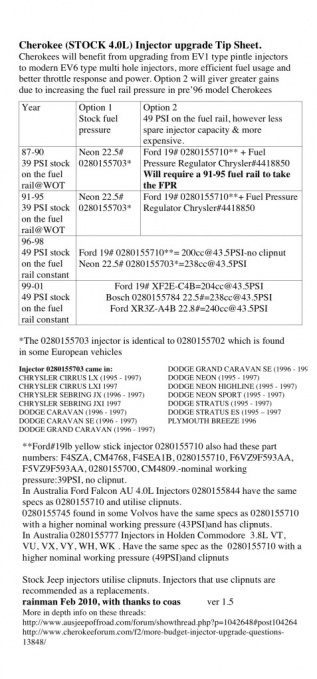
I just did my Injector Upgrade this morning on my 96, I used injectors from a 97 Mercury Cougar with 4.6 liter V8, my stock injectors were filthy so simply cleaning them would have helped, but I most definitely notice a difference in idle and throttle response!
They had 30 dodge neons at my local pick n pull, not a single 703 injector in any of them, so I did a google search on my phone and found this thread......
http://www.jeepforum.com/forum/f13/d...36/index4.html
This is where I got the info on the Ford injectors, it's a super easy swap, took me about 30 minutes, and the 6 injectors were under $50. Totally worth it in my opinion!
They had 30 dodge neons at my local pick n pull, not a single 703 injector in any of them, so I did a google search on my phone and found this thread......
http://www.jeepforum.com/forum/f13/d...36/index4.html
This is where I got the info on the Ford injectors, it's a super easy swap, took me about 30 minutes, and the 6 injectors were under $50. Totally worth it in my opinion!

Thread
Thread Starter
Forum
Replies
Last Post
ZJBeachRunnerGC
Stock Grand Cherokee Tech. All ZJ/WJ/WK Non-modified/stock questions go here!
18
Mar 10, 2021 05:52 PM
Jbri22
Stock XJ Cherokee Tech. All XJ Non-modified/stock questions go here
11
Sep 26, 2015 04:30 PM
Currently Active Users Viewing This Thread: 1 (0 members and 1 guests)