When you click on links to various merchants on this site and make a purchase, this can result in this site earning a commission. Affiliate programs and affiliations include, but are not limited to, the eBay Partner Network.
Sorry if this is a stupid question here, but I have some movement where my trac bar bolts up to the frame. I have seen where some use a bigger bolt, and some weld a washer to replace the original hole.
I have two holes on my bracket... If I buy an adjustable trac bar,
A) Could I just use the other hole
B) If so, what if any could be the downside of doing so?
Sorry if this is a stupid question here, but I have some movement where my trac bar bolts up to the frame. I have seen where some use a bigger bolt, and some weld a washer to replace the original hole.
I have two holes on my bracket... If I buy an adjustable trac bar,
A) Could I just use the other hole Can I use the other hole?
If you have a lift already and non-adjustable trackbar, the 2nd hole would have been drilled to get tracking right.
With an adjustable trackbar, you should be able to use the original hole.
best check it isnt wallowed out too, otherwise reinforcement will be needed anyway
I personally found the metal here pretty flimsy looking, but didnt reinforce it when I fitted my adjustable trackbar (instead of drilling another hole)
If you have a lift already and non-adjustable trackbar, the 2nd hole would have been drilled to get tracking right.
With an adjustable trackbar, you should be able to use the original hole.
best check it isnt wallowed out too, otherwise reinforcement will be needed anyway
I personally found the metal here pretty flimsy looking, but didnt reinforce it when I fitted my adjustable trackbar (instead of drilling another hole)
Yup all that makes sense. Amazing how you could tell that I do have a lift, and that was a secondary hole used to keep the original trac bar on. I never thought about that, and just couldn't understand why I have 2 holes.
So I'll be buying a new trac bar regardless as this one is loose at the other end as well. I will also have to cut the bolt off this one at the axle end as it's seized, and tab is already nearly ripped off (with some vice grips).
I have the 4.5 rough country with 1in spacers, 33in tires, and tom wood drive shaft. Never got any upgraded steering and it's long overdue. Since before I put the lift on this it was fine at any speed and no wobble at all, I'm holding out hope that the original hole is good to go. I'll just make sure I get the currie steering upgrade as well as alignment done, all at same time to ensure I don't wear out the original hole.
all at same time to ensure I don't wear out the original hole.
After having a bad experience with front alignment shop, following my IFS rebuild on another vehicle, I do my own alignments now.
2 x 6m lengths of 2" x 1" Aluminium C-channel, obtained used..I think they frame windows with it....allows me to make dead accurate adjustments of tracking and toe-in.
Camber and Castor measurement require other "tools", but can also be done at home..no Camber adjust on XJ
Some people use string and jackstands, but this is not good enough..a straight edge is needed
A shorter straight edge and laser would probably work
as well as alignment done, all at same time to ensure I don't wear out the original hole.
After having a bad experience with front alignment shop, following my IFS rebuild on another vehicle, I do my own alignments now.
2 x 6m lengths of 2" x 1" Aluminium C-channel, obtained used..I think they frame windows with it....allows me to make dead accurate adjustments of tracking and toe-in.
Camber and Castor measurement require other "tools", but can also be done at home..no Camber adjust on XJ
Some people use string and jackstands, but this is quite accurate enough for my liking..a straight edge is needed imo
A shorter straight edge and laser would probably work
After having a bad experience with front alignment shop, following my IFS rebuild on another vehicle, I do my own alignments now.
2 x 6m lengths of 2" x 1" Aluminium C-channel, obtained used..I think they frame windows with it....allows me to make dead accurate adjustments of tracking and toe-in.
Camber and Castor measurement require other "tools", but can also be done at home..no Camber adjust on XJ
Some people use string and jackstands, but this is quite accurate enough for my liking..a straight edge is needed imo
A shorter straight edge and laser would probably work
I use the string method for alignments on my Jeeps and racecar. Never had any issues with it not being super accurate. You just have to take your time setting it up and it will come out as good as any other method. Its accurate enough that I know my axle is shifted to the left 1/16" at ride height.
I use the string method for alignments on my Jeeps and racecar. Never had any issues with it not being super accurate. You just have to take your time setting it up and it will come out as good as any other method. Its accurate enough that I know my axle is shifted to the left 1/16" at ride height.
a lot of experienced guys do it that way, so it must be satisfactory. What "concerns" me is that string can be floppy..and "not straight".
for Toe-in, one can project the straight edge forward, and get extremely accurate measure
a really accurate toe & camber gauge can be made from scraps, and it measures on rims, not tyres. (just like a real alignment shop)
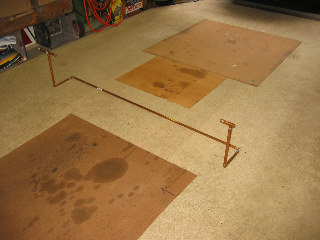
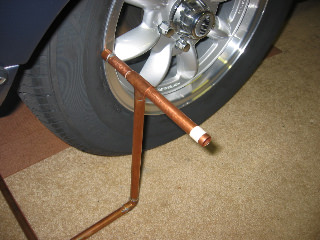
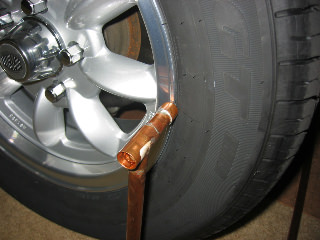
using thin pipes, and scrap lumber, make a device with adjustable arms that sit adjacent to wheels..rotate arms up to wheel rims. Push metal fingers up to wheel rim. Move to opposite side of rim. works kind of like a dial gauge, so it will show any difference in toe or camber to as low as a feeler gauge will allow..I will try and post a pic of this homemade device
a lot of experienced guys do it that way, so it must be satisfactory. What "concerns" me is that string can be floppy..and "not straight".
for Toe-in, one can project the straight edge forward, and get extremely accurate measure
a really accurate toe & camber gauge can be made from scraps, and it measures on rims, not tyres. (just like a real alignment shop)
using thin pipes, and scrap lumber, make a device with adjustable arms that sit adjacent to wheels..rotate arms up to wheel rims. Push metal fingers up to wheel rim. Move to opposite side of rim. works kind of like a dial gauge, so it will show any difference in toe or camber to as low as a feeler gauge will allow..I will try and post a pic of this homemade device
Yes I would love to see how you do it! I dont like how long it takes me to setup doing it with the strings. So if you have a faster way, I am all ears.
And every time I take my measurements, on the Jeeps its from the rim, I never use the tires. Very inaccurate using the tires. On my race car, I pull the wheels off and go directly to the rotors. Makes it easier to adjust everything too.
Also, I understand your concern about the string moving while measuring, cause it does whenever you touch it. I use fishing string which I find better then rope. When I measure, I never touch the string which helps it not move. It being thinner then rope also helps be more accurate.
I copied the above design, but using PVC & joiners with self-tap screws to attach & adjust, much cheaper (and easier to move about and adjust) than copper
As you can see, this allows toe and camber to great precision
So I thought I would update this thread, as I'm still in the process of putting on the new trackbar. Time to myself and my projects is hard to come by...
I had to cut the bolt off where it's pictured above in my posts. And I'm down to one last bolt holding on the bracket. Only thing is, I can't access it without A) taking off the coil springs or B) buying a $30 wrench. (hint: I'm buying the wrench lol)
But as far as those mysterious holes... The hole on the left is indeed a larger sized hole than the one the I cut the bolt from. Too large for the hardware that came with my adjustable track bar from rough country. Also the hole on the left would be a HUGE pita with that tab nut... So I'm at a loss as to what was original, and what was drilled later on.
With all that said, when I put the bolt for the new track arm through the holes I cut the old one from (hole on the left in pic) I get hardly any play. Less than a mm and maybe even less than half a mm. Do you think that is still going to cause death wobble? How snug is that bolt supposed to be in terms of fitting in the hole? I say that because I couldn't image it being more snug in a washer that would be welded in it's place.
So in somewhat of a pickle here with this track bar now.
I installed a new adjustable trackbar from rough country, and used the hole on the right in that picture (the smaller one). Mainly because the larger hole was well, too large. So here is my pickle...
I had to adjust the track bar to it's absolute lowest setting to fit it in. So that means I can really only lengthen the track bar...
Also it does seem like I have 1 inch sticking out more on driver side than passenger side... So if I'm thinking about this right (please tell me) I need to make it longer to have the passenger side stick out more? Or would I rather shorten it to have driver side stick out less?
My death wobble that use to start at 45mph, now doesn't kick in till 55mph since putting in this track bar, so it's a start in the right direction.
So in somewhat of a pickle here with this track bar now.
I installed a new adjustable trackbar from rough country, and used the hole on the right in that picture (the smaller one). Mainly because the larger hole was well, too large. So here is my pickle...
I recently went thru this situation. My vehicles are RHD. The trackbar positions the body over the fixed point on the axle (lower trackbar mount). Lengthening the trackbar will move the body away from that fixed point
problem No1) You have a defect in the axle trackbar mount area. This should be rectified. I would weld a thin triangular plate with the original spec hole (or at least a washer).
To my knowledge, any movement in this area is the No1 cause of death wobble, there is a lot of force on that front hole in particular
To refit the trackbar, its best to have an assistant turn steering wheel, otherwise ratcheting, or shoving body across is needed
this is just my laymans analysis of the problem, I was surprised how thin the bracket metal was, but as my hole was tight, no extra work needed.
I recently went thru this situation. My vehicles are RHD. The trackbar positions the body over the fixed point on the axle (lower trackbar mount). Lengthening the trackbar will move the body away from that fixed point
problem No1) You have a defect in the axle trackbar mount area. This should be rectified. I would weld a thin triangular plate with the original spec hole (or at least a washer).
To my knowledge, any movement in this area is the No1 cause of death wobble, there is a lot of force on that front hole in particular
To refit the trackbar, its best to have an assistant turn steering wheel, otherwise ratcheting, or shoving body across is needed
this is just my laymans analysis of the problem, I was surprised how thin the bracket metal was, but as my hole was tight, no extra work needed.
I guess I still need to research the adjustable track bar I have. I need to move the body of the jeep to the left a bit. So does that mean I need to lengthen or shorten it?
EDIT>>>>> nm I figured it out. I need it longer so I am still in good shape once I make it longer.
From what I can tell, I just need to measure tires and make it longer, which I can thankfully do while it's still installed on the vehicle.
But I have questions...
What are the downstream effects of making my trackbar .5-1.25 inches longer? (depending on how much I need)
Does anything else need lengthened or adjusted? Or no?
From what I can tell, I just need to measure tires and make it longer, which I can thankfully do while it's still installed on the vehicle.
But I have questions...
What are the downstream effects of making my trackbar .5-1.25 inches longer? (depending on how much I need)
Does anything else need lengthened or adjusted? Or no?
technically, the trackbar needs to adjusted half the amount you want to move the body..(in practice you may need more)
draw yourself a diagram of force direction, just remember the body will move away from the fixed lower mount if trackbar made effectively longer
LHD is too confusing for me, as I work on RHD vehicles in Australia (altho my CCKW was LHD)..steering/trackbar is back to front
nothing else needs adjusting, altho i left my LCA bolts a bit loose and drove the vehicle up & back the driveway, prior to torque them, but I had swapped the bushes



 Trac bar bracket fix question... Can I do this?