
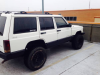
I'm almost at my whits end with this 96 gc with 4.0 I have replaced almost everything up to date I have replaced : starter, coil, distributor cap, rotor, plugs, plug wires, fuel filter, fuel pump relay, crankshaft sensor, all fuses are good. I have no idea what it is? Now it will sit there and turn but won't crank, also driving it will die out and sputter, when it won't crank you can smell fuel, check fuel pressure when in between the times it does this and it was good so I have no clue what to do next

CF Veteran
Quote:
Have you checked the Cam Sensor, located in the distributor cap?Originally Posted by jonwalden68
I'm almost at my whits end with this 96 gc with 4.0 I have replaced almost everything up to date I have replaced : starter, coil, distributor cap, rotor, plugs, plug wires, fuel filter, fuel pump relay, crankshaft sensor, all fuses are good. I have no idea what it is? Now it will sit there and turn but won't crank, also driving it will die out and sputter, when it won't crank you can smell fuel, check fuel pressure when in between the times it does this and it was good so I have no clue what to do next
The following info is taken from the '96 ZJ FSM:
CAMSHAFT POSITION SENSOR
The camshaft position sensor is located in the distributor
on all engines.
The sensor contains a hall effect device called a
sync signal generator to generate a fuel sync signal.
This sync signal generator detects a rotating pulse
ring (shutter) on the distributor shaft. The pulse ring
rotates 180 degrees through the sync signal generator.
Its signal is used in conjunction with the crankshaft
position sensor to differentiate between fuel
injection and spark events. It is also used to synchronize
the fuel injectors with their respective cylinders.
When the leading edge of the pulse ring (shutter)
enters the sync signal generator, the following occurs:
The interruption of magnetic field causes the voltage
to switch high resulting in a sync signal of approximately
5 volts.
When the trailing edge of the pulse ring (shutter)
leaves the sync signal generator, the following occurs:
The change of the magnetic field causes the sync signal
voltage to switch low to 0 volts.
rotates 180 degrees through the sync signal generator.
Its signal is used in conjunction with the crankshaft
position sensor to differentiate between fuel
injection and spark events. It is also used to synchronize
the fuel injectors with their respective cylinders.
When the leading edge of the pulse ring (shutter)
enters the sync signal generator, the following occurs:
The interruption of magnetic field causes the voltage
to switch high resulting in a sync signal of approximately
5 volts.
When the trailing edge of the pulse ring (shutter)
leaves the sync signal generator, the following occurs:
The change of the magnetic field causes the sync signal
voltage to switch low to 0 volts.
To test the sensor
only, refer to the following:
For this test, an analog (non-digital) voltmeter
is needed. Do not remove the distributor connector
from the distributor. Using small paper clips,
insert them into the backside of the distributor wire
harness connector to make contact with the terminals.
Be sure that the connector is not damaged
when inserting the paper clips. Attach voltmeter
leads to these paper clips.
(1) Connect the positive (+) voltmeter lead into the
sensor output wire. This is at done the distributor
wire harness connector. For wire identification, refer
to Group 8W, Wiring Diagrams.
(2) Connect the negative (-) voltmeter lead into the
ground wire. For wire identification, refer to Group
8W, Wiring Diagrams.
(3) Set the voltmeter to the 15 Volt DC scale.
(4) 5.2L/5.9L Engines: Remove distributor cap
from distributor (two screws). Rotate (crank) the
engine until the distributor rotor is pointed towards
the rear of vehicle. The movable pulse ring should
now be within the sensor pickup.
(5) 4.0L Engine: Remove distributor cap from
distributor (two screws). Rotate (crank) the engine
until the distributor rotor is pointed to approximately
the 11 o’clock position. The movable pulse ring
should now be within the sensor pickup.
(6) Turn ignition key to ON position. Voltmeter
should read approximately 5.0 volts.
(7) If voltage is not present, check the voltmeter
leads for a good connection.
(8) If voltage is still not present, check for voltage
at the supply wire. For wire identification, refer to
Group 8W, Wiring Diagrams.
(9) If 5 volts is not present at supply wire, check
for voltage at PCM 32-way connector (cavity A-17).
Refer to Group 8W, Wiring for location of connector/
terminal. Leave the PCM connector connected for
this test.
(10) If voltage is still not present, perform vehicle
test using the DRB scan tool.
(11) If voltage is present at cavity A-17, but not at
the supply wire:
(a) Check continuity between the supply wire.
This is checked between the distributor connector
and cavity A-17 at the PCM. If continuity is not
present, repair the harness as necessary.
(b) Check for continuity between the camshaft
position sensor output wire and cavity A-18 at the
PCM. If continuity is not present, repair the harness
as necessary.
(c) Check for continuity between the ground circuit
wire at the distributor connector and ground.
If continuity is not present, repair the harness as
necessary.
(12) While observing the voltmeter, crank the
engine with ignition switch. The voltmeter needle
should fluctuate between 0 and 5 volts while the
engine is cranking. This verifies that the camshaft
position sensor in the distributor is operating properly
and a sync pulse signal is being generated.
If sync pulse signal is not present, replacement of
the camshaft position sensor is necessary.
CF Veteran
Quote:
Okay.Originally Posted by jonwalden68
Put brand new battery in. And I'll test sensor tomorrow

CF Veteran
Stop throwing money at it fer gawds sake!!!
Your post is confusing at best. We can't help you if you can't provide a better description of what you were trying to correct before you started pouring cash into the engine bay.
You said it turns but won't crank.......?
The video clearly indicates that the engine will crank/turn-over but not run.
You also said it won't start, but then you state that when you drive it dies and then sputters (you got backwards I think). So how are you driving it if it won't start?
So try answering these as best as you can and let's work on this problem....okay?
1.) What was the initial problem that you experienced?
2.) Did your Check Engine Light (CEL) come on?
3.) Did you use a scanner to retrieve any and all error codes? What were the codes?
5.) What is the current status of your CEL? Codes?
You need 4 things to get your engine to run.
1.) Air
2.) Fuel
3.) Ignition source
4.) Proper compression
Your post is confusing at best. We can't help you if you can't provide a better description of what you were trying to correct before you started pouring cash into the engine bay.
You said it turns but won't crank.......?
The video clearly indicates that the engine will crank/turn-over but not run.
You also said it won't start, but then you state that when you drive it dies and then sputters (you got backwards I think). So how are you driving it if it won't start?
So try answering these as best as you can and let's work on this problem....okay?
1.) What was the initial problem that you experienced?
2.) Did your Check Engine Light (CEL) come on?
3.) Did you use a scanner to retrieve any and all error codes? What were the codes?
5.) What is the current status of your CEL? Codes?
You need 4 things to get your engine to run.
1.) Air
2.) Fuel
3.) Ignition source
4.) Proper compression
All that been checked And only code is for oxygen sensor I have own multiple jeeps where the exhaust has been ripped off offloading and run fine for years I'm thinking fuel pump is going in and out I think I'll post codes here in a min