


purpose of relay?

Thread Starter
CF Veteran
Joined: Sep 2009
Posts: 1,471
Likes: 3
From: Knoxville, TN
Year: 1998
Model: Cherokee
Engine: 4.0 inline 6 (o yea!)
 purpose of relay?
I am wiring up my Hella fog lights. I am running 10g wire from the battery to the relay and 10g from relay to lights because I am running 4 lights from one switch and relay. My question is, if I already have a fuse in line with the battery and all the switch does is operate the relay, then what is the purpose of the relay? Why can I not run from battery to fuse, fuse to switch, switch to lights. That would eliminate a LOT of wiring.
It seems to me the only purpose of it is to shut the lights off when brights are one (which I am not wiring it that way anyway)
It seems to me the only purpose of it is to shut the lights off when brights are one (which I am not wiring it that way anyway)
Senior Member
Joined: Oct 2008
Posts: 871
Likes: 0
From: Port Orange, FL
Year: 1993, 1994
Model: Cherokee
Engine: 4.0L HO
The switch probably isn't rated for the power draw of the lights, either that or the wiring isn't. The relay probably has beefier wiring and is rated for higher amps, so it's less likely to melt and/or burst into flame.
Seasoned Member
Joined: Nov 2009
Posts: 302
Likes: 0
From: Western NY
Year: 1999
Model: Cherokee
Engine: 4.0L I6 Power Tech
relay is there to protect the switch from melting and shorting out, take the long road wire in the relay or start saving money now for a new xj
Member
Joined: May 2010
Posts: 155
Likes: 0
From: Orono, Ontario
Year: 97
Model: Cherokee
Engine: 4.0L
when your running that many lights, its gonna have a high amp draw. The 10g wire might be rated for that amp, but the switch wont even be close to that amp rating. if you try to pull that may amps through it, it will melt eventually, causing a XJ BBQ.
What the relay does is allow for safe switching on and off of power on high amp circuits. a relay and a switch work on the same principals (switching things on or off) but do it in a different means. That's why a relay is much bigger than a switch physically. There is larger contacts inside for the high circuit that are less prone to burning out. It also offers extra protection for your wiring to keep it from catching fire.
What the relay does is allow for safe switching on and off of power on high amp circuits. a relay and a switch work on the same principals (switching things on or off) but do it in a different means. That's why a relay is much bigger than a switch physically. There is larger contacts inside for the high circuit that are less prone to burning out. It also offers extra protection for your wiring to keep it from catching fire.

CF Veteran
Joined: May 2008
Posts: 3,018
Likes: 23
Year: 1988
Model: Cherokee
Engine: AMC242
I am wiring up my Hella fog lights. I am running 10g wire from the battery to the relay and 10g from relay to lights because I am running 4 lights from one switch and relay. My question is, if I already have a fuse in line with the battery and all the switch does is operate the relay, then what is the purpose of the relay? Why can I not run from battery to fuse, fuse to switch, switch to lights. That would eliminate a LOT of wiring.
It seems to me the only purpose of it is to shut the lights off when brights are one (which I am not wiring it that way anyway)
It seems to me the only purpose of it is to shut the lights off when brights are one (which I am not wiring it that way anyway)
And, "eliminating wiring" isn't necessarily a good thing - having the extra wiring between the switch and the relay will actually allow the main power leads to be shorter - which is the lead you want reduced length in. The shorter the main power lead is, the more power makes it to the device (and by using a relay, you can save a good deal of money on your switch - and it allows you to use whatever style of switch you like. Want a small press button? Ok. Toggle switch? No trouble. Key switch? Go ahead. Magnetic reed switch? Fine.
Since a relay is a standard part, it can be made inexpensively. Since it's usually hidden, it can be made however you like (the 1" cube of the DIN relay is a convenient standard form.)
The relay allows a small current to control a very large one - just like transistors in electronics, but moreso (the transistor is smaller, so it can't handle as much current as a relay. However, a transistor can react much more quickly than a relay - which is why solid-state amplifiers use transistors or transistor-based electroincs instead of relays.)
I usually use 18/2 or 20/2 wiring (SJOOW, which I can usually get at the hardware store) to wire the switch to the relay. The SJOOW wiring is a (usually black) rubber-jacketed wire, like an extension cord, that is oil-, grease-, and water-resistant. It also means that I can pull a single cable to pull both leads for the switch - which simplifies things immensely. The load wiring is usually 10/2, 12/2, or 14/2 (depending on load) SJOOW - same reason.
Thread Starter
CF Veteran
Joined: Sep 2009
Posts: 1,471
Likes: 3
From: Knoxville, TN
Year: 1998
Model: Cherokee
Engine: 4.0 inline 6 (o yea!)
ugh...this is why I am a mechanical engineer. I hate electrical stuff....ha ha. Do the ground wires for the lights need to be 10g too or will they be okay? I did a test with nothing permanently connected and the grounds seemed okay and were not getting hot or anything.
Trending Topics
Seasoned Member
Joined: Nov 2009
Posts: 302
Likes: 0
From: Western NY
Year: 1999
Model: Cherokee
Engine: 4.0L I6 Power Tech
personaly i like my grounds a little better but... i never gave i thought before on wether or not its good or not i dont think it will hurt anything as long as you run the same size or bigger lead then the power always make sure they the same or power is smaller
Thread Starter
CF Veteran
Joined: Sep 2009
Posts: 1,471
Likes: 3
From: Knoxville, TN
Year: 1998
Model: Cherokee
Engine: 4.0 inline 6 (o yea!)
Finally, got the lights wired. Check my build thread for them. I ended up using 10g wiring for all power supply and left the 16g grounds. So far so good. The relay was rated for 40a so I used it for all four lights. The switch didn't have a rating on it. I also used a 10g 30a fuse holder inline from the battery.



Member
Joined: Aug 2010
Posts: 131
Likes: 0
From: Riverside County
Year: 1991
Model: Cherokee
Engine: 4.0 litre

Danger, Will Robinson, Danger!
Replace the 16g for 10g! You want the ground to be the same size as the supply. In AC (voltage, not cooling) circuits, that would be acceptable, because the ground is not a primary path of voltage. In a DC automotive circuit, negative and ground are synonymous, meaning it is a primary path. Otherwise, your amperage rating of the circuit for your lights is based on the 16g not the 10g. You could have #2 AWG as a supply and if ground is #16AWG, you still calculate amperage capacity based on the 16 gauge wire. Think of the circuit as each wire is a resistor as well. So either you have run 16 gauge for the entire circuit because of that one small piece of wire (it's now the weak link in the chain), or you can have the amperage needed/desired by replacing it with 10 ga.
12 Volt DC chart
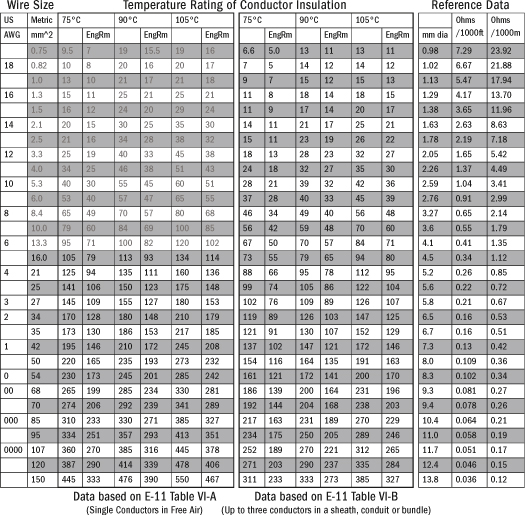
So using this chart, your 16 AWG wire has a capacity of 11 amps (BTW, not recommended). But standard (constant full load) safety rating is equal to -25% of Listed Rating (known as de-rating). Okay, let's downgrade the wire's capacity, that roughly to 8-9 amps for a safe margin. What is the total amperage you are pulling for your OH lights? Amperage=watts/volts (in this case, let's use 12v as a start, though 14.4- (running) is more an average) Let's say you are using KC 124's which draw 100W per light. In a wiring circuit with 4 lights, you have 400 watts (nominal). 400 watts / 12 v = 33.33 A!!!!!!! Way over the amp rating of 16 ga wire. Half that for only 2 lights, still over the rating. Before anyone says it, yes, in a parallel circuit, the amperage rating is decreased, but only at the individual component level. The feed back to the negative/battery still sees the entire total amperage rating.
Next question: Did you "daisy-chain" them, ie, series circuit? Or did you tap off the #10 at each light with a 10 gauge rail? If you series them, you have restricted the amperage to each subsequent light based on the gauge of the lead from the first light itself. And you prolly already know this, but in a daisy chain, if one fails, they all fail.
Bottom Line: Wire it at 125%, fuse it at 100% (or a little above). This will save you from rewiring if you encounter a short circuit situation. If you fuse it at a higher rating than the 16 g wire, expect to replace the wire before you replace the fuse. And the lights will run dimmer than they should. A16 ga wire can only handle so much, and it decreases as it heats up.
For once, since I joined, I can add real knowledge. And happy I can share, because y'all have helped me. It's a pay it forward and back thing.
Last edited by Doc Brnard; Aug 31, 2010 at 12:07 AM.

Newbie
Joined: Aug 2010
Posts: 4
Likes: 0
From: Moseley, VA
Year: 1996
Model: Cherokee
Engine: 4.0
I just added two 55 watt reverse lights (daisy-chained). Used a 12v 40 amp relay and switch assembly. Wired the entire setup in 16ga wire. Am I ok, or should I have used a larger wire?
Member
Joined: Aug 2010
Posts: 131
Likes: 0
From: Riverside County
Year: 1991
Model: Cherokee
Engine: 4.0 litre
55+55=110
110/12= 9.16 A Add the derate for that and you get 12/13 A equivalent power requirement. Wiring is iffy using 16 AWG (above 11 A on the outside pushes it) based on rating and de-rate. I would go 12 ga, if possible.
12 awg will give you 19 Amp rating, use a 15 amp fuse. 40 A relay is good based on those figures.
Another suggestion: Wire them in parallel. That way if one pops a filament, you only lose one. In parallel, the other will continue to work. Wired in series= lose one, lose all. Also helps simplify troubleshooting. If you do lose all in parallel, you know its a feed issue.
Hope that helps, Outdoeman.
110/12= 9.16 A Add the derate for that and you get 12/13 A equivalent power requirement. Wiring is iffy using 16 AWG (above 11 A on the outside pushes it) based on rating and de-rate. I would go 12 ga, if possible.
12 awg will give you 19 Amp rating, use a 15 amp fuse. 40 A relay is good based on those figures.
Another suggestion: Wire them in parallel. That way if one pops a filament, you only lose one. In parallel, the other will continue to work. Wired in series= lose one, lose all. Also helps simplify troubleshooting. If you do lose all in parallel, you know its a feed issue.
Hope that helps, Outdoeman.
Last edited by Doc Brnard; Aug 31, 2010 at 04:02 AM.
CF Veteran
Joined: Feb 2010
Posts: 2,004
Likes: 40
From: corpus christi, texas
Year: 1999
Model: Cherokee (XJ)
Engine: 4.0 I6
flash backs to electrical class in a&p school reading that buts its good to see that type of stuff because most people don't know about reading a wire gauge chart and how to figure wiring capacity over length and derating. very good post doc!!
wire and electricity are like a water hose. the thickness of hte wire restricts the amperage, just like a small hose restricts the flow of water
wire and electricity are like a water hose. the thickness of hte wire restricts the amperage, just like a small hose restricts the flow of water
Newbie
Joined: Aug 2008
Posts: 28
Likes: 0
From: Whitehall, PA
Year: 1997
Model: Cherokee
Engine: 4.0L
i had my simple fog lights hooked up directly to the battery with just a toggle switch like you state you want to do. let me tell you, the amount of power going in to the switch, even with a fuse, was enough to melt the switch, with 18 gauge wire. I recently changed it over to a relay using 12 gauge wire and now everything is happy and cool. just my experience but take it for what it's worth.

Thread
Thread Starter
Forum
Replies
Last Post
ZJBeachRunnerGC
Stock Grand Cherokee Tech. All ZJ/WJ/WK Non-modified/stock questions go here!
18
Mar 10, 2021 05:52 PM
soocom1
Modified XJ Cherokee Tech
27
Nov 30, 2015 05:56 AM
Cherokee_of_Tennessee
Stock XJ Cherokee Tech. All XJ Non-modified/stock questions go here
4
Sep 30, 2015 12:10 PM
AggieNiebs
Stock Grand Cherokee Tech. All ZJ/WJ/WK Non-modified/stock questions go here!
8
Sep 29, 2015 01:50 PM
Currently Active Users Viewing This Thread: 1 (0 members and 1 guests)