When you click on links to various merchants on this site and make a purchase, this can result in this site earning a commission. Affiliate programs and affiliations include, but are not limited to, the eBay Partner Network.
Stock XJ Cherokee Tech. All XJ Non-modified/stock questions go hereXJ (84-01)
All OEM related XJ specific tech. Examples, no start, general maintenance or anything that's stock.
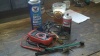
I have an 89 XJ, 4L I6 with the plastic coolant bottle (see pix below) on the passenger side of the firewall. The hose from the return nipple (bottom of tank) is leaking and I'd like to replace the hose (tank is new). Does anyone happen to know the ID of the hose I need? Additionally, can the crimp on the other end of the OEM hose be cut off and a replacement hose put on the metal spigot? Or should I just cut the original hose and use a sleeve to connect it to a new hose stub?. Thanks for any advice.
see quadratec link above for molded hose. I used this hose on my 1990 XJ. part number is Crown 52003876.
Cut off the crimp, do NOT cut the pipe itself. The end of pipe under the crimp has a flare. You NEED the flare.
A dremel or hacksaw can be used to split the crimp, and finish up with aviation snips to avoid nicking the pipe. visegrips can be used to peel it back.
Do not splice to old hose, as that original hose is over 30 years old, it will fail sooner than later. It will be the weak link.
Note that replacement reservoirs have been known to come with faulty caps, and evidently original caps dont work well on the replacement reservoirs I believe folks have found a good cap that works with the new reservoirs, i think it is a Volvo cap? anyway others can advise on that, i read it someplace. you may try a search on this website for details, This issue may or maynot effect your reservoir, just a heads up.
Last edited by robsjeep; Nov 17, 2022 at 07:57 PM.
If memory servers it's a cap from a Volvo 770 that was much better made. You sure it's the hose and the bottle hasn't cracked (yet)?
The aftermarket bottles and caps are poorly made. The bottles don't hold their shape very well once they get hot and the cheap caps slip the threads, lose pressure and causing boiling overs (btdt). You're far better off converting to the "open" style and getting rid of the bottle and eliminating the heater coolant valve, which also tends to crumble when you look at it funny. In fact, if it's the original I'll be surprised if you don't break either the nipple on the bottle or the valve trying to replace that hose.
I tried the cheap bottle after mine exploded rather dramatically one -10*F day. The cap would randomly pop loose from the poorly made threads and I'd boil over. A test also showed the crappy cap vented at 6-psi. I replaced the radiator with a 92 that had the filler neck and eliminated the control valve at the same time. Never had a problem since. I believe the premade heater core lines for a 95 are the right size.
You sure it's the hose and the bottle hasn't cracked (yet)?
Not 100 % sure but it's a new OEM bottle and it's been dripping (very slowly) from around the hose since I put it in - about a year ago - My theory is the original hose got a bit chewed when I yanked the original bottle off (which was leaking at that point).
Here's an idea: remove your tank cut off the lower nipple (if it's cracked and leaking down there), and go to a hardware store and get some threaded brass nipples and adapt them to your existing bottle which ever way is the best way (threaded or using a face gasket).
If you buy a new bottle, take a good look at the lower nipple. If it's poorly molded (which a lot of them seem to be), you can try to fix it, or cut it off, drill out ...and adapt a brass fitting to it. I had two which cracked at the lower nipple (around the nipple) in short order. The tanks have the "potential" to be good if only the quality control were better ...or existed at all. I don't remember the hose size. I would say it's something like 3/4" or 13/16". It's an odd size I do remember that. If you put your own brass nipple on it, you can make it whatever size you want.
Last edited by Jeepwalker; Nov 17, 2022 at 11:24 PM.
If your radiator is aged at all, I would do what lawsoncl did.
And, I would eliminate the heater valve at the same time.
Those bottles are ticking time bombs. Not a quality one out there.
If reliability is the issue, replace all the original hoses, they are over thirty years old.
There is also as I recall a metal tank option, someone makes or made an aluminum tank to replace the plastic one. the one downside is you must open the lid to see the coolant level. I have a VW watercooled Vanagon, it has a simular cooling system to your Renix jeep, with a plastic pressure tank. one day it failed, so I bought an aftermarket aluminum tank made for this purpose. (the aftermarket Vanagon plastic tanks have a quality problem, rarely lasting long) it works fine, and it like the original has a built in level sensor, negating the need for a see through tank to check level of coolant.
I have another car with custom engine conversion, and it uses an old Corvette aluminum pressure tank. this is needed even though it is a vented system as the radiator is very low, the filler needs to be high point. thus the pressure tank mounted higher than the radiator. (Buick 3.8 V6 in an 914) You may find one of these Corvette tank might be adapted to your needs
Another option if you dont want to replace the radiator, but want to convert to an open system and thus eliminate the pressure tank is to install a spliced into upper hose filler cap. this maybe the least expensive option for conversion to an open system as you keep your radiator.......See link below
(note the above part is an example, not necessarily the one that fits your hose diameter and height need. The cap must be the highest point in the system. they make these with tall necks, short necks, and different hose end diameters.)
The original tank was on my 87 until 2 or 3 years ago. That's 32 years by my simple math. Doesn't sound unreliable to me. The new tanks are nice ...*if* you get one where the molding at the cap and nipples are 'good'. Or even fixable. I took some time and fixed my 2nd new tank at the cap and the nipple, so it would seal up better. Probably spent 1.5 hours on it, LOL ...but it's been good ..so far. But also, if an owner's jeep overheats, has head gasket issues or a damaged engine mount, that's going to put more pressure on a tank and lead to premature damage possibly. But if everything is as it should be, hoses good, it seems to be a livable system.
Even though the external pressure tank takes more parts/hoses I'm guessing there 'could' be a desirable engineering reason beyond space-saving (radiator) why Jeep and other serious off-road vehicles used the external pressure tank (up high). Land Rovers ...Defenders, for example, used them for many years up until they stopped making them (I think the new ones still use a pressure coolant bottle). VW used them in their diesel TDI cars at least until the mid 00's if not beyond. But then again, certain Toyota Land Cruisers and of course most American vehicles (except older classics) didn't. So... idk. But yeah, there's more 'stuff' to conceivably go wrong.
Last edited by Jeepwalker; Nov 18, 2022 at 02:39 PM.
I was going through the replacement bottles so often between 3 Renix Jeeps, I wrote the purchase date on the side with a marker. They never lasted a year.
As for the Mac's tanks, they're great and all. Just more expensive than a new radiator!!
Just curious where were the aftermarket tanks are failing for you?
My first one failed at the lower nipple. My 2nd one is on it's 3rd year. If/when it goes, I'll put a brass nipple in it's place, which 'should' solve that problem.



 Help: Coolant expansion tank hose size.