When you click on links to various merchants on this site and make a purchase, this can result in this site earning a commission. Affiliate programs and affiliations include, but are not limited to, the eBay Partner Network.
Stock XJ Cherokee Tech. All XJ Non-modified/stock questions go hereXJ (84-01)
All OEM related XJ specific tech. Examples, no start, general maintenance or anything that's stock.
I do not recall correctly if my 1996 XJ radiator, that I just replaced with another brass/copper unit, has a ground path other than through the fluid. The top has 2 rubber vibration isolators that are bolted to the rad with metal nuts, and then the isolators are attached to the upper radiator support with nuts, so those are electrically isolated. The bottom goes into rubber grommets, with the condenser attached top and bottom to the radiator but don't remember how isolated that is.
The heater core is attached to the firewall(?), so that should be providing a good ground.
Engine: 4.0, new lifters valve job with new springs and exhaust valves, preload set with shims
Interesting, I think it can't hurt. When I laid out $500 recently for a new hot water heater in my house, (which is absolutely ridiculous for a plain old bare bones old direct vent style. These things have gone through the roof for some reason/ through the roof, I made a funny) I wondered the same thing, if the galvanic action on the tank could be slowed by eliminating the potential between the hot and cold, so couple pipe clamps and some #6 bare copper and boom.
I'll let you know in 12 years or so if it gunked up.
Last edited by 97grand4.0; Nov 16, 2019 at 02:23 AM.
I plan on doing that when I'm messing with my battery terminals next weekend. Can put one lead on the cap and one to the block ground stud and see what I get. The filler neck is nice clean brass right now can check from there too with the cap off.
Another look today at the rad mounting and it does look isolated by the rubber bits. If it does not have good continuity, I will probably use a scrap piece of ground wire from the wiring I'm removing from the dead aux lights.
Side note: Lowe's has bolts that are a good match for the six at the ends of the radiator upper support.
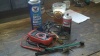
Side note, the six bolts at the ends of the upper radiator support are M6x1.00, 10mm head and Lowe's has very similar bolts for less than $2 a pair. They have thread farther down and are a little longer than the OE, so be careful and check if there is anything behind what you are installing them on. Stock on the right, Lowe's on the left.
Seems like the best place to put a ground on a 1996 XJ radiator is under one of the top isolator pads. Mine is well painted, so going to have to rub that off and get down to bare metal. Passenger side appears easy to get the ground to the bolt that grounds the battery to the body too.
Finally busted out the el cheapo multimeter. Somehow my radiator has a good ground. Really good, like almost as good as testing the leads to each other.
If it is in fact isolated from the frame, there is no need to ground it. Electrolysis only occurs if there is a path, whether it be liquid or metal. Grounding may actually cause a problem where none existed.
If it is in fact isolated from the frame, there is no need to ground it. Electrolysis only occurs if there is a path, whether it be liquid or metal. Grounding may actually cause a problem where none existed.
If the path is through the coolant, that is undesirable.
To determine if that is the case, I will check it again while all the fluids are out when I do the week long flush this spring or so.
Because if you're reading a short now, it's quite low, way less than an ohm.
Ok. What I got from measuring at the upper exposed brass automatic transmission cooler nipple to the grounding screw on the inner fender near the air box was almost zero resistance.
In 50 plus years of working on cars and trucks I have NEVER heard of anyone concerned about grounding a radiator, it is just not something one needs to worry about.
Last edited by Steve Hayes; Jan 27, 2020 at 08:29 PM.



 Ground the Radiator?