

Quote:
If your compression is below normal you're not going to increase MPG by changing injectors.
You need a diagnostic vacuum gauge to check for leaks in the system and if the exhaust is blocked. Like if the catalytic converter is clogged, muffler internals falling apart, bunch of rodents cooked inside the exhaust etc.
I was getting 13-14 MPG with the original injectors, but the Jeep was running OK with them. The replacement injectors were not arbitrarily selected. They are early 2000’s Chrysler 703 injectors with near identical flow rate per several members of this forum and Cherokee Talk. The effort was to improve fuel mileage with rebuilt / cleaned 4 pintle injectors vs. the originals which hadn’t been touched in 165k miles. I did gain some improvement in idle, starting, and possibly some improvement in acceleration, but all of that was probably due more to cleanliness than anything else.Originally Posted by Dave51
So if you were getting good MPG with them, and 4.0 engineers spent a lot of time figuring out what the best overall injector would be, then why throw arbitrarily selected injectors at it and hoping something good will happen? You can test and clean those injectors yourself, or have the service do it for about 20 bucks apiece.If your compression is below normal you're not going to increase MPG by changing injectors.
You need a diagnostic vacuum gauge to check for leaks in the system and if the exhaust is blocked. Like if the catalytic converter is clogged, muffler internals falling apart, bunch of rodents cooked inside the exhaust etc.
Catalytic converter is new as of the week of Labor Day this year. The exhaust was open at that time. Doing compression test today if I have the correct fitting....

Quote:
Originally Posted by Remus Redbone
I was getting 13-14 MPG with the original injectors, but the Jeep was running OK with them.
Quote:
Hah?Originally Posted by Remus Redbone
The first six years, this XJ averaged 20 MPG, meaning it got something between 19 & 21 MPG every tank.

lawsoncl
CF Veteran
close


Apr 3, 2026
- Join DateDec 2017
- Posts:4,365
- Year1989
- ModelComanche (MJ)
- Engine4.0
-
Likes:295
-
Liked:1,215 Times in 984 Posts
The 703s should be fine. Plenty of people run those with no issue. For mileage issues, I'd be looking at the o2 sensor, temp sensor, and verifying the t/c is locking up.
What size tires and lift do you have? I regularly got 22 mpg on my MJ with the stock 215s, manual and 3.07 gears. Along the way, I lifted, regeared, swapped in an automatic, put on 32s, and now get 16-177mpg.
What size tires and lift do you have? I regularly got 22 mpg on my MJ with the stock 215s, manual and 3.07 gears. Along the way, I lifted, regeared, swapped in an automatic, put on 32s, and now get 16-177mpg.
Quote:
1. 125 Originally Posted by dave51
and what's the compression?
2. 128
3. 124
4. 129
5. 124
6. 125
Quote:
I don’t understand this question.Originally Posted by Dave51
Hah?
Beginning 25 years ago, the Jeep got 20 MPG for over 6 years.
For the last 4+ years it has averaged about 13 MPG. A little over 3 of those years, it’s had 703 injectors.
Quote:
1995 - 1997: company vehicle, 20+ MPG averageOriginally Posted by Remus Redbone
I drove this rig as my company vehicle from new until it was about 4 years old and had about 120k miles. I bought the vehicle and drove it up to 152k miles. I sold it to my mother who had to for 14 years and put 9k miles on it. I’ve had it back since Aug. 2016 and it now has 172k miles. The first six years, this XJ averaged 20 MPG, meaning it got something between 19 & 21 MPG every tank. It was 100% stock at that time, including 215/75R15 tires
1997- 2002: my vehicle, average 17 - 21 MPG (I drove it on more short trips and off road than when it was my company vehicle)
2002 - 2016: my mother’s vehicle, I don’t know the average fuel mileage during this time.
Aug. 2016 to Dec. 2020: 13 / 14 MPG.
2016: new tires, upsized from 215/75R15 to 235/75R15. No noticeable change in MPG.
2017: New injectors installed. Plugs, cap, rotor, wires.
2018: water pump, thermostat, swapped gauge cluster and swapped temp switch to temp sensor and oil pressure switch to oil pressure sensor.
2019: Plug wires & plugs again (had a plug go bad and crack porcelain. Corroded plug wire terminals)
2020: clean throttle body, check manifold pressure sensor, new distributor, new cat converter, new O2 sensor, switch from 10w-30 to 5w-40 oil. Still 13 / 14 MPG

BlueRidgeMark
CF Veteran
close

Nov 4, 2025
- Join DateMay 2012
- LocationLost in the wilds of Virginia
- Posts:7,965
- Year1998 Classic (I'll get it running soon....) and 02 Grand
- ModelCherokee (XJ)
- Engine4.0
-
Likes:1,934
-
Liked:964 Times in 776 Posts
So stop trying to find magic injectors and solve the problem that has caused your mileage drop.
Those compression numbers are on the low end, and might be the reason.
Those compression numbers are on the low end, and might be the reason.
Quote:
Those compression numbers are on the low end, and might be the reason.
I’m not looking for magic injectors, I’m looking for possible solutions to poor fuel mileage in a vehicle that achieved good fuel mileage up to about 150k miles, but then was very inactive for about 14 years. Originally Posted by BlueRidgeMark
So stop trying to find magic injectors and solve the problem that has caused your mileage drop.Those compression numbers are on the low end, and might be the reason.
I asked if injectors, that I already have own, would help in my first post.
I didn’t mention anything about injectors in my second post #7
I answered Dave51’s question if I had the original injectors in my third post, #13
I didn’t mention anything about injectors in my fourth post, #15
I tried to explain some information to Dave51 in my fifth post, (#16) which was a question about why I changed out injectors that were providing good MPG. That s not what happened.
My seventh post (#19) was my compression test results I did and posted the same day it was suggested.
My eighth post (#20) was more explanation regarding when the fuel mileage dropped, when I changed injectors, and several other things I’ve done to th Jeep.
Where or what have I posted that makes you think I’m looking for magic injectors?

Spencer_P
CF Veteran
close
Apr 21, 2026
- Join DateSep 2017
- LocationMO
- Posts:1,560
- Year1996
- ModelCherokee (XJ)
- Engine4.0
-
Likes:900
-
Liked:307 Times in 256 Posts
Only 9,000 miles in 16 years, being driven short distance weekly, has probably carboned stuff up pretty good. You've cleaned the TB now I would steam clean the engine with water and put a can of Berryman in the gas tank and get it above 3k RPM.
Again, I would check vacuum to make sure that's steady.
What's fuel pressure?
Any diagnostic codes (that's OBD-I right? I have an OBD-I scanner, looking to see what op data it provides. Been a while since I used it.)?
What's fuel pressure?
Any diagnostic codes (that's OBD-I right? I have an OBD-I scanner, looking to see what op data it provides. Been a while since I used it.)?
::CF Moderator::
cruiser54
::CF Moderator::
close
May 16, 2024
- Join DateAug 2011
- LocationPrescott, Az
- Posts:43,971
- Year1990
- ModelCherokee (XJ)
- Engine4.0
-
Likes:1,979
-
Liked:1,578 Times in 1,279 Posts
How are the plugs, wires, cap and rotor?
Also, fuel has changed. And now, we have winter blend....
Also, fuel has changed. And now, we have winter blend....
Quote:
I have not tried any fuel additive (Berryman, Seafoam, etc). I’ll give it a shot. I’m also guilty of short tripping it since I’ve had it back, but those 14 years my mom drove it was once a week to the hair salon about 3 miles away, and once or twice a week to the grocery store about 3/4 mile away. That couldn’t have been good. It totally clogged two radiators during that time.....Originally Posted by Spencer_P
Only 9,000 miles in 16 years, being driven short distance weekly, has probably carboned stuff up pretty good. You've cleaned the TB now I would steam clean the engine with water and put a can of Berryman in the gas tank and get it above 3k RPM.
Quote:
What's fuel pressure?
Any diagnostic codes (that's OBD-I right? I have an OBD-I scanner, looking to see what op data it provides. Been a while since I used it.)?
I’m going to go ahead and purchase a vacuum gauge & probably do a permanent install.Originally Posted by Dave51
Again, I would check vacuum to make sure that's steady.What's fuel pressure?
Any diagnostic codes (that's OBD-I right? I have an OBD-I scanner, looking to see what op data it provides. Been a while since I used it.)?
It is ODB-I. I don’t have a scanner, so I don’t know if there are any stored codes. I did disco the temp sensor on the stat housing and it did generate a check engine light which cleared upon reconnect. Not much of a test, but that’s about all I had. Considering getting a new temp sensor since that one is 25+ years old. I’ll order one since the one over the counter locally is $25. Seems way too high. I guess I’ve become accustomed to China prices.....
I don’t think I have a way to check the fuel pressure. Does that require a liquid pressure gauge?

Old fart with a wrench
I'm thinking the piston rings and valves have worn and you've lost some compression, plus you get better mileage without ethanol in the fuel and you can't get non-ethanol fuel anymore. Add to that the quality of today's fuels are crap compared to the 90's. The lowest I've ever gotten with my 2000 WJ 4.0 is 12 mpg in the bitter cold of winter and the highest was 26 mpg on a long high speed trip in the summer without the A/C on. After all, what do you expect for a overworked barnyard tractor engine that hasn't had any major changes made to it since it was originally installed in jeeps and has to pull all the dead weight and friction of the front drivetrain when in 2wd? I challenge you to find a more reliable and long lasting engine than the 4.0 in any vehicle on the road today. Admittedly it's an overweight chunk of iron that's too long to fit in most cars today and doesn't run as clean as some of the newer cars, but it does the job it was designed to do quite well.
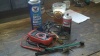
Oh, and don't waste your money on a Harbor Freight fuel pressure tester unless you want to get soaked in gasoline. The hoses leak and the gauges fill up with gas.
Oh, and don't waste your money on a Harbor Freight fuel pressure tester unless you want to get soaked in gasoline. The hoses leak and the gauges fill up with gas.