
does a 87 cherokee have a Ballast Resistor and if so, where is it located .



CF Veteran
The 1987 Model Year is hit-or-miss. No 1987s came from the factory with one - it was added mid-year 1988, and was offered as a "voluntary recall" for 1987-1988.5.
My 1987 didn't have one, either. My 1988 doesn't have one anymore (it's a late 88, but the damned thing got wet and failed. It's patched over with a bit of 14AWG wire instead, and I'll clean it up properly as part of the refit.)
As far as those two other dangly bits you see on the fender liner - the one with the vacuum lines is the EGR control solenoid, and the blue box is the relay for your electric fan (it's a standard DIN relay. Keep a couple in your spare fuses/bulbs box.)
My 1987 didn't have one, either. My 1988 doesn't have one anymore (it's a late 88, but the damned thing got wet and failed. It's patched over with a bit of 14AWG wire instead, and I'll clean it up properly as part of the refit.)
As far as those two other dangly bits you see on the fender liner - the one with the vacuum lines is the EGR control solenoid, and the blue box is the relay for your electric fan (it's a standard DIN relay. Keep a couple in your spare fuses/bulbs box.)
Quote:
My 1987 didn't have one, either. My 1988 doesn't have one anymore (it's a late 88, but the damned thing got wet and failed. It's patched over with a bit of 14AWG wire instead, and I'll clean it up properly as part of the refit.)
As far as those two other dangly bits you see on the fender liner - the one with the vacuum lines is the EGR control solenoid, and the blue box is the relay for your electric fan (it's a standard DIN relay. Keep a couple in your spare fuses/bulbs box.)
cool thanksOriginally Posted by 5-90
The 1987 Model Year is hit-or-miss. No 1987s came from the factory with one - it was added mid-year 1988, and was offered as a "voluntary recall" for 1987-1988.5.My 1987 didn't have one, either. My 1988 doesn't have one anymore (it's a late 88, but the damned thing got wet and failed. It's patched over with a bit of 14AWG wire instead, and I'll clean it up properly as part of the refit.)
As far as those two other dangly bits you see on the fender liner - the one with the vacuum lines is the EGR control solenoid, and the blue box is the relay for your electric fan (it's a standard DIN relay. Keep a couple in your spare fuses/bulbs box.)

Junior Member
Wow, what a great information. I was searching for ballast resistor, I was searching all around the car, under dashboard, on left and right inner fender... And now I know, that here is no ballast resistor on my 87' Pioneer. Thank you.

CF Veteran
Cruiser has said it was added only to quiet the pump some. It can be bypassed for diagnosis, (power out the rear goes straight to the pump), or left off. I've got to wonder if pump wear might be a tad less with the lower voltage to it. (with the resistor).
Yea, it would be forward of the EGR solonoid.
Yea, it would be forward of the EGR solonoid.
::CF Moderator::
cruiser54
::CF Moderator::
close
May 16, 2024
- Join DateAug 2011
- LocationPrescott, Az
- Posts:43,971
- Year1990
- ModelCherokee (XJ)
- Engine4.0
-
Likes:1,979
-
Liked:1,578 Times in 1,279 Posts
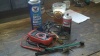
Here's a photo, and pump wear is not an issue. Millions of vehicles are running around with full battery voltage to their pumps.

CF Veteran
Thanks  . Nice to know for certain that when it's using more power, making more noise and working harder, it's not wearing any faster!
 Just it making noise means it's using more energy> http://en.wikipedia.org/wiki/First_law_of_thermodynamics
Granted the FPR keeps the pressure constant, but still there is more friction loss, > http://en.wikipedia.org/wiki/Friction_loss.
I did say "a tad". So maybe 20,000 miles more? WHO KNOWS? No doubt, the pump will last some amount longer.
I don't mean to come off "negative", but just because lots of others buy in, doesent make it right. Maydoff, Chainy...
. Nice to know for certain that when it's using more power, making more noise and working harder, it's not wearing any faster! Just it making noise means it's using more energy> http://en.wikipedia.org/wiki/First_law_of_thermodynamicsGranted the FPR keeps the pressure constant, but still there is more friction loss, > http://en.wikipedia.org/wiki/Friction_loss.
I did say "a tad". So maybe 20,000 miles more? WHO KNOWS? No doubt, the pump will last some amount longer.
I don't mean to come off "negative", but just because lots of others buy in, doesent make it right. Maydoff, Chainy...

Senior Member
well in reality when you increase voltage amperage usually drops so its actually not working as hard with no resistor
CF Veteran
Whatt's that? (volts X amps = watt's). Watts are the total power consumed. If you have more friction loss and are making more noise you are using more watts. Just a tad. I'm absolutely, positively 100% sure of that. The friction through the FPR and lines, (wasted as heat), probably represent more than the sound/vibration as far as the energy spent. Not sure there. I am sure a tad is spent/lost that would otherwise be heat in that ceramic resistor. So instead of heat in the resistor, it is spent by work from the pump.

Junior Member
Question: I have an 88 pioneer and it does have one, damn thing gets so hot you can't touch it but a second. Is that normal? would that have any bearing on my stalling issue?
CF Veteran
Yea, that's why it's ceramic. To get from 14 ish to 10 ish volts, that energy needs to go somewhere! (heat in this case , Edit, and I don't think that is related to it stalling, cps is more like it.
Can you access Cruiser's tips in my signature? You really should take a look, clean your C-101 connecter, check the sensor ground circuit. If your phone or "app" or whatever won't work. LET US KNOW, we can post it all up!
Anyone with an 87 to 90 Renix Jeep has two or three minutes to see that their
CPS is putting out at least .35 AC volts. I don't mean to come off rude, but if you can't connect a meter and turn the key, we may not be much help.
AC voltage CPS test; Small clips on the meter leads really helps. (you need contact with those little pins while it cranks)
Unplug the connector at the back of the manifold with wires going down to the bell-housing/cps. (it's a three wire plug, with only two wires)
Probe the two wires to the cps with the digital meter set on AC volts, a 200 scale on mine. Yours meter may have a lower 2Volt, or “auto range”.
Crank the engine and note the voltage. (jump it if your battery is low). .35 ( is minimum. .4 to .8 is more like it.
Can you access Cruiser's tips in my signature? You really should take a look, clean your C-101 connecter, check the sensor ground circuit. If your phone or "app" or whatever won't work. LET US KNOW, we can post it all up!
Anyone with an 87 to 90 Renix Jeep has two or three minutes to see that their
CPS is putting out at least .35 AC volts. I don't mean to come off rude, but if you can't connect a meter and turn the key, we may not be much help.
AC voltage CPS test; Small clips on the meter leads really helps. (you need contact with those little pins while it cranks)
Unplug the connector at the back of the manifold with wires going down to the bell-housing/cps. (it's a three wire plug, with only two wires)
Probe the two wires to the cps with the digital meter set on AC volts, a 200 scale on mine. Yours meter may have a lower 2Volt, or “auto range”.
Crank the engine and note the voltage. (jump it if your battery is low). .35 ( is minimum. .4 to .8 is more like it.
::CF Moderator::
cruiser54
::CF Moderator::
close
May 16, 2024
- Join DateAug 2011
- LocationPrescott, Az
- Posts:43,971
- Year1990
- ModelCherokee (XJ)
- Engine4.0
-
Likes:1,979
-
Liked:1,578 Times in 1,279 Posts
Quote:
Bypass it for fun. I've never touched one with the engine running to see how hot it gets.Originally Posted by skipp42
Question: I have an 88 pioneer and it does have one, damn thing gets so hot you can't touch it but a second. Is that normal? would that have any bearing on my stalling issue?
Flintstone:
Give your ballast resistor the "touch test" in the name of science, wouldya?