When you click on links to various merchants on this site and make a purchase, this can result in this site earning a commission. Affiliate programs and affiliations include, but are not limited to, the eBay Partner Network.
A lot of pics just documenting how things go together, then some measurements.
I removed the TPS before moving the TB, which is why it isn't in place. The other thing is the IAC.
Dirty. Will need cleaning.
Be careful when you're prying. The part the spring wraps around is some sort of polymer and I image may be fragile. I didn't test it.
Use your finger to pull the spring off.
This is the part you pry against.
These screws are brass, I believe. Use the properly sized screwdriver so as not to damage them
Remember the bore is 52mm diameter.
When the throttle/butterfly valve plate is closed, it sits at a 16deg (8 on each side of the center line) angle off of perpendicular to the axis of the bore. This means that the width is the diameter of the bore (previous photo), but will be wider on the other axis (becomes an oval)
Slot in shaft that the butterfly valve fits in.
It pulls right out.
There are bearings in there that the shaft rotates on. If you're doing anything to the housing, make sure you thoroughly clean them out and grease them before reassembly.
The slot is wider on one side than the other (this side is 52 mm while the other side is wider). Forces the plate centered in the bore.
Width of the slot, so when I cut my new butterfly valve plate, it needs to be .060" thick.
Either Pennzoil 10W30 High Mileage or the Valvoline version (conventional), can't remember. I only drive the heep about once a month and it's been awhile since I last changed it. What are you seeing?
EDIT: might be 10W40...
Also, I sent Cruiser this picture of my intake manifold, just as background to his question:
15/40 and it exceeds what we need for our engines. Cleans em up real quick and is heavy duty as all get out.
Can I run this full time, or just as a cleaning cycle. If just a cleaning cycle, how many miles before swapping back? Can I use a conventional oil filter or will I need something else for this oil?
Can I run this full time, or just as a cleaning cycle. If just a cleaning cycle, how many miles before swapping back? Can I use a conventional oil filter or will I need something else for this oil?
One of the first things I'll be doing when I get her running again!
Absolutely. The temp where I live can vary from 0*F to 105*f and I use it all year in everything I own.
Rotella T3 and Wix oil filters go together like peas and carrots.
I wasn't going to bore it out without the ability to make a new butterfly valve. No point in jumping the gun if I couldn't finish the job. The issue with the valve is that it sits at a 16deg angle to the axis of the throttle body bore. That means, to make a seal around the bore, the butterfly valve must be an oval, not a circle. This also means that the edges have a 16deg bevel at the long ends.
See the angles on the edges?
Short axis
Long axis
So, how does one cut an oval with a particular angle to the edge?
One way is to lay your stock flat, then cut out an oversized oval and walk it in by hand on a grinding wheel.
Or, you can use this as an opportunity to learn how to program a CNC mill and build a jig that holds your plate at 16deg while you cut a circle the diameter you will bore your throttle body out to. (in case it wasn't obvious, this is the option I chose)
Jig, with square stock mounted to it, ready to machine:
This gets mounted in the vise, then a 59.55mm diameter circle is cut, and I end up with a perfectly machined and sized butterfly valve for my 60mm throttle body.
Cut that ish, yo.
You can see my two marked axis. Left - right is my long axis.
Hard to tell, but the correct bevel is on it.
Now that I have that cut, time to bore the throttle body.
I also lengthened the slot in the valve crossbar to fit the new, wider plate.
I also enlarged the counter bore for the attaching screws, as the new ones I bought have a larger diameter head. I bought 6-32 x 5/16" brass screws. The old ones were peened in, and removing them destroyed some threads.
Must go deeper.
Bore it out so that the heads of the new screws sit flush.
The ultrasonic really cleaned the TB up nicely! Be sure to grease those bearings before reassembly.
Install the plate and center it by eye. Open and close the valve several times and the plate should 'self center'.
Mark the mounting hole locations, remove and drill slightly oversized holes, to allow some adjustment when re-installing.
Grease your bearings.
Cut off Q-tip works well.
Reassemble the TB.
The gap seems slightly bigger than the stock gap, but I'll install and see how it idles. If needed, I'll cut a bigger plate and install it. (The gap isn't as big as it seems in the picture - the light is reflecting off the bore and makes the gap look bigger than it actually is)
Lowes only had 6-32 x 3/8" brass screws and they protrude quite a bit. I may order some 3/16" screws to replace these.
Be sure to peen them so they don't back out.
So none of the parts stores within a reasonable driving distance had the throttle body to intake manifold gasket in stock. So I made my own.
So Felpro sells at least 3 different kinds of bulk gasket material - this one, a rubber-cellulose blend, and a rubber-cork sheet. I'm sure they make others, but this is what Advance had on hand.
Lay the material over the hole needing the gasket...
Using the shank of a screwdriver, rub along the outline of the profile, showing you where to cut.
Cut the gasket out and make adjustments so make it fit. It's important that the gasket isn't obstructing the 60mm opening, as you just went to the trouble of being able to use the entire diameter for airflow.
Poke your holes - don't have to be perfect, as long as you don't rip it and cause a path from the 60mm hole to the outside world.
Don't have many pictures here, as I had a friend here helping and we were focused on getting it done, rather than documenting it.
We're replacing both front calipers (my brakes have been dragging (not retracting when I let off the pedal)), all three soft brake lines (left, right, rear), and the booster/master cylinder from a '95 XJ
To get the old one off, I got some vise grips on the nut super tight, then hit that brass fitting with my propane torch to expand it. After a few seconds of heat, the nut broke loose.
(Cool how they stamped the manufacture date on the inner fender...)
I'm replacing the brake booster and master cylinder with a larger one from a '95 XJ (I think...I pulled it from the junk yard 2 years ago and don't remember...). I wanted to disconnect the hardlines from the proportioning valve, but couldn't really get at the back one. Got the front one loose, then decided to just take them off the master cylinder first.
Move your windshield washer fluid tank out of the way.
For some reason, one of the 4 nuts holding the booster to the firewall was a 15mm nut, while the other 3 were 14mm....it was weird and a royal pain to get the larger one out. It was in the hardest to reach spot - the upper, passenger side nut.
Any idea what these two connect to? They're on the same harness as the connector that is on the proportioning valve, but they were just sitting under the brake booster.
So, continuing on with the calipers, soft lines, master cylinder and booster.
To preface, there are 4 types of flares when it comes to hard lines: single and double 45deg, 37deg single flare, and finally, the bubble or metric flare.
Single 45deg flares are used on lower pressure lines: carburetor fuel lines, etc.
Double 45deg flares are higher pressure flares: brake and clutch fluid
Single 37deg flares are used on stainless steel lines for AN-type fitting
The bubble or metric flare is used on both imports and domestics, these days.
All the fittings on my '87 are double 45deg fittings. But.....the new MC I'm putting in is from a '95 XJ and it takes metric fittings with bubble flares. A royal pain to mix and match lines.
Some of these pics were taken after the fact - sorry.
So I buggered up the hard line nut on the driver's side trying to replace the soft lines.
Cut off the old flare as close to the flare as possible.
The final bend in the line is too close to the end of the line to use my tubing bender to straighten, so I drilled a 3/16" hole in some scrap wood and forced the line through that to straighten it out.
You need to straighten it so the new nut will slide far enough up to get the flaring tool on it.
New nut.
Try to get the bend back near the same place so the nut will mount to the soft line properly.
Double 45deg flare on the left, bubble flare for the new MC on the right.
With the old booster out of the way, you can break the rear fitting loose and remove the line. Hold the prop valve with a 20mm wrench.
Fittings for the prop valve. the Inverted Thread fittings are for the double 45deg flares.
The new MC takes metric fittings: M12-1.0 (purple fittings) and M10-1.5 (green fittings). The top tube is 30" long with bubble flares on both ends. Cut it in half and use it to make the new lines.
Bench bleed your MC.
INstall your newly bent lines. I added a bit of power steering hose around the rear hard line to prevent any rubbing on the new booster.
Tape it up to prevent leaking during install.
Fit it in and install the lines.
All hooked up! Just gotta swap the rear soft line and bleed the system.
Those two connectors from a couple posts ago connect to the washer fluid pumps.
The new booster is thicker, forcing the washer fluid reservoir forward. Drill new holes and reinstall the screws.
Plugged the bottom port of the distribution block for the rear brakes and used the line for the sensing valve all the way to the back/rerouted that line to fit the rubber brake line to the axle...(changing some fittings along the way to make it work lol)
The actual sensing valve I currently have it in my tool box...



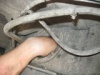
 Throttle body disassembly