When you click on links to various merchants on this site and make a purchase, this can result in this site earning a commission. Affiliate programs and affiliations include, but are not limited to, the eBay Partner Network.
Engine: 4.3L with headers and full 3" exhaust system
Originally Posted by TRCM
Really ??
If the vents are in the back, then the hot air goes up and out, instead of down and under and has no time to build up pressure.....which is better....
If that is the case, you need to tell all those muscle car engineers they put the ram air scoop in the wrong place and facing the wrong way. It may seem like your way is intuitive, but that is not the way it works
If that is the case, you need to tell all those muscle car engineers they put the ram air scoop in the wrong place and facing the wrong way. It may seem like your way is intuitive, but that is not the way it works
Ram air ??
You mean the ram air scoops facing forward that supposedly forced air into the carb ? or the ones that faced backwards and also supposedly forced air into the carb ?
OK...Ram air is to force air into the carb area and under the hood.....the high pressure area under the hood at the firewall has NOTHING to do with ram air other than it will hinder its' effectiveness.
Now, the forward facing scoops literally direct air into the carb using air flow over the grill & front of the hood.....the rearward facing scoops use the high pressure area at the base of the windshield to force air down into the carb and under the hood instead of over the windshield and roof.....still has NOTHING to do really with the high pressure area under the hood at the firewall, and yes, it will still hinder the effectiveness of the ram air.
Now, the high pressure area under the hood everyone keeps talking about is WHY you want the vents at the back so the high pressure forces the air (hot and otherwise) up and out....instead of under the vehicle where it can heat things up and cause lift and turbulence.
Having vents at the front will help some, but not as well.....cuz you will still have a high pressure area at the firewall to force all that heated air under the vehicle where it can heat things up and cause lift and turbulence.
Having them at the back lets that high pressure go up and out instead of under the vehicle where it can cause other problems.
If the front was the answer, then why were the fender vents at the back of the engine compartment and not the front ???
Think of it this way....if you have a box fan blowing in your garage....where do you feel the most air movement.....6" to the side of the box, or 2' in front of the box ?
Well, vents in the front of the hood are the same as 6" to the side of the box....the fan is trying to push air back to the firewall, not 90 deg up......
If you wanna argue the engine is in the way and forces the air up to the forward vents...fine....then nothing removes the heat at the firewall, which is even more reason for vents there.......
Vents in both places would probably be best.....that way high and low speed (pressure) is covered.
Vents in both places would probably be best.....that way high and low speed (pressure) is covered.
You are correct about vents being best in both places for different situations, however the inherent problem with XJ's is not cooling at high speeds, it is cooling at low speeds. High-mounted vents have their use-cases, but they are useless on jeeps that we use to climb mountains at 10mph or less. One type of vent solves a problem that plagues our particular model of vehicle, while the other does not unless you are taking your jeep racing, which if you are, that is AWESOME and I wanna see it.
But yeah, if you're overheating at highway speeds (which is where high-mounted vents do their best work) you have some MUCH bigger problems that those vents have nothing to do with anyway, and good luck with that.
Edit: I want to be a little more thorough with this response.
This has to do with fluid science. Air is fluid, much like water, and fluids always try their hardest to find the path of least resistance to leave a given area. If the only paths to take are difficult and filled with obstacles, you will have significant turbulence, and thus the airflow is disrupted and slowed. This is what high-mounted vents do at low speeds - the air will attempt to enter (or will be sucked through via radiator fans) the engine bay with very little energy, will come across the engine and everything surrounding it, and become disrupted. You will have airflow that leaves via the high-mounted vents, but at these speeds it has not gained the velocity (and therefore the pressure) to render the upper-rear area of the engine bay a high-pressure area as has been mentioned prior. There is no pressure because there is no velocity. Once you reach highway speeds, this area does become a high-pressure area and I'm sure it does assist quite a bit with drawing air through the hot engine bay, where it then leaves quite rapidly through high-mounted vents. The caveat to this whole thing, as mentioned prior, is that XJ's have historically never had issues cooling themselves even without these vents at highway speeds, because the thing that cools the engine the most is the radiator, and since it is at the very front of the vehicle, it receives a massive amount of forced airflow regardless of where the vents are positioned. At highway speeds it performs its job well due to the increased pressure of the air forced through it via your vehicle's high speed. This means that these high-mounted vents simply do not solve a problem pertaining to XJ Cherokees. Yes, they might still aid in cooling at highway speeds, and if you want to add them knowing that they don't solve the classic XJ low-speed cooling issue, more power to you. They do look really cool.
I know you understand why low-mounted vents work, you seem to understand the reasoning behind it - the reason I proclaimed them to be better than high-mounted vents is simply because they actually help solve the XJ's classic low-speed cooling problem, specifically when referring to the vents working in conjunction with the cooling fans as you hopefully saw in the pinwheel video I posted. The XJ's engine bay is pretty cramped, and given the knowledge of basic fluid dynamics that I have along with the visual evidence of significant airflow through the vents, it is pretty obvious that the airflow pulled through the radiator by the radiator fans prefers leaving through low-mounted vents to trying to leave via some other route, whether that's trying to navigate down below the jeep around the engine and oil pan and axle or meandering around the hot engine bay a while longer before finding some other way out. I'm not saying that these vents receive all the airflow given via the radiator fans, I am simply stating that it's clear that they receive quite a bit of airflow. If the air pulled through the radiator via the radiator fans has an easy path to leave the engine bay (fluid dynamics), it therefore reduces turbulence and allows the radiator fans to pull through a large amount of air without it all piling up and slowing down as it is forced to navigate through a labyrinth of convoluted and obstructed exit paths.
I'll state that your point about high-mounted vents having a place and a use-case is absolutely correct. It's just that they're not useful for our jeeps given how we use them, and given the speed at which their cooling shortcomings typically make themselves evident.
Having said that, I might cut some high-mounted vents someday because they look cool.
Second edit: I read through the comments about why the high pressure area is supposed to be there (I hadn't checked back on the topic for a day or so and just came back to read the last few responses) and after having thought about it for a second, it does make sense. That high pressure area is there to make a pressurized dam to keep the low-pressure traveling air flowing smoothly through the radiator, then past/around/underneath the engine and under the jeep. Gee, engineers sure are smart. I'm happy with leaving my potentially incorrect statements about high-mounted vents visible and not editing them out, I'm not afraid of looking like a fool.
Engine: 4.3L with headers and full 3" exhaust system
Originally Posted by TRCM
Ram air ??
You mean the ram air scoops facing forward that supposedly forced air into the carb ? or the ones that faced backwards and also supposedly forced air into the carb ?
OK...Ram air is to force air into the carb area and under the hood.....the high pressure area under the hood at the firewall has NOTHING to do with ram air other than it will hinder its' effectiveness.
Now, the forward facing scoops literally direct air into the carb using air flow over the grill & front of the hood.....the rearward facing scoops use the high pressure area at the base of the windshield to force air down into the carb and under the hood instead of over the windshield and roof.....still has NOTHING to do really with the high pressure area under the hood at the firewall, and yes, it will still hinder the effectiveness of the ram air.
Now, the high pressure area under the hood everyone keeps talking about is WHY you want the vents at the back so the high pressure forces the air (hot and otherwise) up and out....instead of under the vehicle where it can heat things up and cause lift and turbulence.
Having vents at the front will help some, but not as well.....cuz you will still have a high pressure area at the firewall to force all that heated air under the vehicle where it can heat things up and cause lift and turbulence.
Having them at the back lets that high pressure go up and out instead of under the vehicle where it can cause other problems.
If the front was the answer, then why were the fender vents at the back of the engine compartment and not the front ???
Think of it this way....if you have a box fan blowing in your garage....where do you feel the most air movement.....6" to the side of the box, or 2' in front of the box ?
Well, vents in the front of the hood are the same as 6" to the side of the box....the fan is trying to push air back to the firewall, not 90 deg up......
If you wanna argue the engine is in the way and forces the air up to the forward vents...fine....then nothing removes the heat at the firewall, which is even more reason for vents there.......
Vents in both places would probably be best.....that way high and low speed (pressure) is covered.
You will notice that the louvres in the back face forward because the air is moving in the opposite direction. If you place rear facing louvres there you will INCREASE under hood pressure. This is not the only example of someone that has done their homework. As I said, may not seem intuitive, but that is the way it is. The air pressure is high near the windshield and low in front near the header. Yes vents in both places work best, but must be properly oriented to work correctly
You will notice that the louvres in the back face forward because the air is moving in the opposite direction. If you place rear facing louvres there you will INCREASE under hood pressure. This is not the only example of someone that has done their homework. As I said, may not seem intuitive, but that is the way it is. The air pressure is high near the windshield and low in front near the header. Yes vents in both places work best, but must be properly oriented to work correctly
I have checked them out in the past...as I was considering getting them.
1) Those forward facing louvers will receive very little air due to them being so far back on the hood...laminar air flow across the hood is all but non-existent that far back due to the windshield. Air there is NOT moving in the opposite direction, it is turbulent and at a higher pressure due to the angle on the windshield. BY having them face forward, the high pressure air at the windshield base will actually be blocked from getting under the hood as a result of the louvers facing the wrong way.
2) If you look at the placement of the remaining rearward facing louvers, you will find (and they will admit) 40%-50% of them are covered by hood bracing, and do nothing for you. They are there for looks only.
3) As for 'properly oriented' to work correctly...the old chevy hood scoops and many others faced rear ward and they worked just fine.
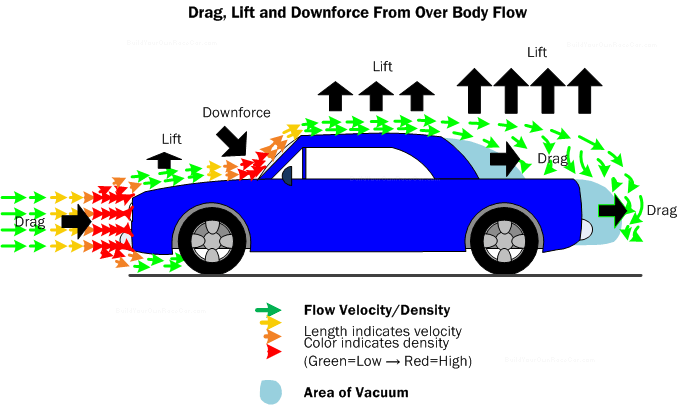
Note the direction & colors of the arrows below.......
went for an evening freeway drive. got home, immediately felt the hood, all except the front mlst foot of the driver side was cold to touch, yet entire front to back section of passenger side was hot. this tells me that maybe the belt drive fan is moving a lot of air, heating up the passenger side more?
went for an evening freeway drive. got home, immediately felt the hood, all except the front mlst foot of the driver side was cold to touch, yet entire front to back section of passenger side was hot. this tells me that maybe the belt drive fan is moving a lot of air, heating up the passenger side more?
At highway speeds the belt drive fan moves less air than the force of the air you're driving through imparts itself. My theory isn't that the belt driven fan is moving air - instead, since it's actually allowing air to move THROUGH it rather than if the blades were stopped and blocking airflow like the electric fan was.
The passenger side was cooler cuz there is less stuff on that side to block airflow as it goes down and out....plus the exhaust is on the drivers side.