When you click on links to various merchants on this site and make a purchase, this can result in this site earning a commission. Affiliate programs and affiliations include, but are not limited to, the eBay Partner Network.
Before I start, I will admit that this is in NO way a question of any sort - I simply figured this useful information would gain the most traction in this particular forum... At the moment 94 are browsing here, where in other places it's 7-14.
This is a writeup on my experiences with my CHEAP DIY hood vents, in a location that I have rarely, if ever, seen them on an XJ. I've always had reservations about the so-called "passive" vents that basically sit on top of the engine at the back of the hood, because cherokees need the additional airflow at low speeds and in those locations all the air is so disrupted by everything in the engine bay I can't help but think they don't do much. These work WITH the radiator fans and give them somewhere to easily shove air out after they've pulled it in and through the radiator, giving the radiator a considerable boost in efficiency since the fans can work more efficiently. I've read that cherokees sit at about 210 degrees normally, and mine did, but with these vents it has dropped to about 185-190 under normal operating conditions and I never overheat anymore.
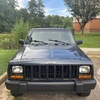
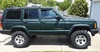
I'll start with a picture.
I cut the vents using a cutoff wheel attachment on an angle grinder. Wasn't very scientific, but I made sure the cuts were evenly spaced and everything was symmetrical on both sides. After they were cut I bent each separate "rib" to my liking with a pair of needlenose pliers, sanded them very well, taped off around them, and gave each one 10 good coats of flat black spray paint inside and out for protection from the elements. It certainly doesn't look destined for SEMA but I honestly couldn't care any less. It works and that's what I'm after.
This depicts the EXACT (yes, exact. I did a fair bit of image-overlaying trickery in photoshop) locations of the vents relative to the things directly underneath them. You can also see the locations of the radiator fans relative to the vents, along with what objects the air needs to work its way around.
Anyway, as the smart cookies among you have probably seen, the right (from driver's perspective) vent sits right over the battery! Well, I thought that might turn out to be a problem after a long enough time so I came up with a cheap solution I'm satisfied with, though it might require more work for some than it did for me since I came up with the idea specifically to work with the battery holddown j-hooks I was already using.
I went to Autozone and bought an appropriately-sized battery box (they sit on a shelf by the battery-related products), then threw away the bottom part and kept the lid. After some trimming with a dremel (as you can see quite easily in the rightmost image) and cutting a hole in it so the pre-existing battery holddown j-screw can be used to additionally hold down the battery lid, it works like a charm. I didn't have a "blueprint" for this so I just cut until there weren't any conflicts anymore. Sure, some water can still get in if it really wants to, but this solution is much better than just leaving an uncovered battery under an open vent - that's simply asking for corrosion and premature battery death.
Another nice part of these vent locations is that there are absolutely no conflicts with any of the hood's structural ribbing. No worries about needing to cut into things you shouldn't!
I don't have any more images to show because that's about all there is to tell. These are just some simple, cheap hood vents that I started and finished in about a day - that includes painting, of course. I probably spent 20 dollars on it since I already had the cutting implements on hand - only needed to buy paint and the battery box to modify. These have worked extremely well for me so far, and in fact, I think I might end up taking a video of just HOW well they work... If you hold your hand over either of the vents while the fans are going, it feels just like a blowdryer's blowing on you, the airflow is crazy!
Anyway, I hope this helps some of you if you're conflicted about where to put vents at. Okay, I'm done with my ranting - have a nice day, and happy jeeping to all!
MAJOR EDIT: I said I wanted to take a video as demonstration of their effectiveness, so I went out and did it! In fact, I was so committed that I went to the dollar store and bought a pinwheel. A whole one (1) of my hard earned dollars went toward this cause. The things I do for you guys, sheesh.
Engine: 4.3L with headers and full 3" exhaust system
I am glad to see someone agrees with me on vent placement. Good job on proper placement where natural vacuum aids in drawing air through the cooling system
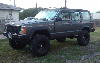
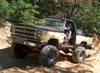
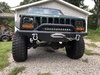
Thanks! I mentioned it in the beginning of the post but I have never understood putting vents in locations like this:
(not my jeep)
It just doesn't make much sense - that's the most obstructed area in the engine bay, behind literally all the stuff. Sure, you might lose some ambient heat in the engine bay from them, but ambient heat isn't what makes an engine run hot, it's the radiator not being able to breathe and do its job efficiently.
Edit: Now that I think about it, putting vents in that area might give some folks a subconscious "muscle car" vibe. That might be a little part of why they're so popular.
Edit 2: Also, vents on the outer front edges of the hood don't get anywhere near as much rain on electronic components - yet another benefit.
If I had to guess, I would say it seems logical for some people to put them there so that air can escape from the rear of the engine compartment. That would mean the air is coming through the grill (in the front) and taking all of the hot air with it that it comes in contact with until it hits the back of the bay and leaves through the back which is as far as it can go.. This covers the whole engine bay, more or less. Where as if the vents are in the front, some people think its not doing anything to remove hot air behind the vents very well and its only coming right into the bay and then leaving again...
This guess is based on the fact that the topic of vent placement isnt usually discussed when vents are being discussed. no one knows the correct placement so they just put the vents where it makes most sense.... somewhere that ALL of the hot air can be pushed out.
I didnt know that was the best place for vents until now. And that guess was based on how I feel it would have worked also, along with probably a lot of other people.
Does that make sense? haha...
its gonna be funny if the picture of that XJ belongs to a member on here and then they see they are getting flamed for having their vents in that location hahahahahah
Last edited by RockyMtn96XJ; May 6, 2021 at 08:43 AM.
Engine: 4.3L with headers and full 3" exhaust system
Originally Posted by RockyMtn96XJ
its gonna be funny if the picture of that XJ belongs to a member on here and then they see they are getting flamed for having their vents in that location hahahahahah
That has already happened to me many times. But every once in awhile, someone you all respect will agree with me
Hey, vents in that location look pretty nice, I'll admit that. Vents on the front corners do tend to look a little weird and out of place, but IMHO they work better, and perhaps some of you think so too after seeing the video I made. I like the way that white XJ looks tho.
If I had to guess, I would say it seems logical for some people to put them there so that air can escape from the rear of the engine compartment. That would mean the air is coming through the grill (in the front) and taking all of the hot air with it that it comes in contact with until it hits the back of the bay and leaves through the back which is as far as it can go.. This covers the whole engine bay, more or less. Where as if the vents are in the front, some people think its not doing anything to remove hot air behind the vents very well and its only coming right into the bay and then leaving again...
I can definitely see this working at high speeds. With enough forced airflow shoved up and around the engine, the high-pressure area near the top rear of the engine bay will inevitably get some airflow through regardless of what is in its' way. However, the purpose of vents in XJ's is to alleviate their cooling issues, which by and large happen at low speeds, where the qualities of the rear-center vents fall short of adequacy. So - high speeds, yes, low speeds, no. I've heard of some racing XJ's in the 24 Hours of Lemons, I wonder where their vents are if they have any...
Edit: I did a cursory google search and none of the "XJ" builds (always with engine swaps) that have been entered in the 24 Hours of Lemons have hood vents. None. Weird!
An XJs properly maintained cooling system will keep it at its design operating temp.
The only "Engine compartment" heat issue I have heard of was the 2000-2001 Cats roasting the fuel rail,, hence vents in that area to keep em slightly cooler.
Engine: 4.3L with headers and full 3" exhaust system
There can be another issue. A lifted XJ can develope turbulence underneath, and by extension an area of greater than normal pressure. That is where the gas milage goes on a lifted rig and can cause cooling issues. I had that happen, as well as some of my friends. You can stay cool with the hood off, but not on unless it is vented
Here is a picture of my attempts to keep my 4.6 happy. I've pretty much covered all the louver postions mentioned by previous posters. I took care not to cut through any of the underhood ribs and where they crossed under the louvers I swiss cheesed (cut a bunch of holes with a step bit) the ribs.
I have never had any issue with water or snow affecting the electrics. That said, I firmly believe properly made & sealed electric connections should be able to survive some water exposure; it is a Jeep that gets used like one.
Sorry it looks like crap now, a hood repaint is coming soon.
There can be another issue. A lifted XJ can develope turbulence underneath, and by extension an area of greater than normal pressure. That is where the gas milage goes on a lifted rig and can cause cooling issues. I had that happen, as well as some of my friends. You can stay cool with the hood off, but not on unless it is vented
I reckon that the more lifted, the less pressure that is developed under the truck, for a given displaced amount of air, determined by frontal area and speed, the larger area under a lifted jeep will give lower peak pressures, and thus enhance the ability to move air from out under the truck.
as for vent, if you allow too much heat out the hood, it can feed back into the cowl vent, thus preheating you cabin air intake. that happened to a friend you thought a vent would solve his 2001 model catalyst heat soak problem. he cooked in his cabin from that heat.
good job on thinking through where the best spot for vents would be.
the reason vents don't go to the back is there engine bay is designed to have a high pressure air pocket in back so the hot air from the radiator goes down and under the jeep. when people put vents in the back, they mess up the high pressure pocket and the way air is supposed to flow through stuff and cool properly. your vents keep the high pressure pocket of air in the back and still release more air.
those vents in the back are never a good idea. if a person is having to do that, something else needs work.
good job on thinking through where the best spot for vents would be.
the reason vents don't go to the back is there engine bay is designed to have a high pressure air pocket in back so the hot air from the radiator goes down and under the jeep. when people put vents in the back, they mess up the high pressure pocket and the way air is supposed to flow through stuff and cool properly. your vents keep the high pressure pocket of air in the back and still release more air.
those vents in the back are never a good idea. if a person is having to do that, something else needs work.
Really ??
If the vents are in the back, then the hot air goes up and out, instead of down and under and has no time to build up pressure.....which is better....
i am just telling you what an engineer told me. that high pressure pocket of air is supposed to be there at the firewall. that bit i know about air pressure and lift and such, it makes sense to me. the back vents never ever made sense to me. why heat everything up and disturb the way air is supposed to flow through the system.
I was having major problems with heat soak / vapor lock. It was so bad I debated parking my XJ during the summer months. It consistently ran at 205F. I bought the hood scoop and mounted it backwards hoping the windshield backflow wouldn’t for are towards the opening. It didn’t. The new airflow has kept the temp close to 195 and I have only had one case of vapor lock since the alteration. The entire area under the scoop is cut out.




 XJ Cherokee hood vent writeup