When you click on links to various merchants on this site and make a purchase, this can result in this site earning a commission. Affiliate programs and affiliations include, but are not limited to, the eBay Partner Network.
Apologies in advance if this is covered in another thread, but I couldn’t find a thread that mentions bushings with the metal sleeve on them, and how to get them in. The directions I received from DPG off-road for my 2.5 OME lift was to NOT grease them (just soapy water), and to use a rubber mallet.
all I’m doing it seems is shaving off metal while trying to hammer these home ontop of some saw horses. Very frustrated and I’m sweating through shirts..
This is my first lift that I’m trying to do myself. any pointers? I’ve got to be missing something obvious. Pictures of my failures below… The only progress I get is when it lodges itself in crooked like this…
I did use a light coating of grease on them when I installed the bushings into my OME springs. Just a very light film of bearing grease is fine.
Use a piece of wood on top of the bushing (like the flat side of a 2"x4"), and hit it with a really big BFH. I used my BFH Thor, and they went right in.
EDIT: Like Sirsy said, put the spring end on another block of wood or something solid first.
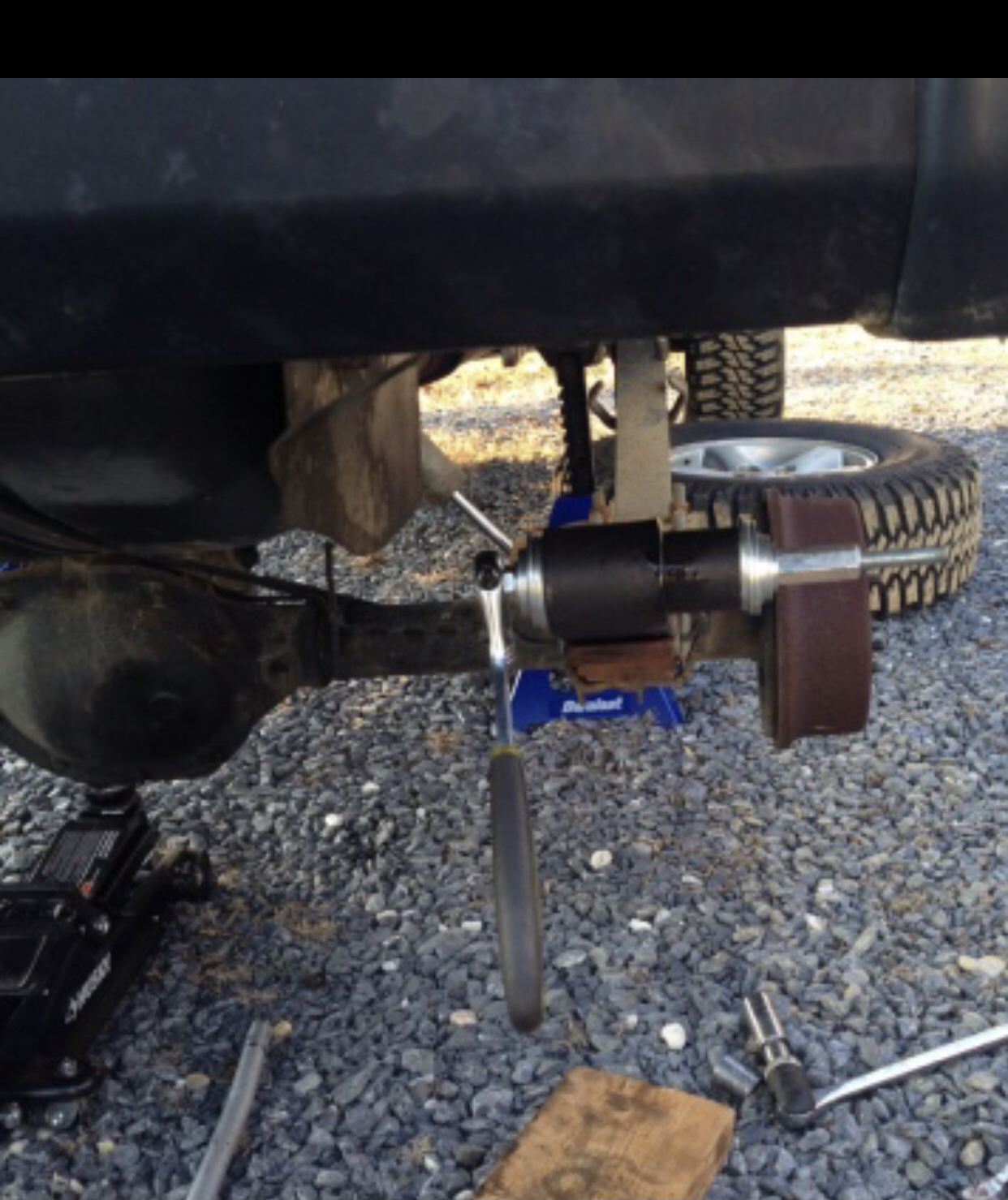
You can get some all thread and sturdy washers larger than the spring eye. Get some nuts for the all thread as well. You can then press them in with this hardware. Worked wonders for me years ago when facing the same problem.
Press it in rather than hammer it in. A dedicated press, a big vice, or large C clamp can work. a bit of antiseize is highly recommended on both surfaces, but keep it off the rubber. if pressless, and clampless, then take it to a shop and get her done. a shop with a press will make quick work of this job.
Thanks everyone - just making sure. I got one half in with a vice. That metal casing on the bushing is meant to be there and meant to be pressed in as is? - just making sure since these will NOT be coming out once they’re in 😄.
That metal casing on the bushing is meant to be there and meant to be pressed in as is? - just making sure since these will NOT be coming out once they’re in 😄.
thanks for bearing with me as a total novice.
Yes it's a press fit, steel sleeve and all. Being a novice isn't your issue. Tolerances from spring manufacturers are not as precise as engine & transmission part manufacturers. With some spring eyelets, the bushings will tap in easily with a hammer, others can be so out of spec that material needs to be removed from the inside of the eyelet. Old Man Emu eyelet ID's tend to run on the smaller side.
Freezing the bushings will do absolutely nothing. They are only supposed to be a .003"-.005" press fit. I'd bet that your spring eyelet ID's are around .008"-.010" smaller than than the bushings. Thermal expansion rate of steel is .00000645" per 1'F. That means you would have to drop the steel below -700'F to achieve enough steel shrinkage. Your household freezer runs at about -3'F. Ain't gonna happen.
What you need is to remove just enough material from the eyelet ID's to easily get the bushings started with a hammer. Then you have to press them in with a hydraulic press, or a ball joint press & high torque impact wrench, or use the threaded rod/washers/nuts method that Tsaani showed.
You can also just bring them to a shop that has a press and have them do it for $40.
Thanks!! Great info. Appreciate the comprehensive response. Feeling a lot better now. I’ll send that one the rest of the way home, and vice in the other 3 - full speed ahead.
Year: 1998 Classic (I'll get it running soon....) and 02 Grand
Model: Cherokee (XJ)
Engine: 4.0
Originally Posted by Randy Bobani
You can also just bring them to a shop that has a press and have them do it for $40.
This is what I did. $50 and well worth it. (Well, I didn't "bring" it to a shop, I took it to a shop. You bring something to yourself, if it's going some other place, you take it there. "Bring to, take away.")
I tried the all-thread and nuts trick on another vehicle where there was no other option, and it worked great. Don't be shy about lubing it. It's not going to make it slip out later. Slather the stuff on. It will make your job easier and act as a rust preventer. You can even use anti-seize.



 Installing leaf bushings with metal sleeve