


Hood vents


No, I don't lick fish.


Joined: Mar 2011
Posts: 11,169
Likes: 26
From: Northern Kentucky
Year: 1999
Model: Cherokee (XJ)
Engine: 4.0

I scavenged stainless louver plates from scrapped out food equipment machinery
Holes thru hood, no additional control for water or snow entry from the top. I figure my junk under there is in top shape. If it can handle the slop thrown up from the road and tires from the underside, it can handle a little water thru from the top.
Checked my underside supports with a tape measure, layed out some tape on the top side. Selected a pattern positons for the plates. Marked screw holes.
Put a heavy cardboard underneath. Be careful not to push drill too far thru. Use a stub drill or put a wad of tape around your drill about 1" drill exposed to keep from going too far thru.
Marked center of screw patterns and hole saw the vent hole. Used #6 stainless fasteners with stainless nyloc nuts.
Remove sharps and burrs from edges and holes, good dab of tremclad paint.
Bolt in place.
Thru 2 winters, no problems
Holes thru hood, no additional control for water or snow entry from the top. I figure my junk under there is in top shape. If it can handle the slop thrown up from the road and tires from the underside, it can handle a little water thru from the top.
Checked my underside supports with a tape measure, layed out some tape on the top side. Selected a pattern positons for the plates. Marked screw holes.
Put a heavy cardboard underneath. Be careful not to push drill too far thru. Use a stub drill or put a wad of tape around your drill about 1" drill exposed to keep from going too far thru.
Marked center of screw patterns and hole saw the vent hole. Used #6 stainless fasteners with stainless nyloc nuts.
Remove sharps and burrs from edges and holes, good dab of tremclad paint.
Bolt in place.
Thru 2 winters, no problems

Junior Member
Joined: May 2015
Posts: 34
Likes: 0
Model: Cherokee
I know what you mean, once you cut the hole there is no turning back. I put a overhead console in my XJ from a Ford F-150. To do so I had to plug weld the mounting plate I made from the roof top. I plan on hitting the salvage yard to see if I can cut a section of roof so that when I mount that vent I can weld it in. (My vent is made of steal). I don't want the vent sticking up to high so that if I want to mount a roof rack for any reason I can still vent it out under the load. Kicking around the idea of mounting a overland roof tent.
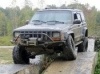
After looking at your XJ again you have the same front Bumper I have. I love the look and the approach angle it gives me.
After looking at your XJ again you have the same front Bumper I have. I love the look and the approach angle it gives me.
Senior Member
Joined: Nov 2014
Posts: 766
Likes: 5
From: Los Angeles, CA
Year: 1989 Limited
Model: Cherokee(XJ)
Engine: I-6 4.0L AMC Renix
Are there hood vents that can be closed to let the engine warm up and once it does I can close them? Just curious because I don't want the engine to never warm up

Banned
Joined: Feb 2014
Posts: 2,379
Likes: 18
From: Florida
Year: 2000
Model: Cherokee(XJ)
Engine: Golen 4.6L
An engine running cold is usually the result of someone putting the wrong thermostat in the motor.

Member
Joined: May 2016
Posts: 122
Likes: 7
From: Enid America
Year: 1989
Model: Comanche (MJ)
Engine: 5.7L LS1
For a factory look I went with 5.9L ZJ vents. These vents were also available on the euro market Orvis Edition XJ but were mounted on the hood with adhesive and non-functional. I found some junk yard 5.9L vents with drip trays and mounted them a little more forward than the Orvis Edition. This allowed me to avoid the underhood supports and install the drip trays correctly (trimmed slightly to fit). Why Jeep didn't actually do this on Euro XJ's is beyond me. I liked the results so much that I've put them on both of my recent builds. Pics:


Senior Member
Joined: Nov 2014
Posts: 766
Likes: 5
From: Los Angeles, CA
Year: 1989 Limited
Model: Cherokee(XJ)
Engine: I-6 4.0L AMC Renix
Originally Posted by extrashaky
Hood vents will not prevent the engine from warming up. The cylinders are generating several hundred degrees of heat inside the motor. It doesn't need heat welling up around the outside of the motor to get the motor to operating temperature.
An engine running cold is usually the result of someone putting the wrong thermostat in the motor.
An engine running cold is usually the result of someone putting the wrong thermostat in the motor.

Banned
Joined: Feb 2014
Posts: 2,379
Likes: 18
From: Florida
Year: 2000
Model: Cherokee(XJ)
Engine: Golen 4.6L
230° is alarming because it signals that you have a problem that can quickly run away.
Under the correct pressure and with the correct coolant/water mix, the coolant should resist boiling until it reaches 260° to 265°. Once it boils is when the coolant is no longer doing anything to cool the engine, and serious damage starts happening.
The problem with these numbers is that you can't run, say, 240° overall without risking that some parts of your motor are running much hotter and boiling away coolant in local pockets. When coolant boils, that red mud precipitates out of it, clogging up the system and eating the water pump so that cooling efficiency is even further reduced. Up to 220°, however, you're usually safe.
Seasoned Member

Joined: Apr 2012
Posts: 261
Likes: 15
From: Puyallup, WA
Year: 1999
Model: Cherokee (XJ)
Engine: 4.0L
210° is normal.
230° is alarming because it signals that you have a problem that can quickly run away.
Under the correct pressure and with the correct coolant/water mix, the coolant should resist boiling until it reaches 260° to 265°. Once it boils is when the coolant is no longer doing anything to cool the engine, and serious damage starts happening.
The problem with these numbers is that you can't run, say, 240° overall without risking that some parts of your motor are running much hotter and boiling away coolant in local pockets. When coolant boils, that red mud precipitates out of it, clogging up the system and eating the water pump so that cooling efficiency is even further reduced. Up to 220°, however, you're usually safe.
230° is alarming because it signals that you have a problem that can quickly run away.
Under the correct pressure and with the correct coolant/water mix, the coolant should resist boiling until it reaches 260° to 265°. Once it boils is when the coolant is no longer doing anything to cool the engine, and serious damage starts happening.
The problem with these numbers is that you can't run, say, 240° overall without risking that some parts of your motor are running much hotter and boiling away coolant in local pockets. When coolant boils, that red mud precipitates out of it, clogging up the system and eating the water pump so that cooling efficiency is even further reduced. Up to 220°, however, you're usually safe.
I have zero cooling problems now, but I always wondered what the hell was the point of a gauge that goes into warning mode even though it's barely above nominal temp?
Last edited by JK253; May 17, 2016 at 04:56 PM.
Banned
Joined: Feb 2014
Posts: 2,379
Likes: 18
From: Florida
Year: 2000
Model: Cherokee(XJ)
Engine: Golen 4.6L
Most of the coolant temperature "gauges" in cars on the market now don't actually give you anything close to an accurate representation of the temperature. My Subaru was designed for track use, yet the needle on the coolant "gauge" hits the center mark at 170° F, then stops and stays there at least until 210° (the highest I've had it). A 40° swing is "normal"? That swing may be even larger, because I don't know how hot you have to get it before it budges off that center position.
I only know it does that because I run Torque and monitor the actual temperature on a dedicated engine tablet. What's ridiculous is that the car actually has that data but doesn't display it because the "gauge" on the dash is really little more than an advanced idiot light. At least the XJ gauge shows you some of the subtle changes around the 210° mark instead of just sticking there regardless of whether the temp is really 180° or 230°.
By the way, the computers in the '97+ XJs will read out the actual temperature in °F on Torque through a Bluetooth OBDII adapter. I had a bad fan clutch and was watching the temp click up and click down as I was in stop and go traffic. Torque is the next best thing to an aftermarket gauge.

Seasoned Member
Joined: Jan 2016
Posts: 270
Likes: 6
From: Nebraska
Year: 1999
Model: Cherokee
Engine: 4.0
For a factory look I went with 5.9L ZJ vents. These vents were also available on the euro market Orvis Edition XJ but were mounted on the hood with adhesive and non-functional. I found some junk yard 5.9L vents with drip trays and mounted them a little more forward than the Orvis Edition. This allowed me to avoid the underhood supports and install the drip trays correctly (trimmed slightly to fit). Why Jeep didn't actually do this on Euro XJ's is beyond me. I liked the results so much that I've put them on both of my recent builds. Pics:
Can you elaborate more on these vents?
What year ZJs, trim, etc, to look for?
I'm very interested in these.