


gas mileage vs. tires question

MJ>XJ
Joined: Mar 2009
Posts: 17,836
Likes: 7
From: Griffin, G.A.
Year: 1990
Model: Comanche
Engine: 4.0 I6

Originally Posted by NPx
Wow, nice flames!

(And I thought we were having a civilized discussion in an attempt to help fellow jeepers!)
CF Veteran
Joined: Feb 2010
Posts: 2,095
Likes: 3
From: Cove, OR
Year: 1993
Model: Cherokee
Engine: 4.0
Sorry, I have to agree with Huntingman, when you post incorrect and misleading information you'll get called on it, as you should. We are attempting to help out the OP, but posting false information doesn't help.

Thread Starter
CF Veteran
Joined: Nov 2011
Posts: 7,387
Likes: 10
From: City of Trees, CA
Year: 93 2 door
Model: Cherokee
Engine: 4.0
ok so from what I've learned...
In the hopes for getting better mileage, I think I'll just run stock tires after the lift and just deal with looking ridiculous.
then after I change gear ratio I'll have to run the 33's the whole time.
In the hopes for getting better mileage, I think I'll just run stock tires after the lift and just deal with looking ridiculous.
then after I change gear ratio I'll have to run the 33's the whole time.

CF Veteran
Joined: Jun 2010
Posts: 1,378
Likes: 0
From: Hayward, CA
Year: 1996
Model: Cherokee
you will still lose some mileage once you lift it even with the stock tires, but not nearly as much. If you are running the 33s with stock gears and then upgrade your gears, you will get a fair chunk of the mileage back. Some careful drivers on here are still getting 17+ MPG with 33" tires, and seem to attribute it to an MPG gain after gearing

Member
Joined: Jan 2011
Posts: 183
Likes: 0
From: Texas
Year: 2000
Model: Cherokee
Engine: 4.0
I’ve done a lot of research, experimentation and logging on this subject. Here’s a brief overview of what I’ve learned and put into practice.
1.Aerodynamics: This is THE single most important area to highway (HWY) fuel economy as after around 55 MPH, over 50% of the fuel your vehicle is using is to overcome the air it is pushing through (This number only increases sharply as you increase in speed) As it pertains to this topic, there are two functional areas that need to be addressed separately.
1.Aerodynamics: This is THE single most important area to highway (HWY) fuel economy as after around 55 MPH, over 50% of the fuel your vehicle is using is to overcome the air it is pushing through (This number only increases sharply as you increase in speed) As it pertains to this topic, there are two functional areas that need to be addressed separately.
a.Frontal Area: Virtual plane cross-reference that your vehicle presents to the oncoming wind (basically looking at your vehicle from the front). Basically, more area, more resistance to travel through wind. Angles of approach and departure also play huge roles in this, however since we’re all talking about the same vehicle body style they are a mute point as it relates to this level of discussion.
Here’s some information to digest based on my own testing and readings as they pertain to aerodynamics testing:i. Adding anything that increases your Frontal Area (raising vehicle and exposing undercarriage or adding a rooftop spare tire) is going to decrease you mileage unless it’s negating a worse mileage inducing effect (air dams and the like).
ii. Wider tires do have some affect on the Frontal Area, but they are more detrimental in other areas if they are of certain criteria.
b.Air Turbulance: Smoother air flow will cause less resistance than turbulent flow… seems logical right? Without getting too into the subject, items like axles, springs, shocks and other steering and suspension components are basically forcing the wind to go around them as they travel through the air. This creates an absolute mess of eddies and vacuums under the vehicle that holds onto the air instead of letting it pass naturally. ii. Wider tires do have some affect on the Frontal Area, but they are more detrimental in other areas if they are of certain criteria.
i. That small three inch plastic air dam is more than for looks, it forces a majority of the oncoming air to travel under the front axle and while slightly increasing Frontal Area, it’s dramatically decreasing the Air Turbulence created by the front end undercarriage.
-Stock Bumper, 3:55 gears, AW4 Auto, 2 inch lift, 30 inch tires. HWY AVG - 24.6 mpg over 6 tanks of fuel (highest is 26.2 mpg for a single 110 mile round trip)
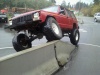
-ARB Bullbar, 3:55 gears, AW4 Auto, 2 inch lift, 30 inch tires. HWY AVG - 22.4 mpg over 2 tanks of fuel (lower lip is higher than the stock airdam, allowing more air to get trapped in the suspension. Later I fabricated and added a plastic airdam/faux skidplate to push the air down and regained 1.4 mpg for subsequent tanks). Here's a pic of what the end result looks like:
-ARB Bullbar, 3:55 gears, AW4 Auto, 6 inch lift, 30 inch tires. (no front plastic skidplate as I was still adjusting the suspension) HWY AVG – 16.8 mpg over 2 tanks of fuel (yes that’s a near 25% reduction in fuel economy)
-ARB Bullbar, 3:55 gears, AW4 Auto, 6 inch lift, 30 inch tires. (with front plastic skidplate adjusted for height) HWY AVG – 21.1 mpg over 6 tanks of fuel (the ambient air temperatures are affecting this number a bit, it could be as much as 22 in the summer months)
2.Rolling Resistance: The force the vehicle has to overcome to start and maintain movement.-ARB Bullbar, 3:55 gears, AW4 Auto, 2 inch lift, 30 inch tires. HWY AVG - 22.4 mpg over 2 tanks of fuel (lower lip is higher than the stock airdam, allowing more air to get trapped in the suspension. Later I fabricated and added a plastic airdam/faux skidplate to push the air down and regained 1.4 mpg for subsequent tanks). Here's a pic of what the end result looks like:
-ARB Bullbar, 3:55 gears, AW4 Auto, 6 inch lift, 30 inch tires. (no front plastic skidplate as I was still adjusting the suspension) HWY AVG – 16.8 mpg over 2 tanks of fuel (yes that’s a near 25% reduction in fuel economy)
-ARB Bullbar, 3:55 gears, AW4 Auto, 6 inch lift, 30 inch tires. (with front plastic skidplate adjusted for height) HWY AVG – 21.1 mpg over 6 tanks of fuel (the ambient air temperatures are affecting this number a bit, it could be as much as 22 in the summer months)
a.Typically this is summed up in the tires, hubs, axles and driveshafts.
b.Being a four-wheel drive vehicle increases rolling resistance simply because of the added components in the drivetrain.
c.Tire selection and maintaining proper air levels change these values drastically (as a rule of thumb: If your tires are louder than stock, they have more rolling resistance) (a 5-10 PSI drop in air pressure can increase rolling resistance by 6-10%).
3.Proper Gearing for the Engine “sweet spot”: Basically where in the rev range the engine produces the most power for the least fuel (best bang for your buck).b.Being a four-wheel drive vehicle increases rolling resistance simply because of the added components in the drivetrain.
c.Tire selection and maintaining proper air levels change these values drastically (as a rule of thumb: If your tires are louder than stock, they have more rolling resistance) (a 5-10 PSI drop in air pressure can increase rolling resistance by 6-10%).
a.Larger tires with stock gearing make gears “longer” forcing the engine to work harder for a longer period of time to get to cruising speed.
b.Larger tires can also put the engine at a disadvantage when at highway speeds in higher gears by making it “lug” or run richly to push the vehicle along. Engineers actually spend time “optimizing” the gearing of these vehicles to make them as all around efficient as possible.
c.Going from a 28.2 inch tire to a 35.6 (36’s) inch tire is a dead swap to 4.56 gears from 3.55, keeping the stock gearing intact (my planned next step)
It should be noted that you can change your speedometer readings easily by changing out the speedo gear on the tailshaft housing of the NP 231 transfercase (not sure about the NP 241).
b.Larger tires can also put the engine at a disadvantage when at highway speeds in higher gears by making it “lug” or run richly to push the vehicle along. Engineers actually spend time “optimizing” the gearing of these vehicles to make them as all around efficient as possible.
c.Going from a 28.2 inch tire to a 35.6 (36’s) inch tire is a dead swap to 4.56 gears from 3.55, keeping the stock gearing intact (my planned next step)
Last edited by JeepNmpg2; Nov 29, 2011 at 02:26 PM. Reason: layout didn't make sense and added picture
Junior Member
Joined: Nov 2011
Posts: 32
Likes: 0
From: washington
Year: 1991
Model: Cherokee
Engine: 4.0 ho
proboly none of you will believe me but im running 3.07 gears in my axles 4.0ho ax15 with 35s and im getting around 18 mpg i dont drive with a lead foot though

Member
Joined: Jul 2011
Posts: 226
Likes: 0
Model: Cherokee
Originally Posted by jskwibble1
I always kind of wondered about the odometer vs tire size. can I just go to a mechanic and have it fixed or where do I go for that?
Member
Joined: Jan 2011
Posts: 183
Likes: 0
From: Texas
Year: 2000
Model: Cherokee
Engine: 4.0
I added a picture to the post above to better illustrate what that plastic air dam I was refering to looks like. It's not as low as it looks as it hangs about 1/4 inch above the lowest part of the axle tube.

CF Veteran
Joined: Nov 2011
Posts: 1,122
Likes: 0
From: Manchester, N.H.
Year: 1995
Model: Cherokee
Engine: 4.0 HO
Most smartphones (android iphone etc) have apps that use GPS to calculate speed and distance. I used "Speedview" in my other vehicle at night due to dash light issues and it was VERY accurate. I mean, if you ran your phone in a cradle as your speedometer, and used it everywhere you went, you would get a good idea of miles traveled vs. fuel burned. Also its a HELL of a lot cheaper to use as a speedometer vs replacing the speedo gear or whatever.
Member
Joined: Jan 2011
Posts: 183
Likes: 0
From: Texas
Year: 2000
Model: Cherokee
Engine: 4.0
Most smartphones (android iphone etc) have apps that use GPS to calculate speed and distance. I used "Speedview" in my other vehicle at night due to dash light issues and it was VERY accurate. I mean, if you ran your phone in a cradle as your speedometer, and used it everywhere you went, you would get a good idea of miles traveled vs. fuel burned. Also its a HELL of a lot cheaper to use as a speedometer vs replacing the speedo gear or whatever.
http://www.quadratec.com/products/pr...eedometer+gear
Thread Starter
CF Veteran
Joined: Nov 2011
Posts: 7,387
Likes: 10
From: City of Trees, CA
Year: 93 2 door
Model: Cherokee
Engine: 4.0
Most smartphones (android iphone etc) have apps that use GPS to calculate speed and distance. I used "Speedview" in my other vehicle at night due to dash light issues and it was VERY accurate. I mean, if you ran your phone in a cradle as your speedometer, and used it everywhere you went, you would get a good idea of miles traveled vs. fuel burned. Also its a HELL of a lot cheaper to use as a speedometer vs replacing the speedo gear or whatever.