


XJ front suspension explained?

Thread Starter
Member
Joined: Jan 2011
Posts: 172
Likes: 0
From: Lansing, MI
Year: 92 abd 98 XJ
Model: Cherokee
Engine: 4.0
 XJ front suspension explained?
After a lot of reading and Googlin' I'm still fuzzy as to what each front suspension peice does and how changing certain things (lift) effect others as well as drivability/ off-road ability. Does anyone know where I can find an online diagram or images that explain it? Not necessarily for an XJ, but at least for a solid front axle setup similar to it. The obvious answer is probably a Chilton Manual, but I dont have access to one. Any help is appreciated.
CF Veteran
Joined: Feb 2010
Posts: 12,367
Likes: 23
From: Oroville, CA
Year: 1995
Model: Grand Cherokee
Engine: 4.0 with all of the noise and clatter
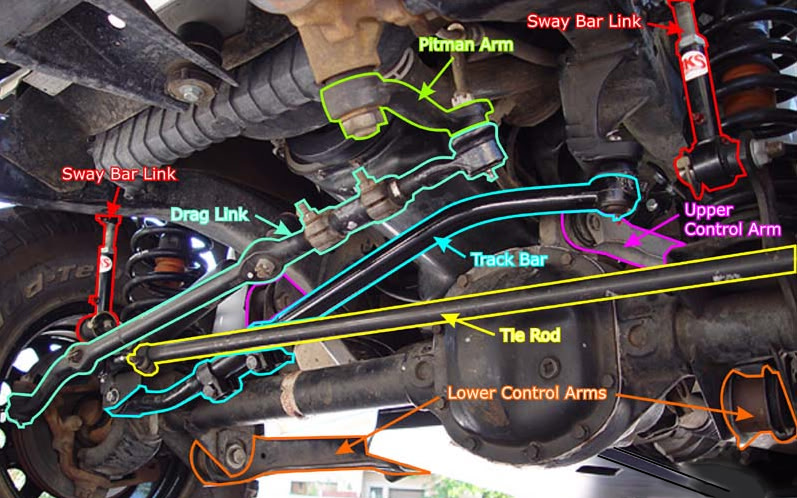
The picture above is from a Grand Cherokee, but it very close to the XJ.
The lower control arms hold the axle in place and also have the caster angle adjusters on them with shims or cam bolts. The upper control arms also hold the axle in place. The track bar centers the front axle and keeps the axle from moving from side to side. An adjustable track bar is recomended with a suspension lift over 3 inches. The tie rod is used to adjust the front wheel toe setting. The drag link connects the pitman arm to the RF steering knuckle, and the adjuster sleeve is for centering the steering wheel after the total toe is set with the tie rod. A lift will change the toe on this type of setup, so an alignment is needed afer a lift is installed. The sway bar links connect the sway bar to the front axle. The sway bar helps keep the vehicle flat while cornering, nothing more, but it is recomended to keep the sway bar for street use. Disconnection the sway bar for off road use will give you better flex. Hope this helps.
What is not pictured is the steering stabilizer. its function is to dampen vibrations. People will argue that it will cure a death wobble issue, but it won't, it only masks the real cause of death wobble. If the suspension is setup properly you do not need a steering stabilizer, and a worn out stabilizer will not cause a vibration. So why do you see so many lifted trucks running one or more stabilizers? Only for the bling factor.
The lower control arms hold the axle in place and also have the caster angle adjusters on them with shims or cam bolts. The upper control arms also hold the axle in place. The track bar centers the front axle and keeps the axle from moving from side to side. An adjustable track bar is recomended with a suspension lift over 3 inches. The tie rod is used to adjust the front wheel toe setting. The drag link connects the pitman arm to the RF steering knuckle, and the adjuster sleeve is for centering the steering wheel after the total toe is set with the tie rod. A lift will change the toe on this type of setup, so an alignment is needed afer a lift is installed. The sway bar links connect the sway bar to the front axle. The sway bar helps keep the vehicle flat while cornering, nothing more, but it is recomended to keep the sway bar for street use. Disconnection the sway bar for off road use will give you better flex. Hope this helps.
What is not pictured is the steering stabilizer. its function is to dampen vibrations. People will argue that it will cure a death wobble issue, but it won't, it only masks the real cause of death wobble. If the suspension is setup properly you do not need a steering stabilizer, and a worn out stabilizer will not cause a vibration. So why do you see so many lifted trucks running one or more stabilizers? Only for the bling factor.
Last edited by Bustedback; Jan 30, 2011 at 01:41 PM.

Thread
Thread Starter
Forum
Replies
Last Post
93civEJ1
Stock XJ Cherokee Tech. All XJ Non-modified/stock questions go here
6
Oct 2, 2019 04:08 AM
MidwestNick
Stock XJ Cherokee Tech. All XJ Non-modified/stock questions go here
10
Feb 28, 2016 02:05 AM
RickJames Bish
Modified XJ Cherokee Tech
5
Sep 2, 2015 03:22 PM
Currently Active Users Viewing This Thread: 1 (0 members and 1 guests)