


Really worth switching?


Thread Starter
Seasoned Member
Joined: Oct 2009
Posts: 449
Likes: 0
From: Gaithersburg, MD
Year: 1998
Model: Cherokee
Engine: Inline 6
 Really worth switching?
since ive bought the jeep 4 years ago ive been using Valvoline maxlife 10w30 with a quart of MMO. my MPG's arent so good so to say. (12mpg) recently ive been reading of allot of guys talking about using 0w30, 5w30, and 10w30 synthetics to gain a little more at the pump. my question is, if i switch over to syn say like MB1 will i see any realistic gain in my MPG's? and if i should keep using MMO with the new oil or just stick with the syn? advise please any bit of info to help me gain MPG's would be greatly appreciated.

CF Veteran
Joined: May 2008
Posts: 3,018
Likes: 23
Year: 1988
Model: Cherokee
Engine: AMC242
Hm.
I generally won't switch to synthetics until 20,000-50,000 miles on the engine - this gives it time to finish "lapping in" parts. Synthetics are 'slicker' than conventional oils, and can inhibit engine break-in when you use them too early (and the break-in process continues for a good 15,000 miles, easy!)
Switch too late, and you'll probably end up "discovering" leaks when the highly detergent synthetic washes away sludge that has built up behind seal lips and pressed them out - the leaks aren't caused by the synthetic in se - they were incipient leaks that merely got accelerated.
As far as oil viscosities, I don't suggest changing away from what the engine was designed to run on. This can screw with engine oiling (particularly pressure) and oil clearances in the bearings - either or both of which can have unexpected (and bad!) results. Taking an engine designed for 10W-30 or 10W-40 and going to 5W-30, 5W-20, or 0W-anything is going to accelerate bearing wear - because it won't be "heavy enough" to stay in the bearing clearances as designed.
Yeah, you can pick up some mileage at the pump by going to a "lighter" oil, but at what cost?
Now, if you can get a synthetic that runs the same viscosity bracket as the conventional oil you're using (10W-30 or 10W-40,) go ahead. If you're going to go to a lighter synthetic (5W-30, say,) I wouldn't do so until after a full overhaul and getting your machine work done to tighten up bearing clearances (say, if the mains clearance runs .001-.003", have the crank ground to give you clearances of .0010-.0015" to accommodate the lower-viscosity oil.)
If you can find synthetic in 10W-30 or 10W-40 (unlikely,) use that. If you can't, continue using the mineral-based 10W-30 or 10W-40 with the MMO (5:1, as you've been doing,) and go with that. The Marvel will function as a viscosity index improver (enables better cold flow, but doesn't do anything to hot flow,) and keeps varnish and sludge down. I've been using Marvel for a number of years in engines, transmissions, and fuel with nothing but good results.
I generally won't switch to synthetics until 20,000-50,000 miles on the engine - this gives it time to finish "lapping in" parts. Synthetics are 'slicker' than conventional oils, and can inhibit engine break-in when you use them too early (and the break-in process continues for a good 15,000 miles, easy!)
Switch too late, and you'll probably end up "discovering" leaks when the highly detergent synthetic washes away sludge that has built up behind seal lips and pressed them out - the leaks aren't caused by the synthetic in se - they were incipient leaks that merely got accelerated.
As far as oil viscosities, I don't suggest changing away from what the engine was designed to run on. This can screw with engine oiling (particularly pressure) and oil clearances in the bearings - either or both of which can have unexpected (and bad!) results. Taking an engine designed for 10W-30 or 10W-40 and going to 5W-30, 5W-20, or 0W-anything is going to accelerate bearing wear - because it won't be "heavy enough" to stay in the bearing clearances as designed.
Yeah, you can pick up some mileage at the pump by going to a "lighter" oil, but at what cost?
Now, if you can get a synthetic that runs the same viscosity bracket as the conventional oil you're using (10W-30 or 10W-40,) go ahead. If you're going to go to a lighter synthetic (5W-30, say,) I wouldn't do so until after a full overhaul and getting your machine work done to tighten up bearing clearances (say, if the mains clearance runs .001-.003", have the crank ground to give you clearances of .0010-.0015" to accommodate the lower-viscosity oil.)
If you can find synthetic in 10W-30 or 10W-40 (unlikely,) use that. If you can't, continue using the mineral-based 10W-30 or 10W-40 with the MMO (5:1, as you've been doing,) and go with that. The Marvel will function as a viscosity index improver (enables better cold flow, but doesn't do anything to hot flow,) and keeps varnish and sludge down. I've been using Marvel for a number of years in engines, transmissions, and fuel with nothing but good results.

CF Veteran
Joined: Jan 2010
Posts: 3,379
Likes: 0
From: Forest, VA
Year: 1999
Model: Cherokee
Engine: 4.0 I6
Hm.
I generally won't switch to synthetics until 20,000-50,000 miles on the engine - this gives it time to finish "lapping in" parts. Synthetics are 'slicker' than conventional oils, and can inhibit engine break-in when you use them too early (and the break-in process continues for a good 15,000 miles, easy!)
Switch too late, and you'll probably end up "discovering" leaks when the highly detergent synthetic washes away sludge that has built up behind seal lips and pressed them out - the leaks aren't caused by the synthetic in se - they were incipient leaks that merely got accelerated.
As far as oil viscosities, I don't suggest changing away from what the engine was designed to run on. This can screw with engine oiling (particularly pressure) and oil clearances in the bearings - either or both of which can have unexpected (and bad!) results. Taking an engine designed for 10W-30 or 10W-40 and going to 5W-30, 5W-20, or 0W-anything is going to accelerate bearing wear - because it won't be "heavy enough" to stay in the bearing clearances as designed.
Yeah, you can pick up some mileage at the pump by going to a "lighter" oil, but at what cost?
Now, if you can get a synthetic that runs the same viscosity bracket as the conventional oil you're using (10W-30 or 10W-40,) go ahead. If you're going to go to a lighter synthetic (5W-30, say,) I wouldn't do so until after a full overhaul and getting your machine work done to tighten up bearing clearances (say, if the mains clearance runs .001-.003", have the crank ground to give you clearances of .0010-.0015" to accommodate the lower-viscosity oil.)
If you can find synthetic in 10W-30 or 10W-40 (unlikely,) use that. If you can't, continue using the mineral-based 10W-30 or 10W-40 with the MMO (5:1, as you've been doing,) and go with that. The Marvel will function as a viscosity index improver (enables better cold flow, but doesn't do anything to hot flow,) and keeps varnish and sludge down. I've been using Marvel for a number of years in engines, transmissions, and fuel with nothing but good results.
I generally won't switch to synthetics until 20,000-50,000 miles on the engine - this gives it time to finish "lapping in" parts. Synthetics are 'slicker' than conventional oils, and can inhibit engine break-in when you use them too early (and the break-in process continues for a good 15,000 miles, easy!)
Switch too late, and you'll probably end up "discovering" leaks when the highly detergent synthetic washes away sludge that has built up behind seal lips and pressed them out - the leaks aren't caused by the synthetic in se - they were incipient leaks that merely got accelerated.
As far as oil viscosities, I don't suggest changing away from what the engine was designed to run on. This can screw with engine oiling (particularly pressure) and oil clearances in the bearings - either or both of which can have unexpected (and bad!) results. Taking an engine designed for 10W-30 or 10W-40 and going to 5W-30, 5W-20, or 0W-anything is going to accelerate bearing wear - because it won't be "heavy enough" to stay in the bearing clearances as designed.
Yeah, you can pick up some mileage at the pump by going to a "lighter" oil, but at what cost?
Now, if you can get a synthetic that runs the same viscosity bracket as the conventional oil you're using (10W-30 or 10W-40,) go ahead. If you're going to go to a lighter synthetic (5W-30, say,) I wouldn't do so until after a full overhaul and getting your machine work done to tighten up bearing clearances (say, if the mains clearance runs .001-.003", have the crank ground to give you clearances of .0010-.0015" to accommodate the lower-viscosity oil.)
If you can find synthetic in 10W-30 or 10W-40 (unlikely,) use that. If you can't, continue using the mineral-based 10W-30 or 10W-40 with the MMO (5:1, as you've been doing,) and go with that. The Marvel will function as a viscosity index improver (enables better cold flow, but doesn't do anything to hot flow,) and keeps varnish and sludge down. I've been using Marvel for a number of years in engines, transmissions, and fuel with nothing but good results.

Member
Joined: Dec 2009
Posts: 189
Likes: 0
From: Missoula, MT
Year: 1995
Model: Cherokee
Engine: 4.0L
5w30 is not lighter than 10w30... It is still a 30 weight oil, it just takes less time to lubricate your engine than a 10w30 oil would. It reduces engine wear because it takes less time to get to operating viscosity.
Member
Joined: Dec 2009
Posts: 189
Likes: 0
From: Missoula, MT
Year: 1995
Model: Cherokee
Engine: 4.0L
As far as oil viscosities, I don't suggest changing away from what the engine was designed to run on. This can screw with engine oiling (particularly pressure) and oil clearances in the bearings - either or both of which can have unexpected (and bad!) results. Taking an engine designed for 10W-30 or 10W-40 and going to 5W-30, 5W-20, or 0W-anything is going to accelerate bearing wear - because it won't be "heavy enough" to stay in the bearing clearances as designed.
Yeah, you can pick up some mileage at the pump by going to a "lighter" oil, but at what cost?
Now, if you can get a synthetic that runs the same viscosity bracket as the conventional oil you're using (10W-30 or 10W-40,) go ahead. If you're going to go to a lighter synthetic (5W-30, say,) I wouldn't do so until after a full overhaul and getting your machine work done to tighten up bearing clearances (say, if the mains clearance runs .001-.003", have the crank ground to give you clearances of .0010-.0015" to accommodate the lower-viscosity oil.)
If you can find synthetic in 10W-30 or 10W-40 (unlikely,) use that. If you can't, continue using the mineral-based 10W-30 or 10W-40 with the MMO (5:1, as you've been doing,) and go with that. The Marvel will function as a viscosity index improver (enables better cold flow, but doesn't do anything to hot flow,) and keeps varnish and sludge down. I've been using Marvel for a number of years in engines, transmissions, and fuel with nothing but good results.
A 10w30, 5w30, 0w30 are all 30 weight oils just like an SAE 30, the difference is the additive that allows it to still flow at colder temps. In -35F weather, a 10w30 is going to be super thick... it will take a lot longer to get to the viscosity of an SAE30 than a 0w30 will.
If you go to a SAE50 than you will be doing major damage **unless** you are driving around in like Africa or on the drag strip.
Everyone needs to read up on viscosity.
http://www.upmpg.com/tech_articles/motoroil_viscosity/
Here is the synthetic multi-weight oil that you should use.
http://www.royalpurple.com/motor-oil.html
You can also use their racing oils in the 5w30. It is formulated with much higher zinc and phosphorus levels that our flat tappet motors were designed to run on.

Senior Member
Joined: Jun 2010
Posts: 849
Likes: 0
From: Slaughter, LA
Year: 1997
Model: Cherokee
Engine: 4.0L
This is rediculous...
A 10w30, 5w30, 0w30 are all 30 weight oils just like an SAE 30, the difference is the additive that allows it to still flow at colder temps. In -35F weather, a 10w30 is going to be super thick... it will take a lot longer to get to the viscosity of an SAE30 than a 0w30 will.
If you go to a SAE50 than you will be doing major damage **unless** you are driving around in like Africa or on the drag strip.
Everyone needs to read up on viscosity.
http://www.upmpg.com/tech_articles/motoroil_viscosity/
Here is the synthetic multi-weight oil that you should use.
http://www.royalpurple.com/motor-oil.html
You can also use their racing oils in the 5w30. It is formulated with much higher zinc and phosphorus levels that our flat tappet motors were designed to run on.
A 10w30, 5w30, 0w30 are all 30 weight oils just like an SAE 30, the difference is the additive that allows it to still flow at colder temps. In -35F weather, a 10w30 is going to be super thick... it will take a lot longer to get to the viscosity of an SAE30 than a 0w30 will.
If you go to a SAE50 than you will be doing major damage **unless** you are driving around in like Africa or on the drag strip.
Everyone needs to read up on viscosity.
http://www.upmpg.com/tech_articles/motoroil_viscosity/
Here is the synthetic multi-weight oil that you should use.
http://www.royalpurple.com/motor-oil.html
You can also use their racing oils in the 5w30. It is formulated with much higher zinc and phosphorus levels that our flat tappet motors were designed to run on.
First, as an Amsoil dealer, don't use my data to try to sell purple junk.
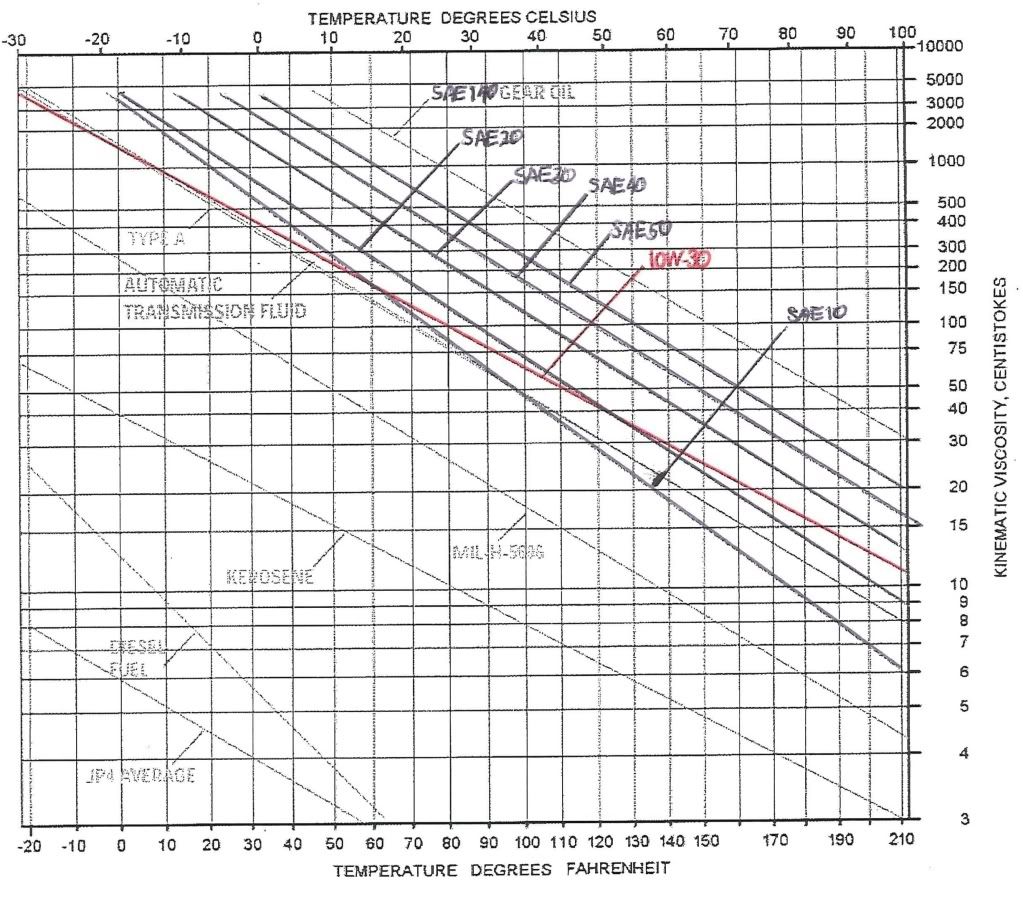
Second, here's a graph showing the actual viscosity performance versus temperature of various SAE oil weights including a 10W30. Note that the multi-viscosity oils have nothing incommon with their straight weight counterparts. The graphs are completely different. (The slopes are shallower allowing a more stable viscosity over the same temperature range.)
5W30 IS lighter than 10W30. (although not much) It can INCREASE wear (minimally) as at the same temperature it has a lower viscosity will therefore have smaller bearing clearances and will allow existing particulate to do more damage to bearing surfaces.
At -35F, a 10W30 is significantly less viscous than straight SAE10 and at "operating temperature" 100C, a 10W30 is more viscous than a straight SAE20 but less viscous than an SAE30.
Read the graph and make your own determination.
CF Veteran
Joined: May 2008
Posts: 3,018
Likes: 23
Year: 1988
Model: Cherokee
Engine: AMC242
This is rediculous...
A 10w30, 5w30, 0w30 are all 30 weight oils just like an SAE 30, the difference is the additive that allows it to still flow at colder temps. In -35F weather, a 10w30 is going to be super thick... it will take a lot longer to get to the viscosity of an SAE30 than a 0w30 will.
If you go to a SAE50 than you will be doing major damage **unless** you are driving around in like Africa or on the drag strip.
Everyone needs to read up on viscosity.
http://www.upmpg.com/tech_articles/motoroil_viscosity/
Here is the synthetic multi-weight oil that you should use.
http://www.royalpurple.com/motor-oil.html
You can also use their racing oils in the 5w30. It is formulated with much higher zinc and phosphorus levels that our flat tappet motors were designed to run on.
A 10w30, 5w30, 0w30 are all 30 weight oils just like an SAE 30, the difference is the additive that allows it to still flow at colder temps. In -35F weather, a 10w30 is going to be super thick... it will take a lot longer to get to the viscosity of an SAE30 than a 0w30 will.
If you go to a SAE50 than you will be doing major damage **unless** you are driving around in like Africa or on the drag strip.
Everyone needs to read up on viscosity.
http://www.upmpg.com/tech_articles/motoroil_viscosity/
Here is the synthetic multi-weight oil that you should use.
http://www.royalpurple.com/motor-oil.html
You can also use their racing oils in the 5w30. It is formulated with much higher zinc and phosphorus levels that our flat tappet motors were designed to run on.
At starting temperatures, the 5-vis damned sure is thinner than the 10-vis. And startups are where the most wear occurs anyhow, because the oil isn't circulating effectively and it's thinner because it's cold. The average starup isn't totally "dry," but it can be fairly close.
Why accelerate wear on the engine at startup, just when it needs all the protection it can get? Unless you've rebuilt it with the use of the lower-viscosity oil in mind (tightening up bearing clearances all through the engine,) you're not going to notice a tangible long-term benefit - the increased fuel economy is going to be offset by the need to overhaul the engine sooner.
I'm not an oil dealer, I'm not even a trained engineer - but I'm a hobbyist mechanic with professional experience (which ecompass about thirty years, taken together,) and I've spent a good deal of time digging around in the why of how things work. After all, you can't make things work better until you understand how and why they work in the first place!
Considering some of my professional (paid) experience comes from building powertrain components for pro-am racing, this knowledge has become important. You should see some of the titles on my bookshelf - just because I'm not a trained engineer doesn't mean I know nothing about the subject, I'm a Hell of a practical mechanical engineer...
Trending Topics

Seasoned Member
Joined: Jan 2011
Posts: 313
Likes: 0
From: Charlotte, NC
Year: 2001
Model: Cherokee
Engine: 4.0
switch to a 5w-20.. 5w will provide better protection @ startup compared to the 10w-30.. also.. 5w-20 will also provide better fuel economy because youre engine will not have to work as hard to move its parts @ operating temp when compared to 10w-30
I would also recommend a synthetic because you will see the viscosity will not thicken as much as the conventional when cooled so you should see better lubrication @ startup.
With a lower viscosity you will see increased flow and when things are "dry" (not really ever dry) you want the flow to be higher so the oil can get there sooner to lube those parts. You will not have to rebuild your engine sooner because you switched to a 5w-20 synthetic or any crazy blanket statement like that is exactly that, CRAZY. I am not a expert but it does not take one to figure that out.
So to answer you question directly, yes its worth it.
I would also recommend a synthetic because you will see the viscosity will not thicken as much as the conventional when cooled so you should see better lubrication @ startup.
With a lower viscosity you will see increased flow and when things are "dry" (not really ever dry) you want the flow to be higher so the oil can get there sooner to lube those parts. You will not have to rebuild your engine sooner because you switched to a 5w-20 synthetic or any crazy blanket statement like that is exactly that, CRAZY. I am not a expert but it does not take one to figure that out.
So to answer you question directly, yes its worth it.
Last edited by SamSissine2; Feb 24, 2011 at 07:53 PM.

Thread
Thread Starter
Forum
Replies
Last Post
ZJBeachRunnerGC
Stock Grand Cherokee Tech. All ZJ/WJ/WK Non-modified/stock questions go here!
18
Mar 10, 2021 05:52 PM
Stabsthedrama
Stock XJ Cherokee Tech. All XJ Non-modified/stock questions go here
15
Oct 3, 2015 05:46 PM
Jeremy Millner
Stock XJ Cherokee Tech. All XJ Non-modified/stock questions go here
10
Oct 2, 2015 02:21 PM
Currently Active Users Viewing This Thread: 1 (0 members and 1 guests)