


Hood Vent feeler


Thread Starter
Senior Member
Joined: Nov 2010
Posts: 976
Likes: 5
From: Cloquet, MN
Year: 2000 Ltd.
Model: Cherokee
Engine: 4.0L I6
 Hood Vent feeler
OK, While I really don't need vents for my XJ as the thing stays cool pretty well, I've been toying with an idea for vents. Here's my concept. Keep in mind this is a work in progress.

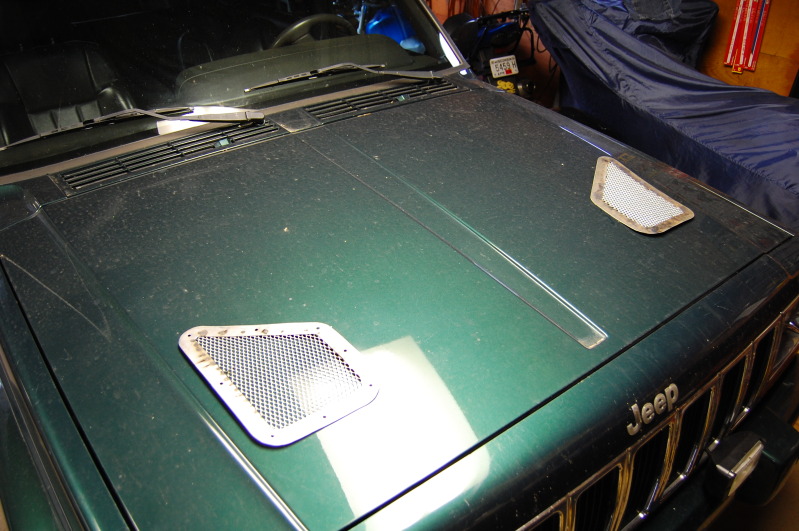
They're shaped to fit in the opening on the underside of the hood as shown.

And, being as open as they are I'm looking to put drip trays on them something like below, but leave a 1/2 gap or so so they aren't too restrictive.

What do you guys think? Any tips for improvement? Would there be any interest in purchasing something like this? I've been working with what primitive tools I have, but I was thinking if I could sell some of these I might be able to invest in a small break and such to form and cut the pieces more professionally. Once to be sold would be higher quality (made with proper tools) than my "prototypes" in the pictures.
They're shaped to fit in the opening on the underside of the hood as shown.
And, being as open as they are I'm looking to put drip trays on them something like below, but leave a 1/2 gap or so so they aren't too restrictive.
What do you guys think? Any tips for improvement? Would there be any interest in purchasing something like this? I've been working with what primitive tools I have, but I was thinking if I could sell some of these I might be able to invest in a small break and such to form and cut the pieces more professionally. Once to be sold would be higher quality (made with proper tools) than my "prototypes" in the pictures.


CF Veteran
Joined: Mar 2012
Posts: 1,369
Likes: 0
From: Richmond, VA
Model: Cherokee
This. I like the vents themselves, but they're pointless if you're going to just let water sit in a tray under them. It's going fill up and boil over and instead of rain hitting stuff it's going to be boiling water.


CF Veteran
Joined: Jan 2012
Posts: 1,057
Likes: 2
From: Nazareth/Pen Argyl, Pennsylvania
Year: 1989
Model: Cherokee
Engine: 4.0L 242ci I6
I've always been iffy on the whole hood vent thing because of water getting in. I'd rather do a nice set of scoops on the hood that don't make it look dumb. I've seen some pretty tasteful ones that I've been tempted to replicate.

CF Veteran
Joined: Nov 2011
Posts: 2,322
Likes: 1
From: Edmonton
Year: 1990
Model: Cherokee
Engine: 4.0
Trending Topics

CF Veteran
Joined: Mar 2011
Posts: 2,570
Likes: 4
From: California
Year: 1992
Model: Cherokee
Engine: 4.0 HO
I like it. Not sure about the placement though. I normally see vents towards the back of the engine, the back of head is generally the hottest part of the engine.
CF Veteran
Joined: Mar 2012
Posts: 1,369
Likes: 0
From: Richmond, VA
Model: Cherokee
CF Veteran
Joined: Jul 2010
Posts: 4,930
Likes: 3
From: 802
Year: 99
Model: Cherokee
Engine: 4.0
Originally Posted by sthon
I like it. Not sure about the placement though. I normally see vents towards the back of the engine, the back of head is generally the hottest part of the engine.
CF Veteran
Joined: Jul 2010
Posts: 4,930
Likes: 3
From: 802
Year: 99
Model: Cherokee
Engine: 4.0
Originally Posted by motorcharge
Yeah, I'll admit I missed it completely. Doesn't change the fact that it's blocking air flow which defeats the point of the vent.
Senior Member
Joined: Oct 2011
Posts: 706
Likes: 0
From: Racine, Ohio
Year: 1999
Model: Grand Cherokee
Engine: 4.7
I don't knock anything and am up for all ideas but I give you my thought. Air pushes thru the grill in the front. If vents go in the front you won't be getting a chance to let the hot air out like you would if they were in the back. As soon as I start my jeep I can feel it forcing air out my vents at the back. Second, vents in the back should have a drip pan because were they are located could interfere with certain things. Vents in the vent where you have them doesn't have much need for the pan. There's not much there that should hurt. I don't have any drip pans on mine and I took it to the car wash today. Like I say, not meaning anything negative by it because I like it when people have original ideas but I just wanted to try to help may looking a little closer at the design.

Thread Starter
Senior Member
Joined: Nov 2010
Posts: 976
Likes: 5
From: Cloquet, MN
Year: 2000 Ltd.
Model: Cherokee
Engine: 4.0L I6
Sorry for the late response, I've been out of town on a camping trip for the weekend.
The drip pans would be optional. My thoughts are to place them so that there's at least about a half inch or so gap between them and the vent to allow air flow. They way they are they have to be tilted inboard so that the water will drain between the battery and the A/C compressor on the passenger side, and between the air box and power steering pump on the driver side. This angle will open the gap up quite a bit on the inboard side since the hood is sloped outward. With the vents located where they are I want the drip pans to keep rain and snow from getting directly on the battery and air box and either sucking into the intake or freezing up on the battery.
The location is intentional. At any speed there is a high pressure zone at the base of the windshield that would want to push air into the hood instead of creating a vacuum to pull the hot air out. The front of the hood has a vacuum that will help draw air out of the hood. At low speed my thought with this is that the coolant system takes the head from the engine and dissipates it through the radiator. If the vents are in the front of the hood directly behind the radiator as I've placed them here the heat can easily escape. The idea is to make the cooling system run more efficiently. While vents in the rear are to let the trapped hot air out, I think it's less efficient. Think of it this way. The engine creates heat. It's a water cooled engine so probably 95% of the heat is dissipated through the radiator. The other 5% would be transferred to the air from the block directly. Now when the hood vents are in the back, the heat starts in the engine, transfers to the air, gets blown back past the engine heating it again, before being allowed to escape out the vents.
I run the rubber mat thing under the radiator to keep slashing of the alternator to a minimum and that also reduces the heat transfer efficiency because the hot air can't get blown down the bottom of the engine bay as easily. The placement of the vents in the front is to allow the air that passes through the radiator an easy and direct route out of the engine bay with out having to pass by the engine first.
The drip pans would be optional. My thoughts are to place them so that there's at least about a half inch or so gap between them and the vent to allow air flow. They way they are they have to be tilted inboard so that the water will drain between the battery and the A/C compressor on the passenger side, and between the air box and power steering pump on the driver side. This angle will open the gap up quite a bit on the inboard side since the hood is sloped outward. With the vents located where they are I want the drip pans to keep rain and snow from getting directly on the battery and air box and either sucking into the intake or freezing up on the battery.
The location is intentional. At any speed there is a high pressure zone at the base of the windshield that would want to push air into the hood instead of creating a vacuum to pull the hot air out. The front of the hood has a vacuum that will help draw air out of the hood. At low speed my thought with this is that the coolant system takes the head from the engine and dissipates it through the radiator. If the vents are in the front of the hood directly behind the radiator as I've placed them here the heat can easily escape. The idea is to make the cooling system run more efficiently. While vents in the rear are to let the trapped hot air out, I think it's less efficient. Think of it this way. The engine creates heat. It's a water cooled engine so probably 95% of the heat is dissipated through the radiator. The other 5% would be transferred to the air from the block directly. Now when the hood vents are in the back, the heat starts in the engine, transfers to the air, gets blown back past the engine heating it again, before being allowed to escape out the vents.
I run the rubber mat thing under the radiator to keep slashing of the alternator to a minimum and that also reduces the heat transfer efficiency because the hot air can't get blown down the bottom of the engine bay as easily. The placement of the vents in the front is to allow the air that passes through the radiator an easy and direct route out of the engine bay with out having to pass by the engine first.
Last edited by Northwoods Snowman; Sep 9, 2012 at 10:16 AM.
Thread Starter
Senior Member
Joined: Nov 2010
Posts: 976
Likes: 5
From: Cloquet, MN
Year: 2000 Ltd.
Model: Cherokee
Engine: 4.0L I6
I think they also can work better at low speeds also by allowing the radiator to do it's job more efficiently. I've spent about $40 on materials so far, but that's also including most of the SS hardware I need to mount them, and also including my dinking around making templates, screwing up parts etc. lol.