When you click on links to various merchants on this site and make a purchase, this can result in this site earning a commission. Affiliate programs and affiliations include, but are not limited to, the eBay Partner Network.
stuck on defrost vacuum issues. all in one place now
Stock XJ Cherokee Tech. All XJ Non-modified/stock questions go hereXJ (84-01)
All OEM related XJ specific tech. Examples, no start, general maintenance or anything that's stock.
Just popped the hose off the vacuum cannister under the front bumper to smoke test the line and it made an audible pop and whoosh sound like it had a vacuum before I disconnected it.
This suggest to a layperson like myself that this Jeep doesn’t have a vacuum leak at all.
Alright so that was more fun than last time. But still not useful. I pulled off the drivers side check valve, checked it by blowing through each side. Seems like it works.
Is it a clue that when I took it apart I heard another whoosh like when disconnecting the vacuum ball last time?
Then I blew smoke into the intake manifold where the check valve was. Once again it only came out the airbox edges and a little out the throttle body shaft.
Then I moved over to the passenger side and tested that check valve. Seems good.
Blew smoke in there and again only smoke from the air box and throttle body.
So what now? Maybe it’s the heater door or something. I seem to remember it possibly being another thing that keeps it on defrost when theres no vacuum leak.
I’ve changed the exhaust manifold and gasket and throttle body gasket.
I put in a new blower motor last winter in a frozen garage. Could I have messed up something in there to cause this?
You don't blow into the intake manifold, you blow into the line. Make sure you remove the check valve (or disconnect the line just above it).
Remember, air flows towards the intake (vacuum). So when blowing into the lines, the check valves should stop the flow. If unsure, remove both ends of the line and cap one end,
When doing the HVAC connection (where it runs through the firewall), set the vents to each position to test the internal harness and the vacuum servos. You'll need to observe inside for any smoke (have someone help or use a long hose)
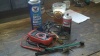
I also have a mytvac hand pump to test specific components. This is the reservoir I picked up at a salvage yard some time back. In this case I used my vacuum gauge to "plug" the line going to the HVAC. The other end of the bottle was capped. I then switched the vac gauge and cap to test the other chamber.
You don't blow into the intake manifold, you blow into the line. Make sure you remove the check valve (or disconnect the line just above it).
Remember, air flows towards the intake (vacuum). So when blowing into the lines, the check valves should stop the flow. If unsure, remove both ends of the line and cap one end,
When doing the HVAC connection (where it runs through the firewall), set the vents to each position to test the internal harness and the vacuum servos. You'll need to observe inside for any smoke (have someone help or use a long hose)
Here's my "tester"
I took off that check valve and tried blowing smoke into the hard line the runs the other direction, into the firewall. It seemed blocked. I was unable to blow in there at all.
When I run across this sort of conflicting or vague advice in other hobbies it usually turns out to be because of the difference in local environment or differences in models or something like that.
I’m going to guess that everyone has a slightly different vacuum system.
Man I really didn’t want to have to get so intimate with the vacuum system.
To replace the rear brake hardware I basically had to study and understand and memorize every part and how it works. That sucked because I’d rather replace them with disc brakes.
Please tell me I don't have to learn the freakin vacuum system to find the leak! I need to get back to work.
And I’ve seen the diagrams. How does that help when I’ve been over every inch with propane already and tried blowing smoke in every hole?
Last edited by lucknuts; May 12, 2024 at 03:28 PM.
It's very simple and nearly the same across all models.
Identify your vacuum source at the intake manifold. Got vacuum?
Go to the reservoir. Got vacuum?
Got vacuum going into the plastic line at the firewall? If you pinch off the vacuum at the intake, what happens to the vacuum at the firewall? Does it go away? If so, the reservoir isn't holding vacuum.
It's very simple and nearly the same across all models.
Identify your vacuum source at the intake manifold. Got vacuum?
Go to the reservoir. Got vacuum?
Got vacuum going into the plastic line at the firewall? If you pinch off the vacuum at the intake, what happens to the vacuum at the firewall? Does it go away? If so, the reservoir isn't holding vacuum.
Thank you for your reply! Okay so studying the vacuum diagram in the FSM for a few minutes, I’m going to guess that the vacuum source would be where the intake manifold connects to the back of the valve cover.
Is that correct? And I would check the vacuum at the intake manifold right?
And do I need a tool or should I try hooking up a tube and sucking on it?
I just remembered that I already blew smoke into that fitting on the manifold and smoke came out the air box and throttle body. So there can’t be a vacuum there.
So where is the vacuum source? Or how would I find it?
Last edited by lucknuts; May 12, 2024 at 09:18 PM.



 stuck on defrost vacuum issues. all in one place now