


push rod and lifter higher than others

Thread Starter
Junior Member
Joined: Jul 2010
Posts: 88
Likes: 0
Model: Cherokee
 push rod and lifter higher than others
I am putting a new head. I have all the head bolts torqued all ready and proceeded to the rocker arm bolts. i noticed one was tightening funny.
Upon inspection i see that the push rod for that rocker is maybe a inch or a little less higher than the rest of the push rods.
So i am guessing the lifter is stuck up or something. The push rod is seated properly. I didnt think much of it at the time but the push rod was slightly elevated when i took the original head off. Also had a slight tap when the engine was warmed up. Motor was totally rebuilt about 10k ago because of a 0331 head.
Is this a sign of a stuck lifter? Do i take the head back off and replace the lifter? I cant torque that rocker down properly without having that push rod lowered down.
Upon inspection i see that the push rod for that rocker is maybe a inch or a little less higher than the rest of the push rods.
So i am guessing the lifter is stuck up or something. The push rod is seated properly. I didnt think much of it at the time but the push rod was slightly elevated when i took the original head off. Also had a slight tap when the engine was warmed up. Motor was totally rebuilt about 10k ago because of a 0331 head.
Is this a sign of a stuck lifter? Do i take the head back off and replace the lifter? I cant torque that rocker down properly without having that push rod lowered down.

CF Veteran
Joined: Aug 2010
Posts: 8,357
Likes: 103
From: Canton, MI
Year: 1999
Model: Cherokee
Engine: 4.0
I am putting a new head. I have all the head bolts torqued all ready and proceeded to the rocker arm bolts. i noticed one was tightening funny.
Upon inspection i see that the push rod for that rocker is maybe a inch or a little less higher than the rest of the push rods.
So i am guessing the lifter is stuck up or something. The push rod is seated properly. I didnt think much of it at the time but the push rod was slightly elevated when i took the original head off. Also had a slight tap when the engine was warmed up. Motor was totally rebuilt about 10k ago because of a 0331 head.
Is this a sign of a stuck lifter? Do i take the head back off and replace the lifter? I cant torque that rocker down properly without having that push rod lowered down.
Upon inspection i see that the push rod for that rocker is maybe a inch or a little less higher than the rest of the push rods.
So i am guessing the lifter is stuck up or something. The push rod is seated properly. I didnt think much of it at the time but the push rod was slightly elevated when i took the original head off. Also had a slight tap when the engine was warmed up. Motor was totally rebuilt about 10k ago because of a 0331 head.
Is this a sign of a stuck lifter? Do i take the head back off and replace the lifter? I cant torque that rocker down properly without having that push rod lowered down.
If it were me, I would pull the head and remove all the lifters and inspect them. They're easy to disassemble. If you do remove them make sure you keep them in order that they were remove. I use a egg carton for this purose, marking each egg slot with the cylinder/int/exh, then place them in the respective slot when removed.
If you do remove the lifters, examine the cam lobe face of the lifters to see if they are pitted or concave. If they are, trash them and get a whole new set.
Thread Starter
Junior Member
Joined: Jul 2010
Posts: 88
Likes: 0
Model: Cherokee
i think that piston was near the top on its compression stroke. The nearest piston was about 2-3 inches from the top of the block.
If i were to turn the crank pulley to bring the piston down i guess that would tell me if it was just at the top of its compression stroke? If the piston lowers and so does the push rod then that was the problem?
If the push rod doesnt lower when i rotate the motor then i guess its a lifter problem?
If i were to turn the crank pulley to bring the piston down i guess that would tell me if it was just at the top of its compression stroke? If the piston lowers and so does the push rod then that was the problem?
If the push rod doesnt lower when i rotate the motor then i guess its a lifter problem?
CF Veteran
Joined: Aug 2010
Posts: 8,357
Likes: 103
From: Canton, MI
Year: 1999
Model: Cherokee
Engine: 4.0
i think that piston was near the top on its compression stroke. The nearest piston was about 2-3 inches from the top of the block.
If i were to turn the crank pulley to bring the piston down i guess that would tell me if it was just at the top of its compression stroke? If the piston lowers and so does the push rod then that was the problem?
If the push rod doesnt lower when i rotate the motor then i guess its a lifter problem?
If i were to turn the crank pulley to bring the piston down i guess that would tell me if it was just at the top of its compression stroke? If the piston lowers and so does the push rod then that was the problem?
If the push rod doesnt lower when i rotate the motor then i guess its a lifter problem?
If you suspect a defective pushrod now is the time to inspect them. Remove the rockers sets and the pushrods. Roll each pushrod on a flat surface, like a piece of glass, to see if they are bent. Place all the pushods next to each other and see if one is shorter or long than the others.
Finding TDC compression on each cylinder on a distributorless motor is a little more difficult than one with a distributor where you can see the position of the rotor.
A good place to start is to remove #1 spark plug. Have someone turn the crank damper clockwise while you are holding your finger over the spark plug hole. When you feel pressure build up the exhaust and intake valves are closed and the piston is on its way up on its compression stroke. Stop at this point and take a look at the crank damper to see where the index mark on the damper is relative to the timing marks on the timing chain cover (see pic). It should be getting close to the 0 (zero) mark on the TC cover. Have the person moving the damper bump the wrench used to turn the damper with their fist until the timing marks align dead nuts (see pic ). If they go past the mark, back the damper up about 20-30 degrees and approach the timing marks again. You are now at TDC compression #1.
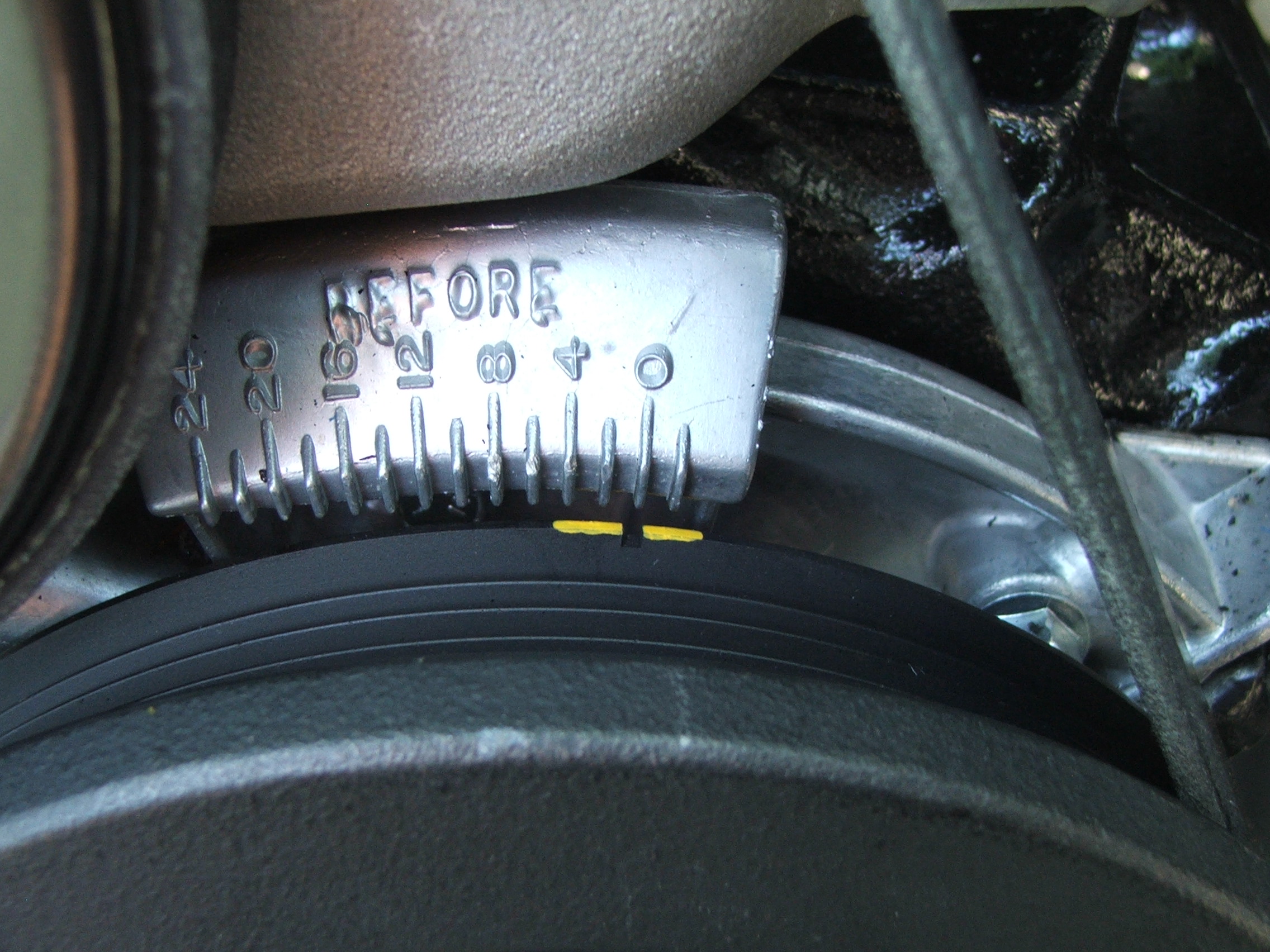
Now you are ready to proceed to the other cylinders in firing order: 1-5-3-6-2-4.
While you have #1 at TDC, check the rocher arms movement. Both rockers should be free (not being depressed), now check #6 rockers, you'll see that the #6 exhaust rocker is depressed. If you were to turn the crank damper 360 degrees to align the timing marks again, #6 would be at TDC compression and #1 exhaust rocker will be depressed.
It's easy to find #1 and #6 TDC compression this way but finding the others cylinders is a PITA. Know that 120 degrees turn on the crank damper will bring you up to the next cylinder in firing order, so when you have #1 at TDC compression if you turn the damper 120 degrees clockwise you'll be at #5 TDC compression. There's no reference marks on the damper to determine this so the only thing you can do is to anticipate that when you turn the damper 120 degrees you should be at or near #5 TDC compression. Try moving the rockers on #5 to see if both rocker are free to move (not being depressed). The same thing applies when finding TDC #3. #6 will be the next in line but that's a simply because the damper/TC timing marks will align. Repeat the process for #2 and #4.
When the cylinder is at TDC compression you can torque down the rocker capscrews (20 ft/lbs), turning each cap screw a little at a time to prevent twisting the rocker bridges.
If you still see a push rod appear to be too long doing this then it would be time to nuke the head off and yank the lifters.
Thread Starter
Junior Member
Joined: Jul 2010
Posts: 88
Likes: 0
Model: Cherokee
Trending Topics
CF Veteran
Joined: Aug 2010
Posts: 8,357
Likes: 103
From: Canton, MI
Year: 1999
Model: Cherokee
Engine: 4.0
CF Veteran
Joined: Aug 2010
Posts: 8,357
Likes: 103
From: Canton, MI
Year: 1999
Model: Cherokee
Engine: 4.0
If the lifter pushrod seat is stuck at the top (it would be like a solid lifter) and the lifter is sitting on top of the cam lobe there may be .4625" extension.

CF Veteran
Joined: Mar 2010
Posts: 47,923
Likes: 38
From: Broward County Fl.
Year: 1989 xj sport 2dr
Model: Cherokee
Engine: 12 hole bosch Injectors
Pull rockers off remove push tubes, instal rockers do they now sit flat ?
Compare push tube lengths ?
Is lifter not seated on cam ?
Is lifter upside down ?
Compare push tube lengths ?
Is lifter not seated on cam ?
Is lifter upside down ?

Senior Member
Joined: Apr 2012
Posts: 578
Likes: 4
From: Ocean, New Jersey
Year: 2000
Model: Cherokee
Engine: 4.0
You should be able to install all the push rods and torque the rockers regardless of the piston position. It's just that some of the bridge bolts may take a couple more turns to get tight. Something else is going on with your push rod sitting in the lifter or the corresponding rocker arm. Try another rocker/push rod set from another cylinder to test if it makes a difference.

Member
Joined: May 2009
Posts: 247
Likes: 2
From: Northern Illinois
Year: 1997
Model: Cherokee
Engine: 4.0L
Have someone assist you.
If you suspect a defective pushrod now is the time to inspect them. Remove the rockers sets and the pushrods. Roll each pushrod on a flat surface, like a piece of glass, to see if they are bent. Place all the pushods next to each other and see if one is shorter or long than the others.
Finding TDC compression on each cylinder on a distributorless motor is a little more difficult than one with a distributor where you can see the position of the rotor.
A good place to start is to remove #1 spark plug. Have someone turn the crank damper clockwise while you are holding your finger over the spark plug hole. When you feel pressure build up the exhaust and intake valves are closed and the piston is on its way up on its compression stroke. Stop at this point and take a look at the crank damper to see where the index mark on the damper is relative to the timing marks on the timing chain cover (see pic). It should be getting close to the 0 (zero) mark on the TC cover. Have the person moving the damper bump the wrench used to turn the damper with their fist until the timing marks align dead nuts (see pic ). If they go past the mark, back the damper up about 20-30 degrees and approach the timing marks again. You are now at TDC compression #1.
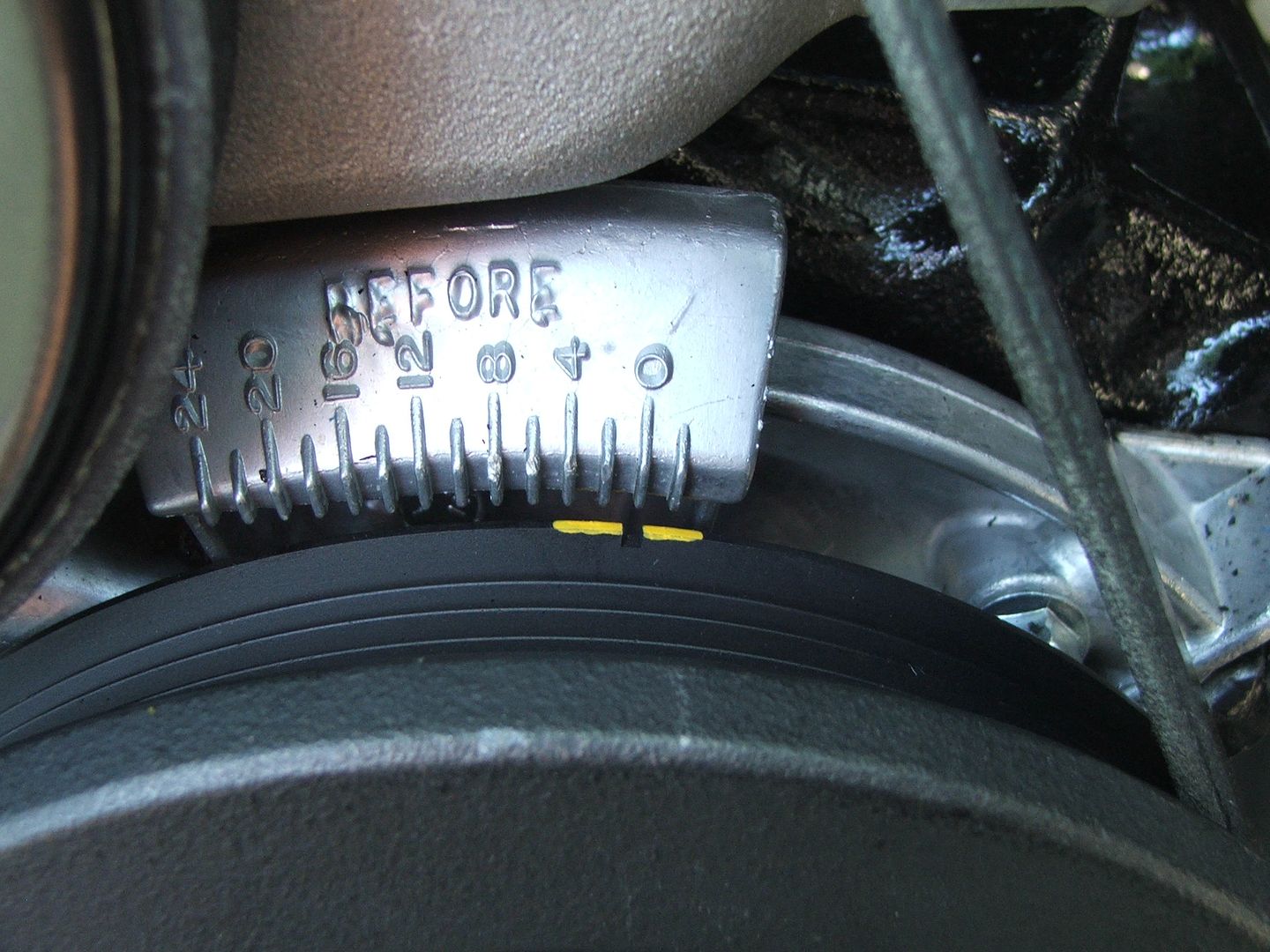
Now you are ready to proceed to the other cylinders in firing order: 1-5-3-6-2-4.
While you have #1 at TDC, check the rocher arms movement. Both rockers should be free (not being depressed), now check #6 rockers, you'll see that the #6 exhaust rocker is depressed. If you were to turn the crank damper 360 degrees to align the timing marks again, #6 would be at TDC compression and #1 exhaust rocker will be depressed.
It's easy to find #1 and #6 TDC compression this way but finding the others cylinders is a PITA. Know that 120 degrees turn on the crank damper will bring you up to the next cylinder in firing order, so when you have #1 at TDC compression if you turn the damper 120 degrees clockwise you'll be at #5 TDC compression. There's no reference marks on the damper to determine this so the only thing you can do is to anticipate that when you turn the damper 120 degrees you should be at or near #5 TDC compression. Try moving the rockers on #5 to see if both rocker are free to move (not being depressed). The same thing applies when finding TDC #3. #6 will be the next in line but that's a simply because the damper/TC timing marks will align. Repeat the process for #2 and #4.
When the cylinder is at TDC compression you can torque down the rocker capscrews (20 ft/lbs), turning each cap screw a little at a time to prevent twisting the rocker bridges.
If you still see a push rod appear to be too long doing this then it would be time to nuke the head off and yank the lifters.
If you suspect a defective pushrod now is the time to inspect them. Remove the rockers sets and the pushrods. Roll each pushrod on a flat surface, like a piece of glass, to see if they are bent. Place all the pushods next to each other and see if one is shorter or long than the others.
Finding TDC compression on each cylinder on a distributorless motor is a little more difficult than one with a distributor where you can see the position of the rotor.
A good place to start is to remove #1 spark plug. Have someone turn the crank damper clockwise while you are holding your finger over the spark plug hole. When you feel pressure build up the exhaust and intake valves are closed and the piston is on its way up on its compression stroke. Stop at this point and take a look at the crank damper to see where the index mark on the damper is relative to the timing marks on the timing chain cover (see pic). It should be getting close to the 0 (zero) mark on the TC cover. Have the person moving the damper bump the wrench used to turn the damper with their fist until the timing marks align dead nuts (see pic ). If they go past the mark, back the damper up about 20-30 degrees and approach the timing marks again. You are now at TDC compression #1.
Now you are ready to proceed to the other cylinders in firing order: 1-5-3-6-2-4.
While you have #1 at TDC, check the rocher arms movement. Both rockers should be free (not being depressed), now check #6 rockers, you'll see that the #6 exhaust rocker is depressed. If you were to turn the crank damper 360 degrees to align the timing marks again, #6 would be at TDC compression and #1 exhaust rocker will be depressed.
It's easy to find #1 and #6 TDC compression this way but finding the others cylinders is a PITA. Know that 120 degrees turn on the crank damper will bring you up to the next cylinder in firing order, so when you have #1 at TDC compression if you turn the damper 120 degrees clockwise you'll be at #5 TDC compression. There's no reference marks on the damper to determine this so the only thing you can do is to anticipate that when you turn the damper 120 degrees you should be at or near #5 TDC compression. Try moving the rockers on #5 to see if both rocker are free to move (not being depressed). The same thing applies when finding TDC #3. #6 will be the next in line but that's a simply because the damper/TC timing marks will align. Repeat the process for #2 and #4.
When the cylinder is at TDC compression you can torque down the rocker capscrews (20 ft/lbs), turning each cap screw a little at a time to prevent twisting the rocker bridges.
If you still see a push rod appear to be too long doing this then it would be time to nuke the head off and yank the lifters.
If turning the damper 120 degrees will bring up #5 to TDC, what about the next cylinders in the firing order?

Senior Member
Joined: Jan 2012
Posts: 952
Likes: 4
Year: 2004
Model: Grand Cherokee
Engine: 2000 4.0
Just to avoid confusion to OP, Pushrod max lift is .254" (1/4") valve lift is .405 b/c 1.6 rocker fulcrum ratio. He said PUSHROD was an inch higher....no way!!
Last edited by bigbadon; Mar 9, 2014 at 09:16 AM.
CF Veteran
Joined: Aug 2010
Posts: 8,357
Likes: 103
From: Canton, MI
Year: 1999
Model: Cherokee
Engine: 4.0
The OP said "maybe a inch or a little less higher than the rest", and by looking at his pics, the gap between the fulcrum and the pedestal it isn't an inch but it is a pretty healthy gap.
At minimum, the OP should make sure that lifter is sitting on the heel of the cam before going any further.
Thread Starter
Junior Member
Joined: Jul 2010
Posts: 88
Likes: 0
Model: Cherokee
I guess all i needed to do was rotate the crankshaft. That allowed that high push rod to go down and elevated others. I guess that's day one stuff.
The Haynes manual doesn't mention anything about putting each cylinder at TDC then torquing those rocker arm bolts. It just says to torque them all down zip zap. It also said to put RTV on the head gasket. After searching the forum common consensus was to leave head gasket dry. I might as well leave that manual on the shelf.
The Haynes manual doesn't mention anything about putting each cylinder at TDC then torquing those rocker arm bolts. It just says to torque them all down zip zap. It also said to put RTV on the head gasket. After searching the forum common consensus was to leave head gasket dry. I might as well leave that manual on the shelf.