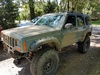
Starting a thread so I can better document my struggles dealing with hot floors over the exhaust. I've been fighting this battle for awhile, and have made progress, but the issue persists. I'm writing this hoping to show how sensitive the system of mitigating exhaust heat is, and hopefully to show a measurable improvement.
The story started when I had a milkcrate melt into my rear carpet over the cat, and melted a tupperware over the muffler. Also, after getting a significant other who was not into Jeeps/cars/wheeling, and trying to keep her happy.
My exhaust setup is not stock, and at this point I forget what stock was like, but I'm putting this in OEM tech as I would like to get everything back to OEM conditions, or better. I recently measured 225°F on my floor under the rear seat after climbing the long hill that I live on. Something needs to improve.
My current setup consists of:
-Banks header (recently installed, not cracked)
-Custom 2.5" downpipe / front pipe
-Magnaflow 2.5" cat (installed ~7-8 years ago). Has the built-in heat shield around it.
-Walker Quiet Flow 2.25" muffler (recently installed)
-Custom 2.5" tailpipe. Clamped on at the muffler. Needs investigation to ensure its not leaking at the joint.
-ZJ heat shield over the front pipe
-AirBake cookie sheet heat shield over cat. Probably closer to the floor than it should be.
-AirBake cookie sheet heat shield over muffler. Got pushed up into the floor last year. Did my best to pry it back down. Needs more attention.
-1" polyiso foam board insulation with OEM carpet (no jute backing) on floor from firewall to rear seats
-1" K-Flex insulation over the trans tunnel and partially up the firewall.
-No rear carpet. No rear seats. Floor over muffler is bare and exposed.
-Stock sized tires, 5.13 gears (for this testing)
-Cowl intake, 62mm throttle body, 4-hole injectors
My current efforts have been very successful to keep the trans tunnel and floors comfortable in the two front seats. With the insulation on the floor and the front pipe heat shield, the floors and tunnel are no longer hot to the touch. This was a huge improvement in itself. The same goes for over the cat. The floor directly behind the front passenger seat is not hot to the touch through the carpet and insulation. However, I would be curious to know how hot the floor is under all that insulation. The foam board is only good to ~200-250°F, and I'm pushing those numbers just about a foot farther back. I had some of the K-Flex insulation on the floor over the muffler, but found it was melting/charring. I also tend to get a burning plastic/rubber smell when going up long hills which I have determined to be from some butyl sound deadener that is over the muffler.
Last year I crushed my muffler and pushed it up into the floor pretty good, which also pushed the heat shield up into the floor. The exhaust manifold was cracked, and upon removal I found it to be cracked in numerous locations. I rebuilt the whole exhaust from the block back and replaced the motor mounts, trans mounts, and exhaust hangers.
When I did this, I was a bit ambitious with how tight I wanted the muffler to tuck to the floor. There was probably 1/4"-1/2" between the floor and my heat shield, and probably touching in some spots, and only an inch or so between the heat shield and the muffler. This caused the floor to get way too hot. I re-did the hangers to move everything down another inch for closer to 2 inches between my muffler and heat shield, and tried to pry the heat shield away from the floor the best I could.
These are the conditions that resulted in me measuring 225°F on the floor.
So, what to do?
First question I asked myself is if there is something going on that would cause the exhaust to get hotter than normal. Short answer is: I don't think so. I have no CEL codes, and looking at fuel trim data on my scanner looks normal, but frankly I don't really know what I'm looking at with that data. I just recently started playing around with it. Fuel trims are +/-10%. Seems to be running okay best I can tell. I measured 300°F at the front of the cat and 400°F at the rear, which also seems normal.
One thing I noted was the heat shield doesn't cover the entire muffler. There is about 3" of muffler which hangs past the heat shield, plus the muffler outlet and joint to the tailpipe. This is also exactly below where I measured the hot floor.
Could it really be that simple?
I'm going to investigate a larger heat shield to cover that gap, and probably mount it more formally. I'm going to try to find an actual fiberglass packed heat shield rather than AirBake sheets. It would be great if that's all it took.
Can anyone with an OEM system add a picture or tell me how far below the floor the muffler is hung? Also a temperature reading of the floor under the rear seat after having the rig under load? Those would be great goals for me to work towards.
So, some data. I'm seeing my long term fuel trim is centered around -7%. It occasionally dips as low as -14-15%, but is pretty well centered on that -7%. Short term is centered on 0%.
Again, this is the first time I've ever looked at data like this, so I have no idea what I'm talking about. But what I can deduce from that is either the O2 sensor is truly identifying a rich mix/incomplete burn that the PCM is correcting in closed-loop mode, OR the O2 sensor is falsely identifying a rich mix that is causing the PCM to command a lean mix in closed-loop mode.
PCM operates closed-loop in cruise conditions, but goes open-loop during acceleration when throttle position or manifold pressure tells the PCM the engine needs to output more power. So if the O2 sensor is giving correct data, the mixture would ideal in cruise mode but be rich in acceleration mode which would cause the cat to burn more fuel and heat up the muffler. If the O2 sensor is giving false data, the mixture would be lean in cruise mode but ideal in acceleration mode. I don't know exactly how to determine which situation is true, but based on how it drives I am inclined to say the issue is in acceleration mode and not cruise mode.
Does that interpretation make sense, or am I missing something? Is -7% LTFT actually a problem? Does this have anything to do with my hot floor issue?
Sounds like your on track towards identifying the issue. If you could find one of those clip in your tail pipe fuel/air ratio gauge kits, you would know for certain if your lean, rich, or spot on while accelerating, cruising, and idling. It would be interesting.
Sounds like your on track towards identifying the issue. If you could find one of those clip in your tail pipe fuel/air ratio gauge kits, you would know for certain if your lean, rich, or spot on while accelerating, cruising, and idling. It would be interesting.
Is your Jeep federal or California emissions?
Getting live AFR readings would be great. I’ll install a wideband gauge if it comes down to it, but not convinced I need to at this point.
It’s a 1999 federal emissions.
Other info from data logging:
All of my sensors were responding how I wol expect them to. TPS swept evenly from 0-100%-0. MAP showed 14.2 psi with engine off and seems to respond how I would expect it to.
My upstream O2 sensor data is quite noisy. The signal bounces from 0.2-0.8 volts quickly, but it is consistent and centered around 0.45 V. The voltage does clip at 0.9 V under heavy acceleration (open-loop PCM).
You're missing all your factory shielding...I've got 2 1/2 inch pipes from the muffler back and all I've got is the factory shielding { note how long it is} ...And I'm not melting anything, not even a hot floor....And remember the factory cat was encased with shielding to help with the heat... I'm curious as to what muffler you're using and if it's keeping too much back pressure in the system.. I see the muffler is hit in the front I'm hoping there's no " V " divertor in the front of the muffler or it might be a restriction...Go to the boneyard and snag the factory parts from a 2000-2001 they still might be intact...
You're missing all your factory shielding...I've got 2 1/2 inch pipes from the muffler back and all I've got is the factory shielding { note how long it is} ...And I'm not melting anything, not even a hot floor....And remember the factory cat was encased with shielding to help with the heat... I'm curious as to what muffler you're using and if it's keeping too much back pressure in the system.. I see the muffler is hit in the front I'm hoping there's no " V " divertor in the front of the muffler or it might be a restriction...Go to the boneyard and snag the factory parts from a 2000-2001 they still might be intact...
Thank you for the picture. That is helpful. I don’t recall ever having a heat shield, but that doesn’t mean there wasn’t one there to begin with. I’m seeing it as part number 55235811AB. I’ll try to get one.
The muffler is a Walker Quiet Flow, and the damaged one in the picture has been replaced with a new one.
On the topic of that picture: I’m noticing that muffler is not discolored, but the hit on the front shows I had already been wheeling with it. My new muffler (same model) was fairly discolored after one drive. A clue?
Did more data logging on the way home. The long term fuel trim actually looks worse than what I said in my last post. Looked to be hovering around -12%. Note the peaks where the LTFT goes to zero is where the PCM goes into open-loop mode.
-7% LTFT means that the fuel system is running inherently rich. This almost certainly due to the 4-hole injectors you mentioned. These are likely flowing ~7% higher than factory injectors. With that said, I don't think this is the cause of the toasty floor because the fuel control system is able to compensate and reach target AFRs.
In the summer, my XJ also gets a pretty warm floor from the firewall to the back of the vehicle. 100% stock motor and exhaust. The 4L motor and AW4 transmission simply throw off a ton of waste heat, and that in combination with your muffler and cat being much closer to the floor is likely the problem.
If you don't want to move the muffler and cat further away from the underbody, then I think its necessary to beef up the heat shielding and insulation.
Heat shields primarily reflect radiant IR. They need to be shiny. But it also will help if they are low thermal conductivity. If you want to get creative, build a bigger heat shield, and maybe make it a layered structure. One suggestion is a 2-layer system where the exhaust-facing layer is shiny metal, and the second layer could be a sheet of metal wrapped in exhaust wrap. Also choice of metal matters greatly. Cookie sheets are made of aluminum which has excellent thermal conductivity. Considering making your heat shield out of 304 stainless steel (preferably polished) which has almost 20x lower thermal conductivity than aluminum. In this scenario, a second layer covered with exhaust wrap wouldn't likely be needed.
Consider shaping the heat shield so that it deflects the hot engine/trans air away from the body.
Lastly, consider plastering portions of the underbody with insulation/heatshield. This is better than doing it from the inside of the vehicle. For the temperatures you mention, I'm not sure what insulation I'd recommend. Some butyl or rubber foam insulation with foil covering can handle perhaps 250F, but for higher temperatures than that, silicone foam or a fiber base is needed.
DEI sells a variety of products, some of which are more expensive than seem justified for putting on a XJ.
Interesting point bringing up the injectors. I installed those a long time ago based on forum recommendations, before I knew better to look into it myself. Now doing some googling, I agree the 784 injectors are likely causing me problems. I'm finding the stock injector flow rate to be 22.5 lb/hr @ 49 psi (or 23.2, conflicting info about 1999 model year. Unsure which PN injectors were OEM). The 784 injectors are rated 22.7 lb/hr @ 43.5 psi. Converting that to match the Jeep's 49 psi fuel rail pressure, the 784 injectors in my Jeep are flowing 24.1 lb/hr @ 49 psi, or 7% more than the computer expects them to. Hm, that math checks out compared to my fuel trims. Guess an injector swap is on my list.
Now, I also don't think this is the cause of my hot floors issue. I'm sure its not helping as the cat is working to burn off the extra fuel in open-loop, but I've had this setup for 10's of thousands of miles. I also have had hot floors for 10's of thousands of miles, but I'm still not convinced its the ONLY cause.
Its worth noting the AirBake sheets I used to make heat shields are a two-layer setup with an air barrier in between. The point of them is to insulate. Ideal choice for this? Probably not. But its a pretty common poor-man's heat shield setup.
Interesting point bringing up the injectors. I installed those a long time ago based on forum recommendations, before I knew better to look into it myself. Now doing some googling, I agree the 784 injectors are likely causing me problems. I'm finding the stock injector flow rate to be 22.5 lb/hr @ 49 psi (or 23.2, conflicting info about 1999 model year. Unsure which PN injectors were OEM). The 784 injectors are rated 22.7 lb/hr @ 43.5 psi. Converting that to match the Jeep's 49 psi fuel rail pressure, the 784 injectors in my Jeep are flowing 24.1 lb/hr @ 49 psi, or 7% more than the computer expects them to. Hm, that math checks out compared to my fuel trims. Guess an injector swap is on my list.
This is interesting! I have the K Suspension 12 hole injectors (they came on the Jeep when purchased) and never thought about if or how different they might be. I actually just assumed they were a "factory style" replacement - as in zero performance upgrade, just new spray pattern. Now I've got research to do! Wooo!
I am assuming the PCM would adjust for any mild increase in flow rate based on the O2 sensor data? Do you think the 7% more fuel you have is outside of the adjustment ability of the computer?
If only you had a wide band AFR sensor kit so we could have the live data...
This is interesting! I have the K Suspension 12 hole injectors (they came on the Jeep when purchased) and never thought about if or how different they might be. I actually just assumed they were a "factory style" replacement - as in zero performance upgrade, just new spray pattern. Now I've got research to do! Wooo!
I am assuming the PCM would adjust for any mild increase in flow rate based on the O2 sensor data? Do you think the 7% more fuel you have is outside of the adjustment ability of the computer?
If only you had a wide band AFR sensor kit so we could have the live data...
The PCM can accommodate a wide range of adjustment based on the O2 sensor data. +/-10% is fairly common and usually no reason for concern. The issue comes with how the computer is programmed to act under different driving conditions.
In "cruise" mode, which is low throttle input and low engine load, the PCM operates in a "closed-loop" feedback system. It takes information from the O2 sensors and adjusts injector pulse-width to achieve 14.7:1 AFR.
In "acceleration" mode, which is higher throttle input or higher engine load (based on MAP sensor data), the PCM operates in an "open-loop" feedback system. It does not take information from the O2 sensors and controls the injectors based on pre-programmed values. This results in an uncontrolled AFR and has potential to have rich or lean mixtures.
This is all new information to me, and is seriously making me question pretty much every mod I've done to my rig, and also all the information I've read on forums about people modifying their vehicles. Also note, typically engines are tuned to run richer under load than the "ideal" stochiometric 14.7:1 ratio. Still learning about this, but I'm seeing as rich as 12:1 is pretty normal, so maybe my O2 sensors reading full-scale voltage under load is normal?
The PCM can accommodate a wide range of adjustment based on the O2 sensor data. +/-10% is fairly common and usually no reason for concern. The issue comes with how the computer is programmed to act under different driving conditions.
In "cruise" mode, which is low throttle input and low engine load, the PCM operates in a "closed-loop" feedback system. It takes information from the O2 sensors and adjusts injector pulse-width to achieve 14.7:1 AFR.
In "acceleration" mode, which is higher throttle input or higher engine load (based on MAP sensor data), the PCM operates in an "open-loop" feedback system. It does not take information from the O2 sensors and controls the injectors based on pre-programmed values. This results in an uncontrolled AFR and has potential to have rich or lean mixtures.
This is all new information to me, and is seriously making me question pretty much every mod I've done to my rig, and also all the information I've read on forums about people modifying their vehicles. Also note, typically engines are tuned to run richer under load than the "ideal" stochiometric 14.7:1 ratio. Still learning about this, but I'm seeing as rich as 12:1 is pretty normal, so maybe my O2 sensors reading full-scale voltage under load is normal?
Wow! This is very juicy info. I had no idea the the factory programming would react like this. I've never really considered it either.