


 Sep 10, 2015, 03:05 PM
Last edit by: IB Advertising
See related guides and technical advice from our community experts:
Browse all: Lighting Guides
- Jeep Cherokee XJ 1984 to 1996 How to Replace Your Headlights and Fog lights
Step by step instructions for do-it-yourself repairs
Browse all: Lighting Guides

Headlight Upgrades
Member
Joined: Jan 2015
Posts: 238
Likes: 1
From: San Diego
Model: Cherokee

Courtesy of EZEARL
Suppose to be the fix:
If you have stock fog lights on a 97+ and upgrade your harness in a manner that uses the factory wiring to trigger some new relays, your fog lights will have and/or cause issues unless you make some additional modifications to address the problem. It doesn't matter if you use a plug and play harness like the eautoworks or if you split your harness open and completely strip out all the extra factory wiring like I did. The factory fog circuit will cause your new lighting system to not work properly.
If you do nothing, your headlights will work as mentioned above. Low beams will be fine, but after you turn on your high beams, they will not turn off again until you completely turn off your headlights. Big issue here is that when you switch back to low beams, both the high beam and low beam filament will be remain powered causing your bulbs to endure 115W worth of heat output instead of the 55W or 60W that they are designed for. From what I've read this can cause them to overheat and burn out within minutes.
So what is happening? If you look at the driver's side headlight plug (and you have factory fogs) you will notice there are two red wires coming out of one of the terminals. One is a small 18g Red wire which sadly is the stock high beam wire. The other is an even smaller 20g Red wire which ties into Fog Lamp Relay #1 in the PDC. Please keep in mind that Fog Lamp Relay #1 is NOT used to provide battery power to the fog lights the way we commonly use them with aftermarket lighting. It is located before the switch and simply cuts power to the Fog Light Switch unless the Headlight Switch and Beam Selector Switch are in the proper positions. It does this as law dictates that you can't run your high beams and fogs at the same time. Though not a problem here in CA, I've read that states with safety inspection programs will fail your vehicle if the lights don't operate this way.
I dug into the wiring diagrams but had to have kastein help me decipher them because there was something about this circuit that just wasn't making much sense to me. I still don't understand the function of Fog Lamp Relay #1 in its entirety, but we're only concerned with the part that is affected by the headlight harness anyways. Essentially, when your Headlight Switch is off, the relay coil receives no power and therefore won't allow your fog lights to come on. When your Headlight Switch is turned on, one side of the relay's coil receives 12V which causes the relay to activate and send power through to your Fog Light Switch. When you turn your high beams on, 12V is sent out to your headlight socket via the Beam Selector Switch, and then is sent back to the other side of the relay coil via the skinny Red wire on that shared terminal. This brings both sides of the relay coil to 12V, thus causing it to deactivate and turn off the Fog Light Switch. Weird huh? The factory designed it so that the relay is off with both sides at 0V, on with one side at 12V, and then off again with both sides at 12V. While it makes perfect sense now, this is the part that was confusing me.
So what's the problem then? Well, it turns out that even when the high beams are off, there is still approximately 5V on that skinny Red trigger wire for some reason which I still don't understand. While this is obviously not a problem in the factory configuration, it becomes a problem when you are using the high beam wire (which is directly tied into the skinny Red wire) to trigger your aftermarket high beam relay. A typical automotive relay requires approximately 8V to activate and needs to drop to somewhere below 1-5V to deactivate. When you first turn on your lights there is no problem because the phantom 5V is not enough to activate your new high beam relay. When you turn your high beams on, your new relay gets 12V and kicks on. When you go to turn off your high beams, the phantom 5V keeps the new relay from deactivating and voilà, your high beams are stuck on...
So how do we fix this? There are a few common suggestions that are out there that I just wasn't happy with, and a few that sort of work, but not as required by law:
1. Don't use your high beams, new lights are bright enough anyways (OK...)
2. If you have to use your high beams, turn your headlights off briefly to get them turn off (PITA)
3. Pull various fuses (lose your fog lights)
4. Pull the fog lamp relay (again, lose your fog lights)
5. Modify the fog lamp relay (fog lights work, but won't cut out when your high beams are on?)
6. Install a jumper in place of the fog light relay (fog lights work, but switch is always hot?)
One post I saw got it right though. lilredxj99 mentioned it in another thread which I didn't find until after the fact. The details were a little fuzzy and I still thought the issue deserved some further explanation so that's why I just wrote this damn novel...
Oh yeah, so the right way to do it... Cut the 20g Red Fog Lamp Relay #1 ground/trigger wire at the back of the driver's side headlight plug. Extend this wire using your preferred method so that it is long enough to reach your new aftermarket high beam relay. Splice it into the 87 pin (output) of your new high beam relay. If you have two 87's (which is ideal), either one is OK. Do not however use 87a if your relay has it!
Yep, that's it... Your high beams will now turn off when they're supposed to, your fog lights will turn on/off when they're supposed to, and your low beams will continue to work as they're supposed to. Sure you could have skipped all the way down to the bottom and found your answer, but you wanted to know how/why it works, right?
Suppose to be the fix:
If you have stock fog lights on a 97+ and upgrade your harness in a manner that uses the factory wiring to trigger some new relays, your fog lights will have and/or cause issues unless you make some additional modifications to address the problem. It doesn't matter if you use a plug and play harness like the eautoworks or if you split your harness open and completely strip out all the extra factory wiring like I did. The factory fog circuit will cause your new lighting system to not work properly.
If you do nothing, your headlights will work as mentioned above. Low beams will be fine, but after you turn on your high beams, they will not turn off again until you completely turn off your headlights. Big issue here is that when you switch back to low beams, both the high beam and low beam filament will be remain powered causing your bulbs to endure 115W worth of heat output instead of the 55W or 60W that they are designed for. From what I've read this can cause them to overheat and burn out within minutes.
So what is happening? If you look at the driver's side headlight plug (and you have factory fogs) you will notice there are two red wires coming out of one of the terminals. One is a small 18g Red wire which sadly is the stock high beam wire. The other is an even smaller 20g Red wire which ties into Fog Lamp Relay #1 in the PDC. Please keep in mind that Fog Lamp Relay #1 is NOT used to provide battery power to the fog lights the way we commonly use them with aftermarket lighting. It is located before the switch and simply cuts power to the Fog Light Switch unless the Headlight Switch and Beam Selector Switch are in the proper positions. It does this as law dictates that you can't run your high beams and fogs at the same time. Though not a problem here in CA, I've read that states with safety inspection programs will fail your vehicle if the lights don't operate this way.
I dug into the wiring diagrams but had to have kastein help me decipher them because there was something about this circuit that just wasn't making much sense to me. I still don't understand the function of Fog Lamp Relay #1 in its entirety, but we're only concerned with the part that is affected by the headlight harness anyways. Essentially, when your Headlight Switch is off, the relay coil receives no power and therefore won't allow your fog lights to come on. When your Headlight Switch is turned on, one side of the relay's coil receives 12V which causes the relay to activate and send power through to your Fog Light Switch. When you turn your high beams on, 12V is sent out to your headlight socket via the Beam Selector Switch, and then is sent back to the other side of the relay coil via the skinny Red wire on that shared terminal. This brings both sides of the relay coil to 12V, thus causing it to deactivate and turn off the Fog Light Switch. Weird huh? The factory designed it so that the relay is off with both sides at 0V, on with one side at 12V, and then off again with both sides at 12V. While it makes perfect sense now, this is the part that was confusing me.
So what's the problem then? Well, it turns out that even when the high beams are off, there is still approximately 5V on that skinny Red trigger wire for some reason which I still don't understand. While this is obviously not a problem in the factory configuration, it becomes a problem when you are using the high beam wire (which is directly tied into the skinny Red wire) to trigger your aftermarket high beam relay. A typical automotive relay requires approximately 8V to activate and needs to drop to somewhere below 1-5V to deactivate. When you first turn on your lights there is no problem because the phantom 5V is not enough to activate your new high beam relay. When you turn your high beams on, your new relay gets 12V and kicks on. When you go to turn off your high beams, the phantom 5V keeps the new relay from deactivating and voilà, your high beams are stuck on...
So how do we fix this? There are a few common suggestions that are out there that I just wasn't happy with, and a few that sort of work, but not as required by law:
1. Don't use your high beams, new lights are bright enough anyways (OK...)
2. If you have to use your high beams, turn your headlights off briefly to get them turn off (PITA)
3. Pull various fuses (lose your fog lights)
4. Pull the fog lamp relay (again, lose your fog lights)
5. Modify the fog lamp relay (fog lights work, but won't cut out when your high beams are on?)
6. Install a jumper in place of the fog light relay (fog lights work, but switch is always hot?)
One post I saw got it right though. lilredxj99 mentioned it in another thread which I didn't find until after the fact. The details were a little fuzzy and I still thought the issue deserved some further explanation so that's why I just wrote this damn novel...
Oh yeah, so the right way to do it... Cut the 20g Red Fog Lamp Relay #1 ground/trigger wire at the back of the driver's side headlight plug. Extend this wire using your preferred method so that it is long enough to reach your new aftermarket high beam relay. Splice it into the 87 pin (output) of your new high beam relay. If you have two 87's (which is ideal), either one is OK. Do not however use 87a if your relay has it!
Yep, that's it... Your high beams will now turn off when they're supposed to, your fog lights will turn on/off when they're supposed to, and your low beams will continue to work as they're supposed to. Sure you could have skipped all the way down to the bottom and found your answer, but you wanted to know how/why it works, right?

Newbie
Joined: Sep 2015
Posts: 1
Likes: 0
From: Oregon
Year: 1999
Model: Cherokee
Engine: 4.0
Fog lights suck
Hey there, so I just finished my H4 conversion too, I snipped the red wire on the drivers side that triggers the fog lights so my high beams turn off correctly (temp fix). After reading page 11 of this thread, 87 should be the one with the blue wires running to it (I think). I'd also appreciate some feedback before I cut into the new harness.
I'm running the Putco harness (with fuses soldered in), ARB IPF H4 lamps from amazon, and Hella 55/100 bulbs.
I'm running the Putco harness (with fuses soldered in), ARB IPF H4 lamps from amazon, and Hella 55/100 bulbs.
Last edited by nayrbgnuj; Sep 9, 2015 at 11:50 AM.
Senior Member
Joined: Mar 2014
Posts: 539
Likes: 4
From: Cincinnati, Ohio
Year: 1999
Model: Cherokee
Engine: 4.0
When I had this same problem I took the small red wire from the Jeep head light wiring harness on the drivers side, cut it, soldered and shrink tape to my high beam wire right behind the head light and every thing worked perfect.
Member
Joined: Aug 2012
Posts: 232
Likes: 0
From: Waxhaw, NC
Year: 1996
Model: Cherokee
Engine: 4.0
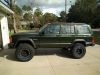
I just finished installing the LMC harness in my '96. Very well made and easy to install. Or it would have been easy to install except for the fact that I have the Wagoneer quad headlight set up. So I did have to make some modifications, but it worked out great. And the lights are much brighter now.
Thread Starter
::CF Moderator::
Joined: Aug 2011
Posts: 43,971
Likes: 1,578
From: Prescott, Az
Year: 1990
Model: Cherokee (XJ)
Engine: 4.0
I just finished installing the LMC harness in my '96. Very well made and easy to install. Or it would have been easy to install except for the fact that I have the Wagoneer quad headlight set up. So I did have to make some modifications, but it worked out great. And the lights are much brighter now.


Thread Starter
::CF Moderator::
Joined: Aug 2011
Posts: 43,971
Likes: 1,578
From: Prescott, Az
Year: 1990
Model: Cherokee (XJ)
Engine: 4.0
Thread Starter
::CF Moderator::
Joined: Aug 2011
Posts: 43,971
Likes: 1,578
From: Prescott, Az
Year: 1990
Model: Cherokee (XJ)
Engine: 4.0
CF Veteran
Joined: Oct 2011
Posts: 1,394
Likes: 8
From: SEMO
Year: 2000
Model: Cherokee (XJ)
Engine: 4.0 L6
A small enough fuse to protect your wiring, but large enough to provide the required current to the bulbs.
Current requirements for various bulb wattage @ 12V:
55w/12V x2 = 9.17 amps
65w/12V x2 = 10.83 amps
80w/12V x2 = 13.33 amps
100w/12V x2 = 16.67 amps
You will want to provide a bit of overhead for these figures. So, run a 10A fuse for 55w bulbs, 15 for 80w, etc. Most of the relay harness diagrams you'll find online show a 20A fuse for each side (high/low).
Current requirements for various bulb wattage @ 12V:
55w/12V x2 = 9.17 amps
65w/12V x2 = 10.83 amps
80w/12V x2 = 13.33 amps
100w/12V x2 = 16.67 amps
You will want to provide a bit of overhead for these figures. So, run a 10A fuse for 55w bulbs, 15 for 80w, etc. Most of the relay harness diagrams you'll find online show a 20A fuse for each side (high/low).
Last edited by Tbone289; Oct 27, 2017 at 10:55 PM.

CF Veteran
Joined: Oct 2011
Posts: 1,394
Likes: 8
From: SEMO
Year: 2000
Model: Cherokee (XJ)
Engine: 4.0 L6
They come with fuseable links. Remove the link and replace with inline fuse holders like these:
Just be sure they have 18ga or larger wires. Those at the link are 16ga I believe, so they would be perfect.
If you buy the Putco, it's best to replace the relays with Bosch-style relays that are sealed. You can get those really cheap as well:
Or you can get one of the ebay harnesses that already has the Bosch-style relays. That's really the best way to go.

Just be sure they have 18ga or larger wires. Those at the link are 16ga I believe, so they would be perfect.
If you buy the Putco, it's best to replace the relays with Bosch-style relays that are sealed. You can get those really cheap as well:
Or you can get one of the ebay harnesses that already has the Bosch-style relays. That's really the best way to go.
Last edited by Tbone289; Dec 14, 2017 at 08:21 AM.