When you click on links to various merchants on this site and make a purchase, this can result in this site earning a commission. Affiliate programs and affiliations include, but are not limited to, the eBay Partner Network.
Corroded Battery Cable Replacement (tons of pics/summary)
Stock XJ Cherokee Tech. All XJ Non-modified/stock questions go hereXJ (84-01)
All OEM related XJ specific tech. Examples, no start, general maintenance or anything that's stock.
There are normally 2 cables coming from the negative battery terminal.
The negative battery terminal is connected to the fender wall.
Can the car run if there is no cable that simultaneously connects the negative battery terminal to the engine block?
I have a Haynes manual coming, but this thread let me get the battery connections right. I bought a 2001 Sport, but the battery was gone, and so were the terminal ends. I bought ring terminals and battery clamps, but could only guess which cables to put where. I guessed wrong, going by the cable lengths and where they would reach. That's how I connected the cable from the power distribution unit to the minus terminal instead of the +. Correcting that got me power to crank and see the indicators on the instrument panel. I still havent got it to start, but when the manual comes I'll know more. My previous Jeep experience was all Renix ECU and AW4 trans...
Nice! I emailed that 5-90 guy about cables but never got a reply so I will probably just buy some store bought cables
Small business isn't like amazon( I'm spoiled as well), from what I've heard good guy and worth waiting. You will not find store bought cables that are specific to your Cherokee.
Year: 1998 Classic (I'll get it running soon....) and 02 Grand
Model: Cherokee (XJ)
Engine: 4.0
Originally Posted by Radi
If I might make one minor comment (intended to be helpful, not to be picky)- it'd be to go back and re-do that ring terminal at the starter.
Either with a good quality crimper, or better yet- solder it. A failure at that point will leave you with a no-start.
Originally Posted by Radi
As to longevity- Everything from engine sensors to the PCM are soldered.
If the job is done correctly, engine bay heat does no damage. What can do damage over time is a poorly-done solder joint that self-heats during use.
For extremely high-current applications, I agree on avoiding solder and using a good crimp or compression connection. That's what the power company uses...for good reason. For sensor/control/low-medium current, solder is preferable if done correctly.
A bad solder connection is much worse than a good crimp, but a good solder connection is better than a good crimp.
Spot on. I know this is an old thread, but since it's been dragged up, I'll add my two cents. Like Radi, I'm an engineer in the telecom industry. I used to install automotive electronics, so I have the education and the practical experience, too.
I know crimp fittings get a bad rap with a lot of people, but in fact, they are mil-spec for a lot of applications, and widely used in industry, as Radi said, for good reasons. It's simply much easier to get a good crimp connection than a good solder connection.
But you'll never get a good crimp fitting using a pair of pliers!!!!
Spend the 20 bucks and get a decent crimper.
Not one of these:
You want one of these:
Or one of these:
And while you're at it, make sure you are using quality connectors. For anything that may get wet, use the kind with the built-in heat shrink. For all other connections, use the more expensive nylon connectors. The insulation is translucent, not opaque. 3M is a good brand, and worth the money. And guys, no wire nuts!
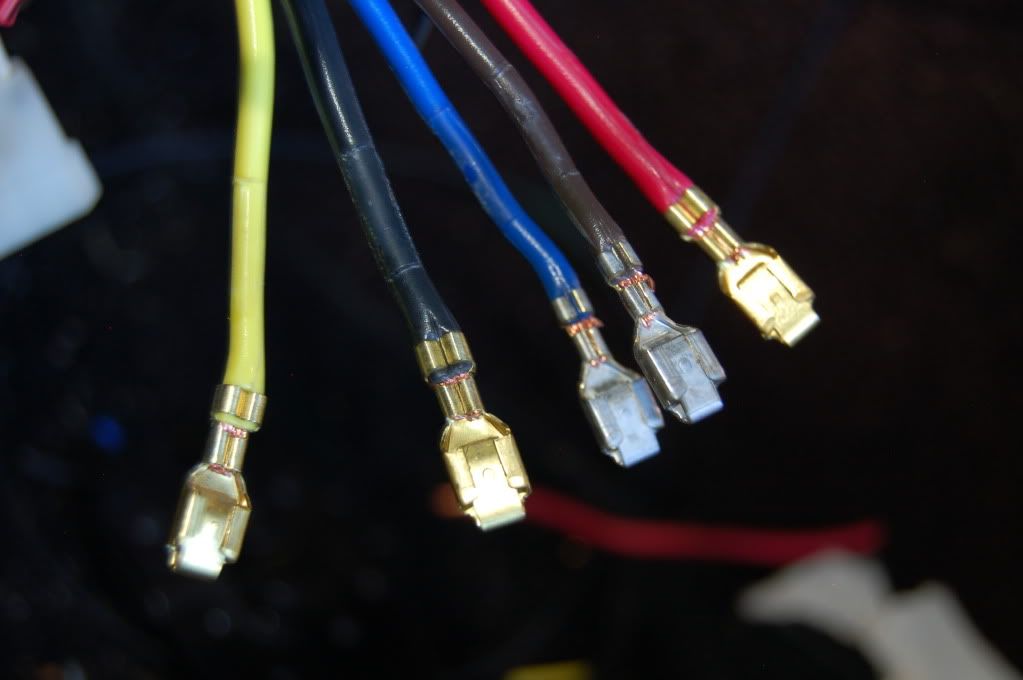
Lastly, do it right. Don't just shove the wire in there, throw the crimpers on, and clamp down any old way. There is a seam in the metal part, and you need to line up with it properly, or you'll split it open. Look inside the butt connector or ring terminal and you'll see it.
Like this:
Lastly, trim back to clean wire and get the length right. Don't leave a bunch sticking out like that. That is inviting corrosion, and it's especially bad because he's starting with corroded wire. See it? Not good.
Do a good crimp with a quality connector and you'll be a happy camper for a long time. Do a sloppy crimp, or use junk components, and you'll son join the ranks of the uninformed who say that crimping makes bad connections.
Not to change the subject but to add my own experience with a amazing product I've used on Harleys and anything else that can get corroded in the eastern part of Washington State. Try Corrosion Block spray or grease and you will be amazed how long it will last and what it will do. I've been running it on my old Harleys for over 16 years and literally anything that can get corroded is protected. Check out the tests on marine engines in Hawaii using Corrosion Block. I have no affiliation with the company other than using the product for years.
Year: 1998 Classic (I'll get it running soon....) and 02 Grand
Model: Cherokee (XJ)
Engine: 4.0
Looks interesting. Found several sources online with a quick search. I think I may try their spray on the underside of my Heep.
Thanks!
EDIT: I did some research and found some reviews on it. It did will in some, not so well in others. Seems to work very well in fresh water conditions, not so well in salt water.
I haven't found anything yet on how well it penetrates existing rust. Seems to be a coating only.
Spot on. I know this is an old thread, but since it's been dragged up, I'll add my two cents. Like Radi, I'm an engineer in the telecom industry. I used to install automotive electronics, so I have the education and the practical experience, too.
I know crimp fittings get a bad rap with a lot of people, but in fact, they are mil-spec for a lot of applications, and widely used in industry, as Radi said, for good reasons. It's simply much easier to get a good crimp connection than a good solder connection.
But you'll never get a good crimp fitting using a pair of pliers!!!!
Spend the 20 bucks and get a decent crimper.
Not one of these:
You want one of these:
Or one of these:
And while you're at it, make sure you are using quality connectors. For anything that may get wet, use the kind with the built-in heat shrink. For all other connections, use the more expensive nylon connectors. The insulation is translucent, not opaque. 3M is a good brand, and worth the money. And guys, no wire nuts!
Lastly, do it right. Don't just shove the wire in there, throw the crimpers on, and clamp down any old way. There is a seam in the metal part, and you need to line up with it properly, or you'll split it open. Look inside the butt connector or ring terminal and you'll see it.
Like this:
Lastly, trim back to clean wire and get the length right. Don't leave a bunch sticking out like that. That is inviting corrosion, and it's especially bad because he's starting with corroded wire. See it? Not good.
Do a good crimp with a quality connector and you'll be a happy camper for a long time. Do a sloppy crimp, or use junk components, and you'll son join the ranks of the uninformed who say that crimping makes bad connections.
i agree the right tool makes all the difference in the world. and from what i have read over the years in most cases a crimp connection is prefered.
I've learned the hard way u get what u pay for. IMO it would be a good idea to spend the little extra when doing something like this. After all the battery cables are one of the most important parts. Understandably some are on a very small budget but if u could afford a few extra bucks then By all means do so.
As far as cheaper terminals and cheaper pliers go I've had good luck using them for some time. Have done a fair amount of wiring with them on things like atv's, dirt bikes, go karts, lawn mowers and cars. Of coarse I did have a few bad crimps in the beginning but I've since corrected the way I've done them. So long as they are done correctly using the cheaper( not cheapest) stuff is fine for most applications.
Year: 1998 Classic (I'll get it running soon....) and 02 Grand
Model: Cherokee (XJ)
Engine: 4.0
Originally Posted by Waynerd
As far as cheaper terminals and cheaper pliers go I've had good luck using them for some time. Have done a fair amount of wiring with them on things like atv's, dirt bikes, go karts, lawn mowers and cars. Of coarse I did have a few bad crimps in the beginning but I've since corrected the way I've done them. So long as they are done correctly using the cheaper( not cheapest) stuff is fine for most applications.
Agreed! As long as you do it correctly, most of us will be fine with a Harbor Freight crimper like this. Just get the right kind (not necessarily a top brand), use it correctly, and your crimps will be happy.
Nice! I emailed that 5-90 guy about cables but never got a reply so I will probably just buy some store bought cables
I know this was in June, But Kelley will respond. This summer he had allot of things going on. I waited 45 days for my cables, but they were very good quality and better built than OTC at autozone stuff.
I know this was in June, But Kelley will respond. This summer he had allot of things going on. I waited 45 days for my cables, but they were very good quality and better built than OTC at autozone stuff.
He was to slow responding for my immediate issue I had. I used his numbers and had my local Napa fab my set. Very good quality and available immediately.



 Sep 16, 2015, 07:17 PM