


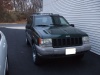
98 cherokee sport no gauges


CF Veteran
Joined: Aug 2010
Posts: 8,357
Likes: 103
From: Canton, MI
Year: 1999
Model: Cherokee
Engine: 4.0

Newbie
Joined: Jun 2018
Posts: 7
Likes: 1
Model: Cherokee (XJ)
 99
99
Sounds like you have a real jewel there...
If you are interested in checking your CCD data bus here's a schematic you can refer to. The schematic shows all the modules on the CCD bus and a description of the pin-outs on the Data Link Connector. All the DLC cavities are numbered but you will only have seven cavities on yours.
You'll need a digital Volt/Ohmmeter.

Voltage tests are done with the key in RUN/engine off. The resistance read is done with the key OFF.
Using your VOM, go from pin cavity 3 to 4 or 5. You should read around 2.41 to 2.50 volts.
Go from pin cavity 11 to 4 or 5, again you should read 2.41 to 2.50 volts.
If any of these voltage readings are not within the range stated there may be a module corrupting the CCD bus.
Check for 120 Ohm resistance in the PCM. Go from pin cavity 3 to 11. You should read 120 Ohms.
~~~~~~
I know you said you checked the fuses, but...
12 volt (B+) supply to the instrument cluster comes from fuse #16 in the PDC. This is the Ignition Off Draw (IOD) fuse. Look on the inside of the PDC cover to locate the IOD fuse.
12 volts also comes from the ignition switch Start-Run output. This if from fuse #9 in the Junction Block (passenger foot well). Here's a schematic of the JB.
Attachment 374129
Check these fuses again.
Ground for the Instrument Cluster is at ground G108. It's located on the instrument panel frame near the headlamp switch.
~~~~~~~
Have you tried the Instrument Cluster Actuator Test?
Refer to the attached table for instrument response.
ACTUATOR TEST
The instrument cluster actuator test will put the cluster into its self-diagnostic mode. In this mode the cluster will position each of the gauge needles at various specified calibration points, and turn all of the CCD data bus message-controlled lamps on and off at specified time intervals.
Successful completion of the actuator test will confirm that the cluster circuitry, gauges, and lamps are capable of operating as designed. However, there may still be a problem with the CCD data bus, the Powertrain Control Module (PCM), the Airbag Control Module (ACM), or the inputs to one of these modules. Use a DRB scan tool and the proper Diagnostic Procedures manual for testing of these components.
If an individual gauge does not respond properly or at all during the Actuator Test, the instrument cluster should be removed. However, check the gauge mounting screws on the printed circuit board for proper tightness before considering instrument cluster replacement. If the mounting screws check OK, replace the faulty cluster.
If an individual indicator lamp does not illuminate during the Actuator Test, the instrument cluster should be removed. However, check that the incandescent lamp bulb is not faulty and that the bulb holder is properly installed on the circuit board before considering instrument cluster replacement. If the bulb and bulb holder check OK, replace the faulty instrument cluster.
(1) Begin the test with the ignition switch in the Off position.
(2) Depress the trip odometer reset button.
(3) While holding the trip odometer reset button depressed, turn the ignition switch to the On position, but do not start the engine.
(4) Release the trip odometer reset button.
(5) Compare the operation of the suspect gauge(s) and/or lamp(s).
(6) The cluster will exit the self-diagnostic mode at the completion of the test, or if the ignition switch is turned to the Off position.
(7) Go back to Step 1 to repeat the test, if required.
Attachment 374130
~~~~~~~~~
I'll see if I have the Instrument Cluster connector(s) pin-out drawing.
If you are interested in checking your CCD data bus here's a schematic you can refer to. The schematic shows all the modules on the CCD bus and a description of the pin-outs on the Data Link Connector. All the DLC cavities are numbered but you will only have seven cavities on yours.
You'll need a digital Volt/Ohmmeter.
Voltage tests are done with the key in RUN/engine off. The resistance read is done with the key OFF.
Using your VOM, go from pin cavity 3 to 4 or 5. You should read around 2.41 to 2.50 volts.
Go from pin cavity 11 to 4 or 5, again you should read 2.41 to 2.50 volts.
If any of these voltage readings are not within the range stated there may be a module corrupting the CCD bus.
Check for 120 Ohm resistance in the PCM. Go from pin cavity 3 to 11. You should read 120 Ohms.
~~~~~~
I know you said you checked the fuses, but...
12 volt (B+) supply to the instrument cluster comes from fuse #16 in the PDC. This is the Ignition Off Draw (IOD) fuse. Look on the inside of the PDC cover to locate the IOD fuse.
12 volts also comes from the ignition switch Start-Run output. This if from fuse #9 in the Junction Block (passenger foot well). Here's a schematic of the JB.
Attachment 374129
Check these fuses again.
Ground for the Instrument Cluster is at ground G108. It's located on the instrument panel frame near the headlamp switch.
~~~~~~~
Have you tried the Instrument Cluster Actuator Test?
Refer to the attached table for instrument response.
ACTUATOR TEST
The instrument cluster actuator test will put the cluster into its self-diagnostic mode. In this mode the cluster will position each of the gauge needles at various specified calibration points, and turn all of the CCD data bus message-controlled lamps on and off at specified time intervals.
Successful completion of the actuator test will confirm that the cluster circuitry, gauges, and lamps are capable of operating as designed. However, there may still be a problem with the CCD data bus, the Powertrain Control Module (PCM), the Airbag Control Module (ACM), or the inputs to one of these modules. Use a DRB scan tool and the proper Diagnostic Procedures manual for testing of these components.
If an individual gauge does not respond properly or at all during the Actuator Test, the instrument cluster should be removed. However, check the gauge mounting screws on the printed circuit board for proper tightness before considering instrument cluster replacement. If the mounting screws check OK, replace the faulty cluster.
If an individual indicator lamp does not illuminate during the Actuator Test, the instrument cluster should be removed. However, check that the incandescent lamp bulb is not faulty and that the bulb holder is properly installed on the circuit board before considering instrument cluster replacement. If the bulb and bulb holder check OK, replace the faulty instrument cluster.
(1) Begin the test with the ignition switch in the Off position.
(2) Depress the trip odometer reset button.
(3) While holding the trip odometer reset button depressed, turn the ignition switch to the On position, but do not start the engine.
(4) Release the trip odometer reset button.
(5) Compare the operation of the suspect gauge(s) and/or lamp(s).
(6) The cluster will exit the self-diagnostic mode at the completion of the test, or if the ignition switch is turned to the Off position.
(7) Go back to Step 1 to repeat the test, if required.
Attachment 374130
~~~~~~~~~
I'll see if I have the Instrument Cluster connector(s) pin-out drawing.

Thread
Thread Starter
Forum
Replies
Last Post
seansr
Stock XJ Cherokee Tech. All XJ Non-modified/stock questions go here
13
Oct 20, 2025 02:48 PM
John T
Stock XJ Cherokee Tech. All XJ Non-modified/stock questions go here
18
Aug 31, 2015 12:41 PM
lhpdiver
Stock XJ Cherokee Tech. All XJ Non-modified/stock questions go here
17
Aug 23, 2015 01:53 PM
Currently Active Users Viewing This Thread: 1 (0 members and 1 guests)