When you click on links to various merchants on this site and make a purchase, this can result in this site earning a commission. Affiliate programs and affiliations include, but are not limited to, the eBay Partner Network.
The bend in the arms doesn't matter bolt to bolt, needs to be parralell need to use some kind of straight edge to see if bars are parralell or possibly string tapped to the bolts. Arms can be bent in any shape but that does not affect point to point.
Flatter angles are always better on steering and track bar but the have to mach. If drag link is lowerd with a dropped pitman arm track bar must also be dropped to match.
If arms aren't parralell and lengths are different the arc path they travel in as suspension cycles is different, paths intersect and track bar will make steeing turn to match its path. This is bump steer.
many jeeps are set up improperly and not all death wobble even though they aren't set up correctly.
Many jeep owners just don't do the research to learn proper geometry and many shops don't have techs that care or get paid enough to actually learn steering and suspension
Not meaning you you seem to want to learn. ounce its learned your rigs will drive better than 99% of jeeps on the road and youl save tons of money not going to shops that just want to take your money and quickly get to taking the next customers money.
Death wobble is usual a combination of this and loose front end getting into a harmony or springing off of eachother.
This harmony is bad ive experienced it on cummins pickups not sure how the truck doesn't disintegrate and engine doesn't become disconnected with frame rails..
The tie rod itself becomes a spring as tires toe in and out then the turning rubber is a gyro that keeps it violently wobbling.
The bend in the arms doesn't matter bolt to bolt, needs to be parralell need to use some kind of straight edge to see if bars are parralell or possibly string tapped to the bolts. Arms can be bent in any shape but that does not affect point to point.
Flatter angles are always better on steering and track bar but the have to mach. If drag link is lowerd with a dropped pitman arm track bar must also be dropped to match.
If arms aren't parralell and lengths are different the arc path they travel in as suspension cycles is different, paths intersect and track bar will make steeing turn to match its path. This is bump steer.
many jeeps are set up improperly and not all death wobble even though they aren't set up correctly.
Many jeep owners just don't do the research to learn proper geometry and many shops don't have techs that care or get paid enough to actually learn steering and suspension
Not meaning you you seem to want to learn. ounce its learned your rigs will drive better than 99% of jeeps on the road and youl save tons of money not going to shops that just want to take your money and quickly get to taking the next customers money.
Death wobble is usual a combination of this and loose front end getting into a harmony or springing off of eachother.
This harmony is bad ive experienced it on cummins pickups not sure how the truck doesn't disintegrate and engine doesn't become disconnected with frame rails..
The tie rod itself becomes a spring as tires toe in and out then the turning rubber is a gyro that keeps it violently wobbling.
its fun stuff for sure.
That makes sense... Wish I could go work on it now but I'm stuck here currently. I hate this place lol
Engine: 4.3L with headers and full 3" exhaust system
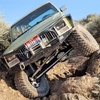
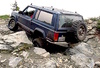
I agree, the aftermarket steering you have if I can see the pick clearly has the drag link on top of the steering arm. Because of the difference of angle between the drag link and track bar, when you hit a bump, the front wheels are quickly and violently pushed toward the passenger side. When the suspension goes back down, they go back. The suddenness of this causes some give in the frame, track bar bushing etc and the front wheels go past where they were and are violently brought back to where they were. All this takes advantage of any slack in the system and you have death wobble. To start, make sure the track bar and drag link pivot points are at the same height on each end and the pivot points are parallel.
I agree, the aftermarket steering you have if I can see the pick clearly has the drag link on top of the steering arm. Because of the difference of angle between the drag link and track bar, when you hit a bump, the front wheels are quickly and violently pushed toward the passenger side. When the suspension goes back down, they go back. The suddenness of this causes some give in the frame, track bar bushing etc and the front wheels go past where they were and are violently brought back to where they were. All this takes advantage of any slack in the system and you have death wobble. To start, make sure the track bar and drag link pivot points are at the same height on each end and the pivot points are parallel.
By steering arm do you mean the pitman arm? If so the drag link heim should be above the Pitnam but instead is mounted below it on my truck. When I take the Trac bar and drag link off tomorrow I'll put it above the Pitnam like trail forged recommends in their online instructions. Ill work on making the drag link and Trac bar parallel And making sure the ends are evenly spaced at both pivot points thanks... I'll report back!
Last edited by Steelhumm; Jul 10, 2021 at 08:51 PM.
Engine: 4.3L with headers and full 3" exhaust system
That should do it. Also pay attention to the track bar axle mount. The hole can get wallowed out and allow movement. Make sure steering box is tight
I meant the arm on the knuckle, but you get the point now
Lololol thanks guys. the wife is dragging is to the beach today so I can't work on the Cherokee... At least I'll get to drive my gladiator in some sand so that's a plus! Tomorrow my son and I will get the front end up and start testing **** out and inspecting. I'm only going to do one thing at a time though so I can easier isolate what makes things better. First thing I'll do is remove the drag link and move it to the top of the pitman... I thought you wanted it as low as possible, isn't that why they have drop Pitnam arms? I'll give er a try, but just curious. The Trac bar and drag link are curved so they'll never get truly parallel with Each other. If you look in the first pic above where the drag link mounts to the Pitnam it is perfectly parallel to the Trac bar before they bend out. I'll try it out tomorrow and report back... Thanks again guys
So the drop pitman arm is kind of a bandaid way to bring the drag link into parallel with the track bar. Granted the bars are both bent, but you want the imaginary line through each corresponding bars pivots to be parallel. Ideally they would be equal length and parallel but that's not a thing without much custom work. Getting them parallel will have them travel in the same sex of travel and should mitigate 90% of bump steer. Doing one thing at a time is perfect so you can feel which has positive or negative effects.
I'm back to chasing a few things myself on my junk box and it's a tedious and sometimes frustrating thing. Steering geometry is the biggest factor in your XJ either having nice road manners or being a total bear to run on the road. I would say in order of priority, flip the drag link, check castor and dial that in as much positive castor as you can until you get either 6-7* or get drivelines vibes, which ever happens first. If you get vibes back it out until they go away, 5-6* is likely where you'll end up. Than you can tweak the toe, and with heim steering like that try to end up between 0 and 1/16th toe in. Tie rod ends have a TINY bit of deflection in the joints so they like to go between a 1/16th and an 1/8th to account for the tires pulling outward with rotational forces, but heims don't have much give so keep it about 1/16th max toe in. The steering you have is a total pain in the behind to adjust accurately so be prepared for a bit of aggravation. I just did mine and it was a couple hours of choice words.
edit: lots of good info above as well, my phone didn't load all the replys until I posted.
Last edited by Hodgexj1996; Jul 10, 2021 at 09:45 PM.
I am so grateful to all you guys for the very educational responses. I would normally throw parts at it until it's fixed but being my son's first truck I really wanted to understand what and why it's doing what is doing so that I and his mom can be confident that when I do finally fix it that our baby will be safe. For giving her and me piece of mind...I truly thank you all!!
So I found part ff the problem... Trac bar bushings are toast!! There's also a slight wobble of three bolts in the bracket holes... How do I fix that? If I enlarge the holes for a bigger bolt it won't fit in the bushing spacer hole? Maybe they sell bushings with enlarged hardware?
Also... I'm guessing the bushing on top of the axle is bad too? How do I remove this freakin thing? There's no bolt head to grab onto?
Last edited by Steelhumm; Jul 11, 2021 at 01:14 PM.
Engine: 4.3L with headers and full 3" exhaust system
If the track bar hole is enlarged, the fix is to weld a washer on the outside of it. Metal is kind of thin there anyway. Instead of trying to buy a washer, take a piece of 1/4" steel and drill it for the proper size then weld it on
So I found part ff the problem... Trac bar bushings are toast!! There's also a slight wobble of three bolts in the bracket holes... How do I fix that? If I enlarge the holes for a bigger bolt it won't fit in the bushing spacer hole? Maybe they sell bushings with enlarged hardware?
Also... I'm guessing the bushing on top of the axle is bad too? How do I remove this freakin thing? There's no bolt head to grab onto?
If possible get a picture of the whole trac bar. We may be able to figure out the make of it. They do sell bushing kits with oversized hardware so you can take care of wallowed out holes. Makes sure the bracket bolts are tight to the frame on the side and underside as well.
Control arm bolts are flag bolts, just spin the nut and that leg is designed to hit the control arm and stop it from spinning to aid in removal. Once the nut it off just tap it out, I find it helpful to have a Jack under the tie rod with a small amount of pressure on it to take tension off the bolt and keep the axle from trying to rotate foreward. Also makes lining the hole back up for a reinstall a little easier.
i know you mentioned you had another thread, but did you ever figure out how much lift you have? Stock upper control arms may not be helping you out at all.