


Axle info

CF Veteran
Joined: Mar 2009
Posts: 2,287
Likes: 0
From: Westfield, MA
Year: 1999.
Model: Cherokee
Engine: 4.0, I6
CF Veteran
Joined: Sep 2010
Posts: 4,968
Likes: 0
From: Salt Lake City, UT
Year: 2000
Model: Cherokee
Engine: 4.0L

Lets start with what we have stock....
The front axle
the front axle is a D30 , came standard in all XJ's but was updated over time, some stronger then others.
1984–1996: Dana 30, High Pinion, Reverse Cut, 27-spline axleshafts (1989 – 1995 : with ABS used 5-297x universal joints, non-ABS had 5-260x universal joints.
1996–1999: Dana 30, High Pinion, Reverse Cut, 297x/760 universal joint, 27-spline axleshafts.
2000–2001: Dana 30, Low Pinion, Standard Cut, 297x/760 universal joint, 27-spline axleshafts.
1985–2001: Straight Axle non-driven front axle for two-wheel drive only.
Rear axle options
1984–1989: Dana 35, non c-clip, with anti-lock braking system (ABS) or non-ABS.
1987–1990: Dana 44, non-abs, 30-spline axleshafts.
1990–1996: Dana 35, c-clip, ABS or non-ABS.
1997–2001: Dana 35, c-clip, ABS.
1991–1996: Chrysler 8.25", c-clip, non-ABS, 27-spline axleshafts.
1996–2001: Chrysler 8.25", c-clip, non-ABS, 29-spline axleshafts.
Jeep XJs came in several standard gearing ratios depending on what options and power train the vehicle was equipped with. its pretty standard that automatics came with 3.55 gearing and manuals came with 3.07's. but 4cyl's had lower options as well.
3.07:1, manual transmission, I6 engine.
3.55:1, automatic transmission, I6, manual transmission I4 engine.
3.73:1, automatic transmission, I6, Tow Package/UpCountry Package.
4.10:1, manual transmission, V6; automatic transmission, I4 engine.
4.56:1, automatic transmission, I4, offroad or tow package
Axle type
Before we get to carrier away with what good swaps are lets explain the differences in axle types other then size.
High pinion differential - A high pinion axle has the pinion gear going into the diff above center line of the axle tube. In a front application the way that the gears mesh actually pulls the gear faces together making them have a strong bond and minimal deflection. In a rear aplication its the opposite. The gear actually turns the other way making the gear faces pull away from each other causing deflection and make the diff weaker under high load.
Low Pinion differential - A low pinion differential enters the diff below the center line of the axle tube. In a rear low pinion application the gear faces mesh and pull each other together making it a strong bond. and in a front Application the gears will pull away from each other causing deflection.
pic to show LP vs HP
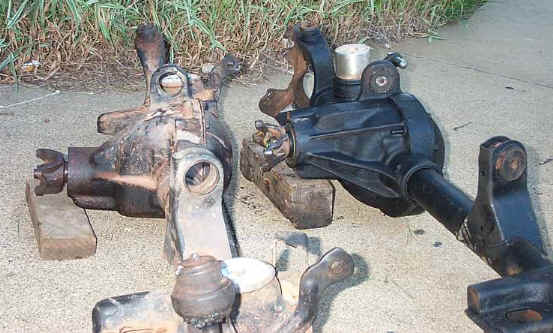
There are also full float and semi float axles. in simple terms:
A full float axle does not hold the weight of the vehicle, just the torque applied to move it, which take a lot of load and binding off the axle shaft and allows it to handle a higher load. the weight of the vehicle in this setup is held by bearings and a hub with a spindle setup. the axle shaft fully floats between the spindle and the diff. this setup allows axle's and wheels to remain in place when they brake and can be driven on for a short period of time with minimal damage.
A Semi float axle has to support the weight of the vehicle and the torque applied which causes the axle to be under more stress and weaker because of it. the axle floats in the diff but is held in place at the outer flange which is why its a "semi" floating axle. the bearings in the axle housing actually ride on the axle shaft and not a spindle. a C-clip is a style of semi float as the C-clip hold the axles position and wont allow the axle to walk out of the diff, which can be a weak point or allow the axle to walk out of the housing if it breaks. which means you must change the shaft immediately if it brakes.
All front axles are Full floating. most 1/2 and some 3/4 ton rear axles are semi floating axles.
Good axle info from a few sites tried to get good info and pile it all together in a organized fashion lol, good way to size up or compare axles you may be thinking about swapping or upgrading to, or compare what you already have, and see there limits.
FRONT AXLES
D27 Front Axle:
Full Floating
Vehicles: '66-'71 CJ-5 and CJ-6; '63-'70 Wagoneer; '67-'71 C-101 Jeepster
Ring Gear: 7.2"
Stock Gearing:
Axleshaft Spline: 10
Axleshaft Diameter: 1.13"
Axle Joint: Spicer 260X
Knuckle: Closed
Brakes: Drum 10" 11"
Weakness: Weak axle for upgrades, low spline count, weak carrier
Width: 51" (CJ and Jeepster), 57.5" (Wagoneer)
Wheel Bolt: 5x5.5"
Max Recommended Tire Size: 31"
D30 Front Axle:
Full/Semi Floating
Vehicles: From ’72 CJ-5, CJ-6, CJ-7, CJ-8, YJ, TJ, XJ, ZJ, C104, WJ
Ring Gear: 7.125”, 7.33” (TJ/WJ Only)
Stock Gearing: 3.07, 3.54 (3.55), 3.73, 4.10 (4.11)
Axleshaft Spline: 27
Axleshaft Diameter: 1.16”, 1.193” (TJ/WJ Only)
Axle Joint: Spicer 260X (pre ’95.5), Spicer 297/760X (post ’95.5), CV & 760 U-Joint (TJ/WJ)
Knuckle: Open
Brakes: Drum 11” (pre ’76), Disc (post ’76)
Weakness: 260X U-joint; YJ Vacuum motor fails; standard CV problems
Width: 51” (’72-’75 CJ, C-104), 53” (’76-’81 CJ), 56” (’82-’86 CJ), 60.5” (TJ, YJ, XJ, WJ)
Wheel Bolt: 5x5.5” (CJ/C-104), 5x4.5” (others)
Max Recommended Tire Size: 35”
AAM 790 Front Axle
Semi Floating
Vehicles: '05 and later WK
Ring Gear: 7.87"
Stock Gearing:
Axleshaft Spline:
Axleshaft Diameter:
Axleshaft Joint: CV
Knuckle: Open
Brakes: Disc
Weakness: Limited modification ability, small ring gear
Width:
Wheel Bolt:
Max Recommended Tire Size: 32"
D44 Front Axle:
Full/Semi Floating
Vehicles: ’57-’65 FC-170; ’63-’70 Gladiator; '67-'79 1/2 & 3/4 Ton Ford Pickups; ’71-’87 J-Series; ’71-’91 Wagoneer; '72-'93 1/2 & 3/4 Ton Dodge Pickups; '73-'79 1/2 & 3/4 Ton Chevy Pickups; ’74-’83 Cherokee; ’03-’06 Rubicon
Ring Gear: 8.5”
Stock Gearing: Many
Axleshaft Spline: 19 (pre ’71), 30 (post ’71)
Axleshaft Diameter: 1.25” (19 spline), 1.31” (30 spline)
Axle Joint: Spicer 206X (pre ’73), Spicer 297/760C (post ’73)
Knuckle: Closed (pre ’73), Open (post ’73)
Brakes: Drum 11” (pre ’73), Disc (post ’73)
Weakness: 260X and 19 spline axleshafts
Width: 63” (FC-170), 57.5” (’71-’73 Wagoneer), 59” (’74 and later Wagoneer), 65.5” (J-Series), 60.5” (Rubicon), Full Width (Ford, Dodge, Chevy)
Wheel Bolt: (Varies)
Max Recommended Tire Size: 37”
D60 Front Axle:
Full Floating
Vehicles: ‘67-’69 Kaiser M-715; ‘72-‘93 3/4 & 1 Ton Dodge Pickups; ‘74-‘77 3/4 Ton Ford Pickups; ‘77-‘87 3/4 & 1 Ton Chevy Pickups; ‘78-‘79 1 Ton Ford Pickups
Ring Gear: 9.75”
Stock Gearing: 4.10, 4.56
Axleshaft Spline: 30
Axleshaft Diameter: 1.31”
Axle Joint: Unknown Spicer
Knuckle: Closed
Brakes: Drum 13”
Weakness: Metallurgically axleshafts inferior to modern metals
Width: 72.5” (M-715), Full Width (Ford, Dodge and Chevy)
Wheel Bolt: 6x8.25”
Max Recommended Tire Size: 42”
REAR AXLES (no order)
D35 Rear Axle:
Semi-floating (’85-’89), C-clip (’90 and later)
Vehicles: Most XJ; YJ; TJ (except Rubicon); ZJ; some WJ
Ring Gear: 7.562”
Stock Gearing: 3.07, 3.54 (3.55), 3.73, 4.10 (4.11)
Axleshaft Spline: 27
Axleshaft Diameter: 1.13”
Brakes: Drum 11”; Disc (later ZJ/WJ)
Weakness: Weak carrier & axleshafts
Width: 60.5”
Wheel Bolt: 5x4.5”
Max Recommended Tire Size: 33”
It has a very weak and flexible housing that causes C-clip axle and differential problems. Unfortunately, it has unbelievable aftermarket support despite its weakness. However, consider any upgrades to this axle a Band-Aid for the real problem. If you're running it hard (especially with a locker) and it hasn't spit out its insides and it's not bleeding gear oil out of the pressed-in tubes and plug welds, it soon will be.
D44 Rear Axle:
Semi Floating
Vehicles (here we go…*long breath*): ’49-’65 6cyl ***** Wagons; ’49.5-’53 CJ-3A; ’53-’68 CJ-3B; ’50-’52 M-38; ’52-’57 M-38A1; ’53-’57 M-170; ’55-’75 CJ-5 & CJ-6; ’85.5-’86 CJ-7; ’58-’65 FC-150; ’57-’65 FC-170; ’63-’70 Wagoneer & Gladiator Pickup; ’67-’71 C-101 Jeepster; ’72-’73 C-104; ’71-’75 Wagoneer & ½-ton J-Series; ’74-’83 Cherokee; ’87-’91 Grand Wagoneer; Some ’86-’92 XJ and MJ; Some ’97-’06 TJ; ’99-’04 WJ; ’96-’98 ZJ
Ring Gear: 8.5”, 8.9” (WJ only )
Stock Gearing: Many, including 3.55, 3.73, 4.11
Axleshaft Spline: 10 (’49-’55), 19 (’56-’70.5), 30 (’70.5 and later)
Axleshaft Diameter: 1.193” (WJ/ZJ) 1.25” (10 and 19 Spline), 1.31 (30 Spline)
Brakes: Drum 9”, 10”, 11”; Disc (Rubicon, ZJ, WJ)
Weakness: 10 & 19 Spline, Some aluminum housings.
Width: 50.5” (up to ’75 CJ, FC, C-101, C-104), 54.5” (’85-’86 CJ), 57.5” (’63-’73 Wagoneer), 60.5” (XJ, MJ, TJ, ZJ, WJ), 65.5” (FSJ Cherokee, J-Series)
Wheel Bolt: Varies
Max Recommended Tire Size: 38"
(Dana 44 non-Wrangler)
Much like the Dana 44 front axle, the 44 rearend enjoys a lot of aftermarket support in the form of optional ratios, floater kits, and aftermarket differentials for more traction. Some early models are plagued with small bend-prone axletubes, weak coarse-spline shafts (as well as two-piece shafts), and coarse-spline pinions. Early '70-and-later Dana 44 rears are much more desirable. Look for 2 3/4-inch axletubes and 30-spline, one-piece shafts.
(Alum Dana 44 ZJ)
It's a decent, relatively durable axle, but there isn't much aftermarket support because it's fairly uncommon.
(06-and-earlier Wrangler Dana 44)
The smallish axletubes (same as Dana 35) can flex and cause carrier bearing and other failures if abused. It has lots of aftermarket support but limited available ratios if you are using the stock Rubicon differential.
(07-and-later Wrangler (Rubicon only) Dana 44)
It features stronger tubes than the axles in the previous model Wrangler and 32-spline shafts. It's sure to see plenty of aftermarket support, including complete assemblies available from Mopar.
D53 Rear Axle:
Semi Floating
Vehicles: '55-'65 ****** pickup; '63-'69 Gladiator; '57-'65 FC-170
Ring Gear: 9.25"
Stock Gearing:
Axleshaft Spline: 20
Axleshaft Diameter: 1.31"
Brakes: Drum 11"
Weakness: Hard to find parts, low spline
Width: 65.5" (Gladitaor), 63" (Others)
Wheel Bolt: 5x5.5"
Max Recommended Tire Size: 35"
D60 Rear Axle:
Semi/Full Floating
Vehicles: ‘67-‘69 1/2 & 3/4 Ton Ford Pickups; ’69-’87 J-2000/J-20; ‘72-‘93 3/4 Ton Dodge Pickups
Ring Gear: 9.75”
Stock Gearing 4.10, 4.56
Axleshaft Spline: 30
Axleshaft Diameter: 1.31”
Brakes: Drum 12”
Weakness:
Width: 65.5” (J-2000/J-20), Full Width (Ford, Dodge & Chevy)
Wheel Bolt: 8x6.5”
Max Recommended Tire Size: 42”
(Full-floating, 30-spline Dana 60)
These are extremely common and can be easily found in junkyards under Dodges, Fords, GMs, and Jeeps alike. They are most often found under 3/4-ton vans and pickups, but a few came under Mopar musclecars. There is a lot of aftermarket support for the Dana 60.
(Full-floating 35-spline Dana 60)
They enjoy plenty of aftermarket support because they use common Dana 60 gears and carriers. However, they're very uncommon, and you're not likely to find one in a wrecking yard. Many 35-spline 60 rear axles have been converted from 30-spline housings.
(Semifloating Dana 60)
It's a little rare, but it can be found under early F-150s and early-'70s FSJ pickups. It features desirable 35-spline shafts and uses common Dana 60 gears and carriers, so a lot of aftermarket ratios and differentials are available.
D70 Rear Axle:
Full Floating
Vehicles:’58-’68 FC-170 w/dual rear wheels; ’63-’68 J-3000 w/dual rear wheels; ’67-’69 M-715; CJ-10; '72-‘93 3/4 & 1 Ton Dodge Pickups; ‘76-‘77 3/4 Ton Ford Pickups; ‘77-‘87 1 Ton Chevrolet Pickups; ‘78-‘79 1 Ton Ford Pickups
Ring Gear: 10.5”
Stock Gearing: 4.10, 4.56
Axleshaft Spline: 23, 35
Axleshaft Diameter: 1.5”
Brakes: Drum 13”
Weakness: Poor parts availability
Width: 59” (FC & Pickup), 72” (M-715), Full Width (Ford, Dodge and Chevy)
Wheel Bolt: 6x7.25” (M-715), 8x6.5” (others)
Max Recommended Tire Size: 44”
The Dana 70 is another member of the cheap beef squad. However, there are several versions making them more difficult to identify. Look for the Dana 70U or 70HD. These feature desirable 1 1/2-inch, 35-spline shafts. There are also plenty of ratios and a good number of aftermarket differentials available for these versions of the 70 as well. They are often found in 1-ton Dodge, Ford, and GM trucks, vans, and even some tractors and heavy equipment.
AMC20 Rear Axle:
Semi Floating
Vehicles: ’76-’86 CJ; ’76-’91 Wagoneer and J-10
Ring Gear: 8.875”
Stock Gearing: 2.76, 3.07
Axleshaft Spline: 20
Axleshaft Diameter: 1.31”
Brakes: Drum 11”
Weakness: 2 piece axleshafts (CJ only), tubes spin, 20 spline
Width: 50.5” (’76-’81 CJ), 54.5” (’82-’86 CJ), 59” (Wagoneer), 65.5” (J-Series)
Wheel Bolt: 5x5.5” (CJ), 6x5.5” (Wagoneer and J-Series)
Max Recommended Tire Size: 33”-35”
(CJ)
The AMC 20 is marginal in a stock application. It has a very weak and flexible housing that can lead to other problems. The two-piece axleshafts are notoriously fail-prone. Much like the Dana 35, this axle is best swapped out if you are planning to spend money on it or run larger-than-stock tires.
(AMC 20 FSJ)
The FSJ AMC 20 is stronger than the CJ version and perhaps about equal to the strength of a newer Dana 44. However, it doesn't enjoy as much aftermarket support as the Dana. Fewer gear ratios and lockers are available.
Chrysler 8.25 Rear Axle:
C-clip
Vehicles: '91-'01 XJ
Ring Gear: 8.25”
Stock Gearing: 3.55, 3.73, 4.10
Axleshaft Spline: 27 ('91-'96), 29 ('96-'01)
Axleshaft Diameter: 1.17” (27 spline), 1.21 (29 spline)
Brakes: Drum 11”
Weakness: 27 spline, c-clip
Width: 60.5”
Wheel Bolt: 5x4.5”
Max Recommended Tire Size: 35”
It's a decent axle when mated with moderate-sized tires, however, few gear ratios are available. It doesn't have much aftermarket support.The 29 Spline is a better choice then the 27, and the 29 spline is comparable to the D44.
Ford 8.8 Rear Axle
Vehicles: Ford Explorer (Prefered Swap, information reflects Explorer only), Ford F-Series , Ford Ranger
Ring Gear: 8.8"
Stock Gearing: 3.08, 3.27, 3.55, 3.73, 4.10
Axleshaft Spline: 28, 31
Axleshaft Diameter: 1.320"
Brakes: Drum ('91-'94), Disc ('95-'01)
Weakness: C-clip, weak carrier
Width: 59.625" to 65.6"
Wheel Bolt: Most 5x4.5"
Max Recommended Tire Size: 40"
(Ranger and Explorer)
Some versions have weaker 28-spline shafts. The '91-'01 Explorer 31-spline version is preferred ('95-and-later have disc brakes). There's a lot of aftermarket support for the 8.8, but the C-clip shafts are a notable weakness. Commonly swapped into Wranglers in place of the Dana 35, although the marginal gain in strength hardly seems worth the effort.
(full size version)
All have 31-spline shafts and undesirable C-clips retaining the axles. Not a particularly good full-width axle for a Jeep swap
Ford 9 inch
vehicles: 57-'59 Ford station wagons, including Ranchero and sedan delivery
58-'90 F-100 and F-150 pickups
57-'67 Thunderbird
63-'69 Falcon and Comet
57-'64 Ford and Mercury full-size cars 63-'69 Fairlane (note: '67 Fairlanes had coil rear springs instead of leaf)
58-'60 Edsel
66-'77 Bronco (uses a larger five-on-51/2-inch wheel bolt pattern)
75-'78 Ford Granada and Mercury Monarch
71-'76 Torino, Ranchero and Mercury Montego
77-'81 Lincoln Versailles
70-'79 Lincoln and Continental
72-'86 E-250 Ford vans
65-'73 Mustang
67-'73 Cougar
Stock gearing:2.50,3.08, 3.27, 3.55, 3.73,4.11,4.30
Axleshaft Spline:28, 31
Axleshaft Diameter:
Brakes:
Width:
Wheel Bolt:
Max Recommended Tire Size:40"
It's the king of aftermarket components. The 9-inch came in Ford cars and trucks and can be found in many configurations, lug patterns, and widths; junkyard versions are becoming more difficult to find. Look for the stronger 31-spline versions over the weaker 28-spline. Most axles can be converted to stronger 31-, 33-, 35-, and even 40-spline shafts with bolt-on parts. Plenty of differentials are available and gear ratios ranging from 2.80:1 to 6.50:1 are easy to find. Complete aftermarket housings and entire assemblies are available.
Ford 10.25
Vehicles:
E250: 1985 - 1998
F150: 2000 - 2006
F250: 1985 - 1998
F350: 1985 - 1998
Differentials older than 1993 will require a new yoke to be compatible with a new ring and pinion.
Ring Gear Diameter: 10.25" and 10.5"
Ring Gear Bolts: (12) 1/2 x 20 RH
Cover Bolts: 12
Carrier Breaks: None
Spline Count: 1.940 / 31
Float: FF, some SF
Pinion Support: N/A
Ring gear measures 10.5".
35 Spline axle shafts with a 1.5" diameter
Ratios 3.08 to 4.30. Current production ratios offered are 3.73, 4.10 and 4.30
Axle Lugs: 8
The ring gear is huge, but aftermarket support is not. The gear ratios and differential selection is limited. Heavy use will also cause the axletubes to break free and rotate inside the centersection. Not a great full-width swap. Most applications were full floating however some applications do have c/clip axles
GM 14 bolt
Vehicle; The 14bolt is found in a huge number of GM 4x4 pickup trucks and vans, 3/4 and 1 ton, from the 70's right through until at least 2000.
73-96 C20, C2573-00 C30, C3573-00 G30, G3573-00 K20, K2573-00 K30, K3584-88 CUCV,
88-91.5 V30 As well as a whole lot more cab and chasis trucks, delivery vans, etc.
Axles are 30 spline axles
1.590” diameter shank on the pinion
Gear ratios: 3.21, 3.42, 3.73, 4.10, 4.56, 4.88, 5.13, and 5.38
Carrier break: 3.21:1 - 4.11:1 and 4:56 - 5.38
axle spline diameter 1.50”
axle shaft diameter 1.34”
Strong Axles - 1.5" diameter, 30-spline
Stout Housing - large 3.375" x 0.5" tubes
Easily converted to disc brakes
Common to find with 4.10 and 4.56 ratio
Pinion supported with bearings on both sides of the teeth which minimizes pinion deflection
Removable pinion support
Weight: 550 pounds (250 kg)
(Full-Floating GM 14-bolt)
The 14-bolt is the king of cheap beef when running tires up to and more than 44 inches tall. The 10.5" full-floating 14 bolts are much easier to find and are super strong as built from the factory and pretty cheap to buy. You can't deny the strength of the 10 1/2-inch ring gear, huge 30-spline pinion, and 1 1/2-inch, 30-spline axleshafts. It also enjoys a decent number of aftermarket gear ratios and differentials. The fact that it has a removable pinion support and spanner adjustable backlash makes 14-bolt gear and differential swaps relatively easy. It can be found in GM 3/4- and 1-ton trucks and vans in a few different widths. It's often found in wrecking yards for less than $200 because it's so common. Perhaps its only real weakness is the thin tinfoil-like diff cover.
(semi floating GM 14 bolt)
The light-duty 3/4 tons and optioned Z-71's had the 9.5" semi-floating 14 bolt. still a strong axle not as big or strong as its big brother. but cam in a more wide spread lug pattern with some 6,5,8 lug options.
Other axle info but not really ideal for XJ's
Low-pinion Dana 30 (Mexico CJ)
It's a rare pile, but it's out there. It has weak tubes, a smallish ring gear, and two-piece axleshafts.
Chevy 10-bolt
Much like the Dana 35, it has a very weak and flexible housing that can lead to other problems. An abused Gov-loc is a death warrant for the 10-bolt rearend. It's not a swap-worthy, full-width axle for Jeeps.
GM 12-bolt
Similar to the GM 10-bolt. It has a flexible housing and weak tubes for a full-width axle. It's not really a good 4x4 axle worth swapping into a Jeep.
Toyota 8-inch
Overall, it's a stout axle for its compact size. It actually makes an OK Jeep swap, but is often frowned upon for being an import part. The Toyota 8-inch has lots of aftermarket support.
Toyota Land Cruiser
They're getting harder to find, but they're still usable for a Jeep in need of an offset rearend, albeit an expensive oddball possibility with C-clips. An offset Dana 44 from a Quadra-Trac FSJ would be a better option.
Chrysler 9.25
It's only found in Dodge trucks and vans. Even though it's relatively strong, it's not all that great of a swap for a full-width axle. Very few ratios and aftermarket differentials are available for the 9.25. It's also a C-clip axle.
Rockwell 2 1/2-ton
Rockwell rear axles are often two to three times less expensive than their frontend counterparts. The housing, gears, carrier, and bearings are extremely durable. The 16-spline axleshafts are not. Aftermarket shafts are available to bring it above Dana 80 strength. Only one gear ratio and few lockers are available. Due to size, 6.72:1 gearing, and weight, it's not a good axle for tires less than 44 inches tall
AXLE STRENGHTS:
COT - Continuous Output Torque
MOT - Maximum Output Torque
Dana 35 ........................ COT: 870 MOT: 3480
Dana 44 ........................ COT: 1100 MOT: 4460
Ford 8.8 28 spline ........... COT: 1250 MOT: 4600
Ford 8.8 31 spline ........... COT: 1360 MOT: 5100
Dana 60 semifloat ........... COT: 1500 MOT: 5500
also should have one of these in here, main jeep diffs

one with almost all diffs
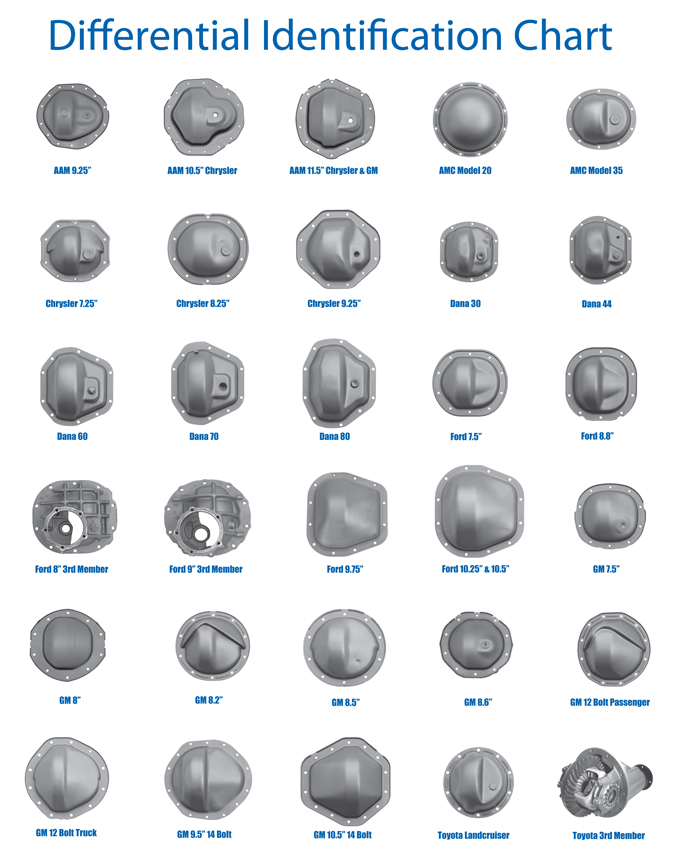
If there is an axle you would like me to get more info on let me know.
Like to thank Google, pirate4x4, TORD, RME 4x4, th ranger station for public info. hope this helps. all info is to help you find info and facts. can not be 100% on all information but true to my knowledge.
The front axle
the front axle is a D30 , came standard in all XJ's but was updated over time, some stronger then others.
1984–1996: Dana 30, High Pinion, Reverse Cut, 27-spline axleshafts (1989 – 1995 : with ABS used 5-297x universal joints, non-ABS had 5-260x universal joints.
1996–1999: Dana 30, High Pinion, Reverse Cut, 297x/760 universal joint, 27-spline axleshafts.
2000–2001: Dana 30, Low Pinion, Standard Cut, 297x/760 universal joint, 27-spline axleshafts.
1985–2001: Straight Axle non-driven front axle for two-wheel drive only.
Rear axle options
1984–1989: Dana 35, non c-clip, with anti-lock braking system (ABS) or non-ABS.
1987–1990: Dana 44, non-abs, 30-spline axleshafts.
1990–1996: Dana 35, c-clip, ABS or non-ABS.
1997–2001: Dana 35, c-clip, ABS.
1991–1996: Chrysler 8.25", c-clip, non-ABS, 27-spline axleshafts.
1996–2001: Chrysler 8.25", c-clip, non-ABS, 29-spline axleshafts.
Jeep XJs came in several standard gearing ratios depending on what options and power train the vehicle was equipped with. its pretty standard that automatics came with 3.55 gearing and manuals came with 3.07's. but 4cyl's had lower options as well.
3.07:1, manual transmission, I6 engine.
3.55:1, automatic transmission, I6, manual transmission I4 engine.
3.73:1, automatic transmission, I6, Tow Package/UpCountry Package.
4.10:1, manual transmission, V6; automatic transmission, I4 engine.
4.56:1, automatic transmission, I4, offroad or tow package
Axle type
Before we get to carrier away with what good swaps are lets explain the differences in axle types other then size.
High pinion differential - A high pinion axle has the pinion gear going into the diff above center line of the axle tube. In a front application the way that the gears mesh actually pulls the gear faces together making them have a strong bond and minimal deflection. In a rear aplication its the opposite. The gear actually turns the other way making the gear faces pull away from each other causing deflection and make the diff weaker under high load.
Low Pinion differential - A low pinion differential enters the diff below the center line of the axle tube. In a rear low pinion application the gear faces mesh and pull each other together making it a strong bond. and in a front Application the gears will pull away from each other causing deflection.
pic to show LP vs HP
There are also full float and semi float axles. in simple terms:
A full float axle does not hold the weight of the vehicle, just the torque applied to move it, which take a lot of load and binding off the axle shaft and allows it to handle a higher load. the weight of the vehicle in this setup is held by bearings and a hub with a spindle setup. the axle shaft fully floats between the spindle and the diff. this setup allows axle's and wheels to remain in place when they brake and can be driven on for a short period of time with minimal damage.
A Semi float axle has to support the weight of the vehicle and the torque applied which causes the axle to be under more stress and weaker because of it. the axle floats in the diff but is held in place at the outer flange which is why its a "semi" floating axle. the bearings in the axle housing actually ride on the axle shaft and not a spindle. a C-clip is a style of semi float as the C-clip hold the axles position and wont allow the axle to walk out of the diff, which can be a weak point or allow the axle to walk out of the housing if it breaks. which means you must change the shaft immediately if it brakes.
All front axles are Full floating. most 1/2 and some 3/4 ton rear axles are semi floating axles.
Good axle info from a few sites tried to get good info and pile it all together in a organized fashion lol, good way to size up or compare axles you may be thinking about swapping or upgrading to, or compare what you already have, and see there limits.
FRONT AXLES
D27 Front Axle:
Full Floating
Vehicles: '66-'71 CJ-5 and CJ-6; '63-'70 Wagoneer; '67-'71 C-101 Jeepster
Ring Gear: 7.2"
Stock Gearing:
Axleshaft Spline: 10
Axleshaft Diameter: 1.13"
Axle Joint: Spicer 260X
Knuckle: Closed
Brakes: Drum 10" 11"
Weakness: Weak axle for upgrades, low spline count, weak carrier
Width: 51" (CJ and Jeepster), 57.5" (Wagoneer)
Wheel Bolt: 5x5.5"
Max Recommended Tire Size: 31"
D30 Front Axle:
Full/Semi Floating
Vehicles: From ’72 CJ-5, CJ-6, CJ-7, CJ-8, YJ, TJ, XJ, ZJ, C104, WJ
Ring Gear: 7.125”, 7.33” (TJ/WJ Only)
Stock Gearing: 3.07, 3.54 (3.55), 3.73, 4.10 (4.11)
Axleshaft Spline: 27
Axleshaft Diameter: 1.16”, 1.193” (TJ/WJ Only)
Axle Joint: Spicer 260X (pre ’95.5), Spicer 297/760X (post ’95.5), CV & 760 U-Joint (TJ/WJ)
Knuckle: Open
Brakes: Drum 11” (pre ’76), Disc (post ’76)
Weakness: 260X U-joint; YJ Vacuum motor fails; standard CV problems
Width: 51” (’72-’75 CJ, C-104), 53” (’76-’81 CJ), 56” (’82-’86 CJ), 60.5” (TJ, YJ, XJ, WJ)
Wheel Bolt: 5x5.5” (CJ/C-104), 5x4.5” (others)
Max Recommended Tire Size: 35”
AAM 790 Front Axle
Semi Floating
Vehicles: '05 and later WK
Ring Gear: 7.87"
Stock Gearing:
Axleshaft Spline:
Axleshaft Diameter:
Axleshaft Joint: CV
Knuckle: Open
Brakes: Disc
Weakness: Limited modification ability, small ring gear
Width:
Wheel Bolt:
Max Recommended Tire Size: 32"
D44 Front Axle:
Full/Semi Floating
Vehicles: ’57-’65 FC-170; ’63-’70 Gladiator; '67-'79 1/2 & 3/4 Ton Ford Pickups; ’71-’87 J-Series; ’71-’91 Wagoneer; '72-'93 1/2 & 3/4 Ton Dodge Pickups; '73-'79 1/2 & 3/4 Ton Chevy Pickups; ’74-’83 Cherokee; ’03-’06 Rubicon
Ring Gear: 8.5”
Stock Gearing: Many
Axleshaft Spline: 19 (pre ’71), 30 (post ’71)
Axleshaft Diameter: 1.25” (19 spline), 1.31” (30 spline)
Axle Joint: Spicer 206X (pre ’73), Spicer 297/760C (post ’73)
Knuckle: Closed (pre ’73), Open (post ’73)
Brakes: Drum 11” (pre ’73), Disc (post ’73)
Weakness: 260X and 19 spline axleshafts
Width: 63” (FC-170), 57.5” (’71-’73 Wagoneer), 59” (’74 and later Wagoneer), 65.5” (J-Series), 60.5” (Rubicon), Full Width (Ford, Dodge, Chevy)
Wheel Bolt: (Varies)
Max Recommended Tire Size: 37”
D60 Front Axle:
Full Floating
Vehicles: ‘67-’69 Kaiser M-715; ‘72-‘93 3/4 & 1 Ton Dodge Pickups; ‘74-‘77 3/4 Ton Ford Pickups; ‘77-‘87 3/4 & 1 Ton Chevy Pickups; ‘78-‘79 1 Ton Ford Pickups
Ring Gear: 9.75”
Stock Gearing: 4.10, 4.56
Axleshaft Spline: 30
Axleshaft Diameter: 1.31”
Axle Joint: Unknown Spicer
Knuckle: Closed
Brakes: Drum 13”
Weakness: Metallurgically axleshafts inferior to modern metals
Width: 72.5” (M-715), Full Width (Ford, Dodge and Chevy)
Wheel Bolt: 6x8.25”
Max Recommended Tire Size: 42”
REAR AXLES (no order)
D35 Rear Axle:
Semi-floating (’85-’89), C-clip (’90 and later)
Vehicles: Most XJ; YJ; TJ (except Rubicon); ZJ; some WJ
Ring Gear: 7.562”
Stock Gearing: 3.07, 3.54 (3.55), 3.73, 4.10 (4.11)
Axleshaft Spline: 27
Axleshaft Diameter: 1.13”
Brakes: Drum 11”; Disc (later ZJ/WJ)
Weakness: Weak carrier & axleshafts
Width: 60.5”
Wheel Bolt: 5x4.5”
Max Recommended Tire Size: 33”
It has a very weak and flexible housing that causes C-clip axle and differential problems. Unfortunately, it has unbelievable aftermarket support despite its weakness. However, consider any upgrades to this axle a Band-Aid for the real problem. If you're running it hard (especially with a locker) and it hasn't spit out its insides and it's not bleeding gear oil out of the pressed-in tubes and plug welds, it soon will be.
D44 Rear Axle:
Semi Floating
Vehicles (here we go…*long breath*): ’49-’65 6cyl ***** Wagons; ’49.5-’53 CJ-3A; ’53-’68 CJ-3B; ’50-’52 M-38; ’52-’57 M-38A1; ’53-’57 M-170; ’55-’75 CJ-5 & CJ-6; ’85.5-’86 CJ-7; ’58-’65 FC-150; ’57-’65 FC-170; ’63-’70 Wagoneer & Gladiator Pickup; ’67-’71 C-101 Jeepster; ’72-’73 C-104; ’71-’75 Wagoneer & ½-ton J-Series; ’74-’83 Cherokee; ’87-’91 Grand Wagoneer; Some ’86-’92 XJ and MJ; Some ’97-’06 TJ; ’99-’04 WJ; ’96-’98 ZJ
Ring Gear: 8.5”, 8.9” (WJ only )
Stock Gearing: Many, including 3.55, 3.73, 4.11
Axleshaft Spline: 10 (’49-’55), 19 (’56-’70.5), 30 (’70.5 and later)
Axleshaft Diameter: 1.193” (WJ/ZJ) 1.25” (10 and 19 Spline), 1.31 (30 Spline)
Brakes: Drum 9”, 10”, 11”; Disc (Rubicon, ZJ, WJ)
Weakness: 10 & 19 Spline, Some aluminum housings.
Width: 50.5” (up to ’75 CJ, FC, C-101, C-104), 54.5” (’85-’86 CJ), 57.5” (’63-’73 Wagoneer), 60.5” (XJ, MJ, TJ, ZJ, WJ), 65.5” (FSJ Cherokee, J-Series)
Wheel Bolt: Varies
Max Recommended Tire Size: 38"
(Dana 44 non-Wrangler)
Much like the Dana 44 front axle, the 44 rearend enjoys a lot of aftermarket support in the form of optional ratios, floater kits, and aftermarket differentials for more traction. Some early models are plagued with small bend-prone axletubes, weak coarse-spline shafts (as well as two-piece shafts), and coarse-spline pinions. Early '70-and-later Dana 44 rears are much more desirable. Look for 2 3/4-inch axletubes and 30-spline, one-piece shafts.
(Alum Dana 44 ZJ)
It's a decent, relatively durable axle, but there isn't much aftermarket support because it's fairly uncommon.
(06-and-earlier Wrangler Dana 44)
The smallish axletubes (same as Dana 35) can flex and cause carrier bearing and other failures if abused. It has lots of aftermarket support but limited available ratios if you are using the stock Rubicon differential.
(07-and-later Wrangler (Rubicon only) Dana 44)
It features stronger tubes than the axles in the previous model Wrangler and 32-spline shafts. It's sure to see plenty of aftermarket support, including complete assemblies available from Mopar.
D53 Rear Axle:
Semi Floating
Vehicles: '55-'65 ****** pickup; '63-'69 Gladiator; '57-'65 FC-170
Ring Gear: 9.25"
Stock Gearing:
Axleshaft Spline: 20
Axleshaft Diameter: 1.31"
Brakes: Drum 11"
Weakness: Hard to find parts, low spline
Width: 65.5" (Gladitaor), 63" (Others)
Wheel Bolt: 5x5.5"
Max Recommended Tire Size: 35"
D60 Rear Axle:
Semi/Full Floating
Vehicles: ‘67-‘69 1/2 & 3/4 Ton Ford Pickups; ’69-’87 J-2000/J-20; ‘72-‘93 3/4 Ton Dodge Pickups
Ring Gear: 9.75”
Stock Gearing 4.10, 4.56
Axleshaft Spline: 30
Axleshaft Diameter: 1.31”
Brakes: Drum 12”
Weakness:
Width: 65.5” (J-2000/J-20), Full Width (Ford, Dodge & Chevy)
Wheel Bolt: 8x6.5”
Max Recommended Tire Size: 42”
(Full-floating, 30-spline Dana 60)
These are extremely common and can be easily found in junkyards under Dodges, Fords, GMs, and Jeeps alike. They are most often found under 3/4-ton vans and pickups, but a few came under Mopar musclecars. There is a lot of aftermarket support for the Dana 60.
(Full-floating 35-spline Dana 60)
They enjoy plenty of aftermarket support because they use common Dana 60 gears and carriers. However, they're very uncommon, and you're not likely to find one in a wrecking yard. Many 35-spline 60 rear axles have been converted from 30-spline housings.
(Semifloating Dana 60)
It's a little rare, but it can be found under early F-150s and early-'70s FSJ pickups. It features desirable 35-spline shafts and uses common Dana 60 gears and carriers, so a lot of aftermarket ratios and differentials are available.
D70 Rear Axle:
Full Floating
Vehicles:’58-’68 FC-170 w/dual rear wheels; ’63-’68 J-3000 w/dual rear wheels; ’67-’69 M-715; CJ-10; '72-‘93 3/4 & 1 Ton Dodge Pickups; ‘76-‘77 3/4 Ton Ford Pickups; ‘77-‘87 1 Ton Chevrolet Pickups; ‘78-‘79 1 Ton Ford Pickups
Ring Gear: 10.5”
Stock Gearing: 4.10, 4.56
Axleshaft Spline: 23, 35
Axleshaft Diameter: 1.5”
Brakes: Drum 13”
Weakness: Poor parts availability
Width: 59” (FC & Pickup), 72” (M-715), Full Width (Ford, Dodge and Chevy)
Wheel Bolt: 6x7.25” (M-715), 8x6.5” (others)
Max Recommended Tire Size: 44”
The Dana 70 is another member of the cheap beef squad. However, there are several versions making them more difficult to identify. Look for the Dana 70U or 70HD. These feature desirable 1 1/2-inch, 35-spline shafts. There are also plenty of ratios and a good number of aftermarket differentials available for these versions of the 70 as well. They are often found in 1-ton Dodge, Ford, and GM trucks, vans, and even some tractors and heavy equipment.
AMC20 Rear Axle:
Semi Floating
Vehicles: ’76-’86 CJ; ’76-’91 Wagoneer and J-10
Ring Gear: 8.875”
Stock Gearing: 2.76, 3.07
Axleshaft Spline: 20
Axleshaft Diameter: 1.31”
Brakes: Drum 11”
Weakness: 2 piece axleshafts (CJ only), tubes spin, 20 spline
Width: 50.5” (’76-’81 CJ), 54.5” (’82-’86 CJ), 59” (Wagoneer), 65.5” (J-Series)
Wheel Bolt: 5x5.5” (CJ), 6x5.5” (Wagoneer and J-Series)
Max Recommended Tire Size: 33”-35”
(CJ)
The AMC 20 is marginal in a stock application. It has a very weak and flexible housing that can lead to other problems. The two-piece axleshafts are notoriously fail-prone. Much like the Dana 35, this axle is best swapped out if you are planning to spend money on it or run larger-than-stock tires.
(AMC 20 FSJ)
The FSJ AMC 20 is stronger than the CJ version and perhaps about equal to the strength of a newer Dana 44. However, it doesn't enjoy as much aftermarket support as the Dana. Fewer gear ratios and lockers are available.
Chrysler 8.25 Rear Axle:
C-clip
Vehicles: '91-'01 XJ
Ring Gear: 8.25”
Stock Gearing: 3.55, 3.73, 4.10
Axleshaft Spline: 27 ('91-'96), 29 ('96-'01)
Axleshaft Diameter: 1.17” (27 spline), 1.21 (29 spline)
Brakes: Drum 11”
Weakness: 27 spline, c-clip
Width: 60.5”
Wheel Bolt: 5x4.5”
Max Recommended Tire Size: 35”
It's a decent axle when mated with moderate-sized tires, however, few gear ratios are available. It doesn't have much aftermarket support.The 29 Spline is a better choice then the 27, and the 29 spline is comparable to the D44.
Ford 8.8 Rear Axle
Vehicles: Ford Explorer (Prefered Swap, information reflects Explorer only), Ford F-Series , Ford Ranger
Ring Gear: 8.8"
Stock Gearing: 3.08, 3.27, 3.55, 3.73, 4.10
Axleshaft Spline: 28, 31
Axleshaft Diameter: 1.320"
Brakes: Drum ('91-'94), Disc ('95-'01)
Weakness: C-clip, weak carrier
Width: 59.625" to 65.6"
Wheel Bolt: Most 5x4.5"
Max Recommended Tire Size: 40"
(Ranger and Explorer)
Some versions have weaker 28-spline shafts. The '91-'01 Explorer 31-spline version is preferred ('95-and-later have disc brakes). There's a lot of aftermarket support for the 8.8, but the C-clip shafts are a notable weakness. Commonly swapped into Wranglers in place of the Dana 35, although the marginal gain in strength hardly seems worth the effort.
(full size version)
All have 31-spline shafts and undesirable C-clips retaining the axles. Not a particularly good full-width axle for a Jeep swap
Ford 9 inch
vehicles: 57-'59 Ford station wagons, including Ranchero and sedan delivery
58-'90 F-100 and F-150 pickups
57-'67 Thunderbird
63-'69 Falcon and Comet
57-'64 Ford and Mercury full-size cars 63-'69 Fairlane (note: '67 Fairlanes had coil rear springs instead of leaf)
58-'60 Edsel
66-'77 Bronco (uses a larger five-on-51/2-inch wheel bolt pattern)
75-'78 Ford Granada and Mercury Monarch
71-'76 Torino, Ranchero and Mercury Montego
77-'81 Lincoln Versailles
70-'79 Lincoln and Continental
72-'86 E-250 Ford vans
65-'73 Mustang
67-'73 Cougar
Stock gearing:2.50,3.08, 3.27, 3.55, 3.73,4.11,4.30
Axleshaft Spline:28, 31
Axleshaft Diameter:
Brakes:
Width:
Wheel Bolt:
Max Recommended Tire Size:40"
It's the king of aftermarket components. The 9-inch came in Ford cars and trucks and can be found in many configurations, lug patterns, and widths; junkyard versions are becoming more difficult to find. Look for the stronger 31-spline versions over the weaker 28-spline. Most axles can be converted to stronger 31-, 33-, 35-, and even 40-spline shafts with bolt-on parts. Plenty of differentials are available and gear ratios ranging from 2.80:1 to 6.50:1 are easy to find. Complete aftermarket housings and entire assemblies are available.
Ford 10.25
Vehicles:
E250: 1985 - 1998
F150: 2000 - 2006
F250: 1985 - 1998
F350: 1985 - 1998
Differentials older than 1993 will require a new yoke to be compatible with a new ring and pinion.
Ring Gear Diameter: 10.25" and 10.5"
Ring Gear Bolts: (12) 1/2 x 20 RH
Cover Bolts: 12
Carrier Breaks: None
Spline Count: 1.940 / 31
Float: FF, some SF
Pinion Support: N/A
Ring gear measures 10.5".
35 Spline axle shafts with a 1.5" diameter
Ratios 3.08 to 4.30. Current production ratios offered are 3.73, 4.10 and 4.30
Axle Lugs: 8
The ring gear is huge, but aftermarket support is not. The gear ratios and differential selection is limited. Heavy use will also cause the axletubes to break free and rotate inside the centersection. Not a great full-width swap. Most applications were full floating however some applications do have c/clip axles
GM 14 bolt
Vehicle; The 14bolt is found in a huge number of GM 4x4 pickup trucks and vans, 3/4 and 1 ton, from the 70's right through until at least 2000.
73-96 C20, C2573-00 C30, C3573-00 G30, G3573-00 K20, K2573-00 K30, K3584-88 CUCV,
88-91.5 V30 As well as a whole lot more cab and chasis trucks, delivery vans, etc.
Axles are 30 spline axles
1.590” diameter shank on the pinion
Gear ratios: 3.21, 3.42, 3.73, 4.10, 4.56, 4.88, 5.13, and 5.38
Carrier break: 3.21:1 - 4.11:1 and 4:56 - 5.38
axle spline diameter 1.50”
axle shaft diameter 1.34”
Strong Axles - 1.5" diameter, 30-spline
Stout Housing - large 3.375" x 0.5" tubes
Easily converted to disc brakes
Common to find with 4.10 and 4.56 ratio
Pinion supported with bearings on both sides of the teeth which minimizes pinion deflection
Removable pinion support
Weight: 550 pounds (250 kg)
(Full-Floating GM 14-bolt)
The 14-bolt is the king of cheap beef when running tires up to and more than 44 inches tall. The 10.5" full-floating 14 bolts are much easier to find and are super strong as built from the factory and pretty cheap to buy. You can't deny the strength of the 10 1/2-inch ring gear, huge 30-spline pinion, and 1 1/2-inch, 30-spline axleshafts. It also enjoys a decent number of aftermarket gear ratios and differentials. The fact that it has a removable pinion support and spanner adjustable backlash makes 14-bolt gear and differential swaps relatively easy. It can be found in GM 3/4- and 1-ton trucks and vans in a few different widths. It's often found in wrecking yards for less than $200 because it's so common. Perhaps its only real weakness is the thin tinfoil-like diff cover.
(semi floating GM 14 bolt)
The light-duty 3/4 tons and optioned Z-71's had the 9.5" semi-floating 14 bolt. still a strong axle not as big or strong as its big brother. but cam in a more wide spread lug pattern with some 6,5,8 lug options.
Other axle info but not really ideal for XJ's
Low-pinion Dana 30 (Mexico CJ)
It's a rare pile, but it's out there. It has weak tubes, a smallish ring gear, and two-piece axleshafts.
Chevy 10-bolt
Much like the Dana 35, it has a very weak and flexible housing that can lead to other problems. An abused Gov-loc is a death warrant for the 10-bolt rearend. It's not a swap-worthy, full-width axle for Jeeps.
GM 12-bolt
Similar to the GM 10-bolt. It has a flexible housing and weak tubes for a full-width axle. It's not really a good 4x4 axle worth swapping into a Jeep.
Toyota 8-inch
Overall, it's a stout axle for its compact size. It actually makes an OK Jeep swap, but is often frowned upon for being an import part. The Toyota 8-inch has lots of aftermarket support.
Toyota Land Cruiser
They're getting harder to find, but they're still usable for a Jeep in need of an offset rearend, albeit an expensive oddball possibility with C-clips. An offset Dana 44 from a Quadra-Trac FSJ would be a better option.
Chrysler 9.25
It's only found in Dodge trucks and vans. Even though it's relatively strong, it's not all that great of a swap for a full-width axle. Very few ratios and aftermarket differentials are available for the 9.25. It's also a C-clip axle.
Rockwell 2 1/2-ton
Rockwell rear axles are often two to three times less expensive than their frontend counterparts. The housing, gears, carrier, and bearings are extremely durable. The 16-spline axleshafts are not. Aftermarket shafts are available to bring it above Dana 80 strength. Only one gear ratio and few lockers are available. Due to size, 6.72:1 gearing, and weight, it's not a good axle for tires less than 44 inches tall
AXLE STRENGHTS:
COT - Continuous Output Torque
MOT - Maximum Output Torque
Dana 35 ........................ COT: 870 MOT: 3480
Dana 44 ........................ COT: 1100 MOT: 4460
Ford 8.8 28 spline ........... COT: 1250 MOT: 4600
Ford 8.8 31 spline ........... COT: 1360 MOT: 5100
Dana 60 semifloat ........... COT: 1500 MOT: 5500
also should have one of these in here, main jeep diffs
one with almost all diffs
If there is an axle you would like me to get more info on let me know.
Like to thank Google, pirate4x4, TORD, RME 4x4, th ranger station for public info. hope this helps. all info is to help you find info and facts. can not be 100% on all information but true to my knowledge.
Last edited by Gorillaxj; Nov 27, 2011 at 02:12 PM.
CF Veteran
Joined: Sep 2010
Posts: 4,968
Likes: 0
From: Salt Lake City, UT
Year: 2000
Model: Cherokee
Engine: 4.0L
hope it helps. will be nice to have a link to send people to. I know you already covered some of it, just wanted to throw out all the info from a few links I normally check.
Last edited by Gorillaxj; Nov 27, 2011 at 02:19 PM.
Old Skewl CF like a Sir
Joined: Feb 2008
Posts: 4,355
Likes: 3
From: Fort Myers, FL
Year: 1996
Model: Cherokee
Engine: 4.0L High Output OBDII
Lets start with what we have stock....
The front axle
the front axle is a D30 , came standard in all XJ's but was updated over time, some stronger then others.
1984–1996: Dana 30, High Pinion, Reverse Cut, 27-spline axleshafts (1989 – 1995 : with ABS used 5-297x universal joints, non-ABS had 5-260x universal joints.
1996–1999: Dana 30, High Pinion, Reverse Cut, 297x/760 universal joint, 27-spline axleshafts.
2000–2001: Dana 30, Low Pinion, Standard Cut, 297x/760 universal joint, 27-spline axleshafts.
1985–2001: Straight Axle non-driven front axle for two-wheel drive only.
Rear axle options
1984–1989: Dana 35, non c-clip, with anti-lock braking system (ABS) or non-ABS.
1987–1990: Dana 44, non-abs, 30-spline axleshafts.
1990–1996: Dana 35, c-clip, ABS or non-ABS.
1997–2001: Dana 35, c-clip, ABS.
1991–1996: Chrysler 8.25", c-clip, non-ABS, 27-spline axleshafts.
1996–2001: Chrysler 8.25", c-clip, non-ABS, 29-spline axleshafts.
Jeep XJs came in several standard gearing ratios depending on what options and power train the vehicle was equipped with. its pretty standard that automatics came with 3.55 gearing and manuals came with 3.07's. but 4cyl's had lower options as well.
3.07:1, manual transmission, I6 engine.
3.55:1, automatic transmission, I6, manual transmission I4 engine.
3.73:1, automatic transmission, I6, Tow Package/UpCountry Package.
4.10:1, manual transmission, V6; automatic transmission, I4 engine.
4.56:1, automatic transmission, I4, offroad or tow package
Axle type
Before we get to carrier away with what good swaps are lets explain the differences in axle types other then size.
High pinion differential - A high pinion axle has the pinion gear going into the diff above center line of the axle tube. In a front application the way that the gears mesh actually pulls the gear faces together making them have a strong bond and minimal deflection. In a rear aplication its the opposite. The gear actually turns the other way making the gear faces pull away from each other causing deflection and make the diff weaker under high load.
Low Pinion differential - A low pinion differential enters the diff below the center line of the axle tube. In a rear low pinion application the gear faces mesh and pull each other together making it a strong bond. and in a front Application the gears will pull away from each other causing deflection.
pic to show LP vs HP
There are also full float and semi float axles. in simple terms:
A full float axle does not hold the weight of the vehicle, just the torque applied to move it, which take a lot of load and binding off the axle shaft and allows it to handle a higher load. the weight of the vehicle in this setup is held by bearings and a hub with a spindle setup. the axle shaft fully floats between the spindle and the diff. this setup allows axle's and wheels to remain in place when they brake and can be driven on for a short period of time with minimal damage.
A Semi float axle has to support the weight of the vehicle and the torque applied which causes the axle to be under more stress and weaker because of it. the axle floats in the diff but is held in place at the outer flange which is why its a "semi" floating axle. the bearings in the axle housing actually ride on the axle shaft and not a spindle. a C-clip is a style of semi float as the C-clip hold the axles position and wont allow the axle to walk out of the diff, which can be a weak point or allow the axle to walk out of the housing if it breaks. which means you must change the shaft immediately if it brakes.
All front axles are Full floating. most 1/2 and some 3/4 ton rear axles are semi floating axles.
Good axle info from a few sites tried to get good info and pile it all together in a organized fashion lol, good way to size up or compare axles you may be thinking about swapping or upgrading to, or compare what you already have, and see there limits.
FRONT AXLES
D27 Front Axle:
Full Floating
Vehicles: '66-'71 CJ-5 and CJ-6; '63-'70 Wagoneer; '67-'71 C-101 Jeepster
Ring Gear: 7.2"
Stock Gearing:
Axleshaft Spline: 10
Axleshaft Diameter: 1.13"
Axle Joint: Spicer 260X
Knuckle: Closed
Brakes: Drum 10" 11"
Weakness: Weak axle for upgrades, low spline count, weak carrier
Width: 51" (CJ and Jeepster), 57.5" (Wagoneer)
Wheel Bolt: 5x5.5"
Max Recommended Tire Size: 31"
D30 Front Axle:
Full/Semi Floating
Vehicles: From ’72 CJ-5, CJ-6, CJ-7, CJ-8, YJ, TJ, XJ, ZJ, C104, WJ
Ring Gear: 7.125”, 7.33” (TJ/WJ Only)
Stock Gearing: 3.07, 3.54 (3.55), 3.73, 4.10 (4.11)
Axleshaft Spline: 27
Axleshaft Diameter: 1.16”, 1.193” (TJ/WJ Only)
Axle Joint: Spicer 260X (pre ’95.5), Spicer 297/760X (post ’95.5), CV & 760 U-Joint (TJ/WJ)
Knuckle: Open
Brakes: Drum 11” (pre ’76), Disc (post ’76)
Weakness: 260X U-joint; YJ Vacuum motor fails; standard CV problems
Width: 51” (’72-’75 CJ, C-104), 53” (’76-’81 CJ), 56” (’82-’86 CJ), 60.5” (TJ, YJ, XJ, WJ)
Wheel Bolt: 5x5.5” (CJ/C-104), 5x4.5” (others)
Max Recommended Tire Size: 35”
AAM 790 Front Axle
Semi Floating
Vehicles: '05 and later WK
Ring Gear: 7.87"
Stock Gearing:
Axleshaft Spline:
Axleshaft Diameter:
Axleshaft Joint: CV
Knuckle: Open
Brakes: Disc
Weakness: Limited modification ability, small ring gear
Width:
Wheel Bolt:
Max Recommended Tire Size: 32"
D44 Front Axle:
Full/Semi Floating
Vehicles: ’57-’65 FC-170; ’63-’70 Gladiator; '67-'79 1/2 & 3/4 Ton Ford Pickups; ’71-’87 J-Series; ’71-’91 Wagoneer; '72-'93 1/2 & 3/4 Ton Dodge Pickups; '73-'79 1/2 & 3/4 Ton Chevy Pickups; ’74-’83 Cherokee; ’03-’06 Rubicon
Ring Gear: 8.5”
Stock Gearing: Many
Axleshaft Spline: 19 (pre ’71), 30 (post ’71)
Axleshaft Diameter: 1.25” (19 spline), 1.31” (30 spline)
Axle Joint: Spicer 206X (pre ’73), Spicer 297/760C (post ’73)
Knuckle: Closed (pre ’73), Open (post ’73)
Brakes: Drum 11” (pre ’73), Disc (post ’73)
Weakness: 260X and 19 spline axleshafts
Width: 63” (FC-170), 57.5” (’71-’73 Wagoneer), 59” (’74 and later Wagoneer), 65.5” (J-Series), 60.5” (Rubicon), Full Width (Ford, Dodge, Chevy)
Wheel Bolt: (Varies)
Max Recommended Tire Size: 37”
D60 Front Axle:
Full Floating
Vehicles: ‘67-’69 Kaiser M-715; ‘72-‘93 3/4 & 1 Ton Dodge Pickups; ‘74-‘77 3/4 Ton Ford Pickups; ‘77-‘87 3/4 & 1 Ton Chevy Pickups; ‘78-‘79 1 Ton Ford Pickups
Ring Gear: 9.75”
Stock Gearing: 4.10, 4.56
Axleshaft Spline: 30
Axleshaft Diameter: 1.31”
Axle Joint: Unknown Spicer
Knuckle: Closed
Brakes: Drum 13”
Weakness: Metallurgically axleshafts inferior to modern metals
Width: 72.5” (M-715), Full Width (Ford, Dodge and Chevy)
Wheel Bolt: 6x8.25”
Max Recommended Tire Size: 42”
REAR AXLES (no order)
D35 Rear Axle:
Semi-floating (’85-’89), C-clip (’90 and later)
Vehicles: Most XJ; YJ; TJ (except Rubicon); ZJ; some WJ
Ring Gear: 7.562”
Stock Gearing: 3.07, 3.54 (3.55), 3.73, 4.10 (4.11)
Axleshaft Spline: 27
Axleshaft Diameter: 1.13”
Brakes: Drum 11”; Disc (later ZJ/WJ)
Weakness: Weak carrier & axleshafts
Width: 60.5”
Wheel Bolt: 5x4.5”
Max Recommended Tire Size: 33”
It has a very weak and flexible housing that causes C-clip axle and differential problems. Unfortunately, it has unbelievable aftermarket support despite its weakness. However, consider any upgrades to this axle a Band-Aid for the real problem. If you're running it hard (especially with a locker) and it hasn't spit out its insides and it's not bleeding gear oil out of the pressed-in tubes and plug welds, it soon will be.
D44 Rear Axle:
Semi Floating
Vehicles (here we go…*long breath*): ’49-’65 6cyl ***** Wagons; ’49.5-’53 CJ-3A; ’53-’68 CJ-3B; ’50-’52 M-38; ’52-’57 M-38A1; ’53-’57 M-170; ’55-’75 CJ-5 & CJ-6; ’85.5-’86 CJ-7; ’58-’65 FC-150; ’57-’65 FC-170; ’63-’70 Wagoneer & Gladiator Pickup; ’67-’71 C-101 Jeepster; ’72-’73 C-104; ’71-’75 Wagoneer & ½-ton J-Series; ’74-’83 Cherokee; ’87-’91 Grand Wagoneer; Some ’86-’92 XJ and MJ; Some ’97-’06 TJ; ’99-’04 WJ; ’96-’98 ZJ
Ring Gear: 8.5”, 8.9” (WJ only )
Stock Gearing: Many, including 3.55, 3.73, 4.11
Axleshaft Spline: 10 (’49-’55), 19 (’56-’70.5), 30 (’70.5 and later)
Axleshaft Diameter: 1.193” (WJ/ZJ) 1.25” (10 and 19 Spline), 1.31 (30 Spline)
Brakes: Drum 9”, 10”, 11”; Disc (Rubicon, ZJ, WJ)
Weakness: 10 & 19 Spline, Some aluminum housings.
Width: 50.5” (up to ’75 CJ, FC, C-101, C-104), 54.5” (’85-’86 CJ), 57.5” (’63-’73 Wagoneer), 60.5” (XJ, MJ, TJ, ZJ, WJ), 65.5” (FSJ Cherokee, J-Series)
Wheel Bolt: Varies
Max Recommended Tire Size: 38"
(Dana 44 non-Wrangler)
Much like the Dana 44 front axle, the 44 rearend enjoys a lot of aftermarket support in the form of optional ratios, floater kits, and aftermarket differentials for more traction. Some early models are plagued with small bend-prone axletubes, weak coarse-spline shafts (as well as two-piece shafts), and coarse-spline pinions. Early '70-and-later Dana 44 rears are much more desirable. Look for 2 3/4-inch axletubes and 30-spline, one-piece shafts.
(Alum Dana 44 ZJ)
It's a decent, relatively durable axle, but there isn't much aftermarket support because it's fairly uncommon.
(06-and-earlier Wrangler Dana 44)
The smallish axletubes (same as Dana 35) can flex and cause carrier bearing and other failures if abused. It has lots of aftermarket support but limited available ratios if you are using the stock Rubicon differential.
(07-and-later Wrangler (Rubicon only) Dana 44)
It features stronger tubes than the axles in the previous model Wrangler and 32-spline shafts. It's sure to see plenty of aftermarket support, including complete assemblies available from Mopar.
D53 Rear Axle:
Semi Floating
Vehicles: '55-'65 ****** pickup; '63-'69 Gladiator; '57-'65 FC-170
Ring Gear: 9.25"
Stock Gearing:
Axleshaft Spline: 20
Axleshaft Diameter: 1.31"
Brakes: Drum 11"
Weakness: Hard to find parts, low spline
Width: 65.5" (Gladitaor), 63" (Others)
Wheel Bolt: 5x5.5"
Max Recommended Tire Size: 35"
D60 Rear Axle:
Semi/Full Floating
Vehicles: ‘67-‘69 1/2 & 3/4 Ton Ford Pickups; ’69-’87 J-2000/J-20; ‘72-‘93 3/4 Ton Dodge Pickups
Ring Gear: 9.75”
Stock Gearing 4.10, 4.56
Axleshaft Spline: 30
Axleshaft Diameter: 1.31”
Brakes: Drum 12”
Weakness:
Width: 65.5” (J-2000/J-20), Full Width (Ford, Dodge & Chevy)
Wheel Bolt: 8x6.5”
Max Recommended Tire Size: 42”
(Full-floating, 30-spline Dana 60)
These are extremely common and can be easily found in junkyards under Dodges, Fords, GMs, and Jeeps alike. They are most often found under 3/4-ton vans and pickups, but a few came under Mopar musclecars. There is a lot of aftermarket support for the Dana 60.
(Full-floating 35-spline Dana 60)
They enjoy plenty of aftermarket support because they use common Dana 60 gears and carriers. However, they're very uncommon, and you're not likely to find one in a wrecking yard. Many 35-spline 60 rear axles have been converted from 30-spline housings.
(Semifloating Dana 60)
It's a little rare, but it can be found under early F-150s and early-'70s FSJ pickups. It features desirable 35-spline shafts and uses common Dana 60 gears and carriers, so a lot of aftermarket ratios and differentials are available.
D70 Rear Axle:
Full Floating
Vehicles:’58-’68 FC-170 w/dual rear wheels; ’63-’68 J-3000 w/dual rear wheels; ’67-’69 M-715; CJ-10; '72-‘93 3/4 & 1 Ton Dodge Pickups; ‘76-‘77 3/4 Ton Ford Pickups; ‘77-‘87 1 Ton Chevrolet Pickups; ‘78-‘79 1 Ton Ford Pickups
Ring Gear: 10.5”
Stock Gearing: 4.10, 4.56
Axleshaft Spline: 23, 35
Axleshaft Diameter: 1.5”
Brakes: Drum 13”
Weakness: Poor parts availability
Width: 59” (FC & Pickup), 72” (M-715), Full Width (Ford, Dodge and Chevy)
Wheel Bolt: 6x7.25” (M-715), 8x6.5” (others)
Max Recommended Tire Size: 44”
The Dana 70 is another member of the cheap beef squad. However, there are several versions making them more difficult to identify. Look for the Dana 70U or 70HD. These feature desirable 1 1/2-inch, 35-spline shafts. There are also plenty of ratios and a good number of aftermarket differentials available for these versions of the 70 as well. They are often found in 1-ton Dodge, Ford, and GM trucks, vans, and even some tractors and heavy equipment.
AMC20 Rear Axle:
Semi Floating
Vehicles: ’76-’86 CJ; ’76-’91 Wagoneer and J-10
Ring Gear: 8.875”
Stock Gearing: 2.76, 3.07
Axleshaft Spline: 20
Axleshaft Diameter: 1.31”
Brakes: Drum 11”
Weakness: 2 piece axleshafts (CJ only), tubes spin, 20 spline
Width: 50.5” (’76-’81 CJ), 54.5” (’82-’86 CJ), 59” (Wagoneer), 65.5” (J-Series)
Wheel Bolt: 5x5.5” (CJ), 6x5.5” (Wagoneer and J-Series)
Max Recommended Tire Size: 33”-35”
(CJ)
The AMC 20 is marginal in a stock application. It has a very weak and flexible housing that can lead to other problems. The two-piece axleshafts are notoriously fail-prone. Much like the Dana 35, this axle is best swapped out if you are planning to spend money on it or run larger-than-stock tires.
(AMC 20 FSJ)
The FSJ AMC 20 is stronger than the CJ version and perhaps about equal to the strength of a newer Dana 44. However, it doesn't enjoy as much aftermarket support as the Dana. Fewer gear ratios and lockers are available.
Chrysler 8.25 Rear Axle:
C-clip
Vehicles: '91-'01 XJ
Ring Gear: 8.25”
Stock Gearing: 3.55, 3.73, 4.10
Axleshaft Spline: 27 ('91-'96), 29 ('96-'01)
Axleshaft Diameter: 1.17” (27 spline), 1.21 (29 spline)
Brakes: Drum 11”
Weakness: 27 spline, c-clip
Width: 60.5”
Wheel Bolt: 5x4.5”
Max Recommended Tire Size: 35”
It's a decent axle when mated with moderate-sized tires, however, few gear ratios are available. It doesn't have much aftermarket support.The 29 Spline is a better choice then the 27, and the 29 spline is comparable to the D44.
Ford 8.8 Rear Axle
Vehicles: Ford Explorer (Prefered Swap, information reflects Explorer only), Ford F-Series , Ford Ranger
Ring Gear: 8.8"
Stock Gearing: 3.08, 3.27, 3.55, 3.73, 4.10
Axleshaft Spline: 28, 31
Axleshaft Diameter: 1.320"
Brakes: Drum ('91-'94), Disc ('95-'01)
Weakness: C-clip, weak carrier
Width: 59.625" to 65.6"
Wheel Bolt: Most 5x4.5"
Max Recommended Tire Size: 40"
(Ranger and Explorer)
Some versions have weaker 28-spline shafts. The '91-'01 Explorer 31-spline version is preferred ('95-and-later have disc brakes). There's a lot of aftermarket support for the 8.8, but the C-clip shafts are a notable weakness. Commonly swapped into Wranglers in place of the Dana 35, although the marginal gain in strength hardly seems worth the effort.
(full size version)
All have 31-spline shafts and undesirable C-clips retaining the axles. Not a particularly good full-width axle for a Jeep swap
Ford 9 inch
vehicles: 57-'59 Ford station wagons, including Ranchero and sedan delivery
58-'90 F-100 and F-150 pickups
57-'67 Thunderbird
63-'69 Falcon and Comet
57-'64 Ford and Mercury full-size cars 63-'69 Fairlane (note: '67 Fairlanes had coil rear springs instead of leaf)
58-'60 Edsel
66-'77 Bronco (uses a larger five-on-51/2-inch wheel bolt pattern)
75-'78 Ford Granada and Mercury Monarch
71-'76 Torino, Ranchero and Mercury Montego
77-'81 Lincoln Versailles
70-'79 Lincoln and Continental
72-'86 E-250 Ford vans
65-'73 Mustang
67-'73 Cougar
Stock gearing:2.50,3.08, 3.27, 3.55, 3.73,4.11,4.30
Axleshaft Spline:28, 31
Axleshaft Diameter:
Brakes:
Width:
Wheel Bolt:
Max Recommended Tire Size:40"
It's the king of aftermarket components. The 9-inch came in Ford cars and trucks and can be found in many configurations, lug patterns, and widths; junkyard versions are becoming more difficult to find. Look for the stronger 31-spline versions over the weaker 28-spline. Most axles can be converted to stronger 31-, 33-, 35-, and even 40-spline shafts with bolt-on parts. Plenty of differentials are available and gear ratios ranging from 2.80:1 to 6.50:1 are easy to find. Complete aftermarket housings and entire assemblies are available.
Ford 10.25
Vehicles:
E250: 1985 - 1998
F150: 2000 - 2006
F250: 1985 - 1998
F350: 1985 - 1998
Differentials older than 1993 will require a new yoke to be compatible with a new ring and pinion.
Ring Gear Diameter: 10.25" and 10.5"
Ring Gear Bolts: (12) 1/2 x 20 RH
Cover Bolts: 12
Carrier Breaks: None
Spline Count: 1.940 / 31
Float: FF, some SF
Pinion Support: N/A
Ring gear measures 10.5".
35 Spline axle shafts with a 1.5" diameter
Ratios 3.08 to 4.30. Current production ratios offered are 3.73, 4.10 and 4.30
Axle Lugs: 8
The ring gear is huge, but aftermarket support is not. The gear ratios and differential selection is limited. Heavy use will also cause the axletubes to break free and rotate inside the centersection. Not a great full-width swap. Most applications were full floating however some applications do have c/clip axles
GM 14 bolt
Vehicle; The 14bolt is found in a huge number of GM 4x4 pickup trucks and vans, 3/4 and 1 ton, from the 70's right through until at least 2000.
73-96 C20, C2573-00 C30, C3573-00 G30, G3573-00 K20, K2573-00 K30, K3584-88 CUCV,
88-91.5 V30 As well as a whole lot more cab and chasis trucks, delivery vans, etc.
Axles are 30 spline axles
1.590” diameter shank on the pinion
Gear ratios: 3.21, 3.42, 3.73, 4.10, 4.56, 4.88, 5.13, and 5.38
Carrier break: 3.21:1 - 4.11:1 and 4:56 - 5.38
axle spline diameter 1.50”
axle shaft diameter 1.34”
Strong Axles - 1.5" diameter, 30-spline
Stout Housing - large 3.375" x 0.5" tubes
Easily converted to disc brakes
Common to find with 4.10 and 4.56 ratio
Pinion supported with bearings on both sides of the teeth which minimizes pinion deflection
Removable pinion support
Weight: 550 pounds (250 kg)
(Full-Floating GM 14-bolt)
The 14-bolt is the king of cheap beef when running tires up to and more than 44 inches tall. The 10.5" full-floating 14 bolts are much easier to find and are super strong as built from the factory and pretty cheap to buy. You can't deny the strength of the 10 1/2-inch ring gear, huge 30-spline pinion, and 1 1/2-inch, 30-spline axleshafts. It also enjoys a decent number of aftermarket gear ratios and differentials. The fact that it has a removable pinion support and spanner adjustable backlash makes 14-bolt gear and differential swaps relatively easy. It can be found in GM 3/4- and 1-ton trucks and vans in a few different widths. It's often found in wrecking yards for less than $200 because it's so common. Perhaps its only real weakness is the thin tinfoil-like diff cover.
(semi floating GM 14 bolt)
The light-duty 3/4 tons and optioned Z-71's had the 9.5" semi-floating 14 bolt. still a strong axle not as big or strong as its big brother. but cam in a more wide spread lug pattern with some 6,5,8 lug options.
Other axle info but not really ideal for XJ's
Low-pinion Dana 30 (Mexico CJ)
It's a rare pile, but it's out there. It has weak tubes, a smallish ring gear, and two-piece axleshafts.
Chevy 10-bolt
Much like the Dana 35, it has a very weak and flexible housing that can lead to other problems. An abused Gov-loc is a death warrant for the 10-bolt rearend. It's not a swap-worthy, full-width axle for Jeeps.
GM 12-bolt
Similar to the GM 10-bolt. It has a flexible housing and weak tubes for a full-width axle. It's not really a good 4x4 axle worth swapping into a Jeep.
Toyota 8-inch
Overall, it's a stout axle for its compact size. It actually makes an OK Jeep swap, but is often frowned upon for being an import part. The Toyota 8-inch has lots of aftermarket support.
Toyota Land Cruiser
They're getting harder to find, but they're still usable for a Jeep in need of an offset rearend, albeit an expensive oddball possibility with C-clips. An offset Dana 44 from a Quadra-Trac FSJ would be a better option.
Chrysler 9.25
It's only found in Dodge trucks and vans. Even though it's relatively strong, it's not all that great of a swap for a full-width axle. Very few ratios and aftermarket differentials are available for the 9.25. It's also a C-clip axle.
Rockwell 2 1/2-ton
Rockwell rear axles are often two to three times less expensive than their frontend counterparts. The housing, gears, carrier, and bearings are extremely durable. The 16-spline axleshafts are not. Aftermarket shafts are available to bring it above Dana 80 strength. Only one gear ratio and few lockers are available. Due to size, 6.72:1 gearing, and weight, it's not a good axle for tires less than 44 inches tall
AXLE STRENGHTS:
COT - Continuous Output Torque
MOT - Maximum Output Torque
Dana 35 ........................ COT: 870 MOT: 3480
Dana 44 ........................ COT: 1100 MOT: 4460
Ford 8.8 28 spline ........... COT: 1250 MOT: 4600
Ford 8.8 31 spline ........... COT: 1360 MOT: 5100
Dana 60 semifloat ........... COT: 1500 MOT: 5500
also should have one of these in here, main jeep diffs
one with almost all diffs
If there is an axle you would like me to get more info on let me know.
Like to thank Google, pirate4x4, TORD, RME 4x4, th ranger station for public info. hope this helps. all info is to help you find info and facts. can not be 100% on all information but true to my knowledge.
The front axle
the front axle is a D30 , came standard in all XJ's but was updated over time, some stronger then others.
1984–1996: Dana 30, High Pinion, Reverse Cut, 27-spline axleshafts (1989 – 1995 : with ABS used 5-297x universal joints, non-ABS had 5-260x universal joints.
1996–1999: Dana 30, High Pinion, Reverse Cut, 297x/760 universal joint, 27-spline axleshafts.
2000–2001: Dana 30, Low Pinion, Standard Cut, 297x/760 universal joint, 27-spline axleshafts.
1985–2001: Straight Axle non-driven front axle for two-wheel drive only.
Rear axle options
1984–1989: Dana 35, non c-clip, with anti-lock braking system (ABS) or non-ABS.
1987–1990: Dana 44, non-abs, 30-spline axleshafts.
1990–1996: Dana 35, c-clip, ABS or non-ABS.
1997–2001: Dana 35, c-clip, ABS.
1991–1996: Chrysler 8.25", c-clip, non-ABS, 27-spline axleshafts.
1996–2001: Chrysler 8.25", c-clip, non-ABS, 29-spline axleshafts.
Jeep XJs came in several standard gearing ratios depending on what options and power train the vehicle was equipped with. its pretty standard that automatics came with 3.55 gearing and manuals came with 3.07's. but 4cyl's had lower options as well.
3.07:1, manual transmission, I6 engine.
3.55:1, automatic transmission, I6, manual transmission I4 engine.
3.73:1, automatic transmission, I6, Tow Package/UpCountry Package.
4.10:1, manual transmission, V6; automatic transmission, I4 engine.
4.56:1, automatic transmission, I4, offroad or tow package
Axle type
Before we get to carrier away with what good swaps are lets explain the differences in axle types other then size.
High pinion differential - A high pinion axle has the pinion gear going into the diff above center line of the axle tube. In a front application the way that the gears mesh actually pulls the gear faces together making them have a strong bond and minimal deflection. In a rear aplication its the opposite. The gear actually turns the other way making the gear faces pull away from each other causing deflection and make the diff weaker under high load.
Low Pinion differential - A low pinion differential enters the diff below the center line of the axle tube. In a rear low pinion application the gear faces mesh and pull each other together making it a strong bond. and in a front Application the gears will pull away from each other causing deflection.
pic to show LP vs HP
There are also full float and semi float axles. in simple terms:
A full float axle does not hold the weight of the vehicle, just the torque applied to move it, which take a lot of load and binding off the axle shaft and allows it to handle a higher load. the weight of the vehicle in this setup is held by bearings and a hub with a spindle setup. the axle shaft fully floats between the spindle and the diff. this setup allows axle's and wheels to remain in place when they brake and can be driven on for a short period of time with minimal damage.
A Semi float axle has to support the weight of the vehicle and the torque applied which causes the axle to be under more stress and weaker because of it. the axle floats in the diff but is held in place at the outer flange which is why its a "semi" floating axle. the bearings in the axle housing actually ride on the axle shaft and not a spindle. a C-clip is a style of semi float as the C-clip hold the axles position and wont allow the axle to walk out of the diff, which can be a weak point or allow the axle to walk out of the housing if it breaks. which means you must change the shaft immediately if it brakes.
All front axles are Full floating. most 1/2 and some 3/4 ton rear axles are semi floating axles.
Good axle info from a few sites tried to get good info and pile it all together in a organized fashion lol, good way to size up or compare axles you may be thinking about swapping or upgrading to, or compare what you already have, and see there limits.
FRONT AXLES
D27 Front Axle:
Full Floating
Vehicles: '66-'71 CJ-5 and CJ-6; '63-'70 Wagoneer; '67-'71 C-101 Jeepster
Ring Gear: 7.2"
Stock Gearing:
Axleshaft Spline: 10
Axleshaft Diameter: 1.13"
Axle Joint: Spicer 260X
Knuckle: Closed
Brakes: Drum 10" 11"
Weakness: Weak axle for upgrades, low spline count, weak carrier
Width: 51" (CJ and Jeepster), 57.5" (Wagoneer)
Wheel Bolt: 5x5.5"
Max Recommended Tire Size: 31"
D30 Front Axle:
Full/Semi Floating
Vehicles: From ’72 CJ-5, CJ-6, CJ-7, CJ-8, YJ, TJ, XJ, ZJ, C104, WJ
Ring Gear: 7.125”, 7.33” (TJ/WJ Only)
Stock Gearing: 3.07, 3.54 (3.55), 3.73, 4.10 (4.11)
Axleshaft Spline: 27
Axleshaft Diameter: 1.16”, 1.193” (TJ/WJ Only)
Axle Joint: Spicer 260X (pre ’95.5), Spicer 297/760X (post ’95.5), CV & 760 U-Joint (TJ/WJ)
Knuckle: Open
Brakes: Drum 11” (pre ’76), Disc (post ’76)
Weakness: 260X U-joint; YJ Vacuum motor fails; standard CV problems
Width: 51” (’72-’75 CJ, C-104), 53” (’76-’81 CJ), 56” (’82-’86 CJ), 60.5” (TJ, YJ, XJ, WJ)
Wheel Bolt: 5x5.5” (CJ/C-104), 5x4.5” (others)
Max Recommended Tire Size: 35”
AAM 790 Front Axle
Semi Floating
Vehicles: '05 and later WK
Ring Gear: 7.87"
Stock Gearing:
Axleshaft Spline:
Axleshaft Diameter:
Axleshaft Joint: CV
Knuckle: Open
Brakes: Disc
Weakness: Limited modification ability, small ring gear
Width:
Wheel Bolt:
Max Recommended Tire Size: 32"
D44 Front Axle:
Full/Semi Floating
Vehicles: ’57-’65 FC-170; ’63-’70 Gladiator; '67-'79 1/2 & 3/4 Ton Ford Pickups; ’71-’87 J-Series; ’71-’91 Wagoneer; '72-'93 1/2 & 3/4 Ton Dodge Pickups; '73-'79 1/2 & 3/4 Ton Chevy Pickups; ’74-’83 Cherokee; ’03-’06 Rubicon
Ring Gear: 8.5”
Stock Gearing: Many
Axleshaft Spline: 19 (pre ’71), 30 (post ’71)
Axleshaft Diameter: 1.25” (19 spline), 1.31” (30 spline)
Axle Joint: Spicer 206X (pre ’73), Spicer 297/760C (post ’73)
Knuckle: Closed (pre ’73), Open (post ’73)
Brakes: Drum 11” (pre ’73), Disc (post ’73)
Weakness: 260X and 19 spline axleshafts
Width: 63” (FC-170), 57.5” (’71-’73 Wagoneer), 59” (’74 and later Wagoneer), 65.5” (J-Series), 60.5” (Rubicon), Full Width (Ford, Dodge, Chevy)
Wheel Bolt: (Varies)
Max Recommended Tire Size: 37”
D60 Front Axle:
Full Floating
Vehicles: ‘67-’69 Kaiser M-715; ‘72-‘93 3/4 & 1 Ton Dodge Pickups; ‘74-‘77 3/4 Ton Ford Pickups; ‘77-‘87 3/4 & 1 Ton Chevy Pickups; ‘78-‘79 1 Ton Ford Pickups
Ring Gear: 9.75”
Stock Gearing: 4.10, 4.56
Axleshaft Spline: 30
Axleshaft Diameter: 1.31”
Axle Joint: Unknown Spicer
Knuckle: Closed
Brakes: Drum 13”
Weakness: Metallurgically axleshafts inferior to modern metals
Width: 72.5” (M-715), Full Width (Ford, Dodge and Chevy)
Wheel Bolt: 6x8.25”
Max Recommended Tire Size: 42”
REAR AXLES (no order)
D35 Rear Axle:
Semi-floating (’85-’89), C-clip (’90 and later)
Vehicles: Most XJ; YJ; TJ (except Rubicon); ZJ; some WJ
Ring Gear: 7.562”
Stock Gearing: 3.07, 3.54 (3.55), 3.73, 4.10 (4.11)
Axleshaft Spline: 27
Axleshaft Diameter: 1.13”
Brakes: Drum 11”; Disc (later ZJ/WJ)
Weakness: Weak carrier & axleshafts
Width: 60.5”
Wheel Bolt: 5x4.5”
Max Recommended Tire Size: 33”
It has a very weak and flexible housing that causes C-clip axle and differential problems. Unfortunately, it has unbelievable aftermarket support despite its weakness. However, consider any upgrades to this axle a Band-Aid for the real problem. If you're running it hard (especially with a locker) and it hasn't spit out its insides and it's not bleeding gear oil out of the pressed-in tubes and plug welds, it soon will be.
D44 Rear Axle:
Semi Floating
Vehicles (here we go…*long breath*): ’49-’65 6cyl ***** Wagons; ’49.5-’53 CJ-3A; ’53-’68 CJ-3B; ’50-’52 M-38; ’52-’57 M-38A1; ’53-’57 M-170; ’55-’75 CJ-5 & CJ-6; ’85.5-’86 CJ-7; ’58-’65 FC-150; ’57-’65 FC-170; ’63-’70 Wagoneer & Gladiator Pickup; ’67-’71 C-101 Jeepster; ’72-’73 C-104; ’71-’75 Wagoneer & ½-ton J-Series; ’74-’83 Cherokee; ’87-’91 Grand Wagoneer; Some ’86-’92 XJ and MJ; Some ’97-’06 TJ; ’99-’04 WJ; ’96-’98 ZJ
Ring Gear: 8.5”, 8.9” (WJ only )
Stock Gearing: Many, including 3.55, 3.73, 4.11
Axleshaft Spline: 10 (’49-’55), 19 (’56-’70.5), 30 (’70.5 and later)
Axleshaft Diameter: 1.193” (WJ/ZJ) 1.25” (10 and 19 Spline), 1.31 (30 Spline)
Brakes: Drum 9”, 10”, 11”; Disc (Rubicon, ZJ, WJ)
Weakness: 10 & 19 Spline, Some aluminum housings.
Width: 50.5” (up to ’75 CJ, FC, C-101, C-104), 54.5” (’85-’86 CJ), 57.5” (’63-’73 Wagoneer), 60.5” (XJ, MJ, TJ, ZJ, WJ), 65.5” (FSJ Cherokee, J-Series)
Wheel Bolt: Varies
Max Recommended Tire Size: 38"
(Dana 44 non-Wrangler)
Much like the Dana 44 front axle, the 44 rearend enjoys a lot of aftermarket support in the form of optional ratios, floater kits, and aftermarket differentials for more traction. Some early models are plagued with small bend-prone axletubes, weak coarse-spline shafts (as well as two-piece shafts), and coarse-spline pinions. Early '70-and-later Dana 44 rears are much more desirable. Look for 2 3/4-inch axletubes and 30-spline, one-piece shafts.
(Alum Dana 44 ZJ)
It's a decent, relatively durable axle, but there isn't much aftermarket support because it's fairly uncommon.
(06-and-earlier Wrangler Dana 44)
The smallish axletubes (same as Dana 35) can flex and cause carrier bearing and other failures if abused. It has lots of aftermarket support but limited available ratios if you are using the stock Rubicon differential.
(07-and-later Wrangler (Rubicon only) Dana 44)
It features stronger tubes than the axles in the previous model Wrangler and 32-spline shafts. It's sure to see plenty of aftermarket support, including complete assemblies available from Mopar.
D53 Rear Axle:
Semi Floating
Vehicles: '55-'65 ****** pickup; '63-'69 Gladiator; '57-'65 FC-170
Ring Gear: 9.25"
Stock Gearing:
Axleshaft Spline: 20
Axleshaft Diameter: 1.31"
Brakes: Drum 11"
Weakness: Hard to find parts, low spline
Width: 65.5" (Gladitaor), 63" (Others)
Wheel Bolt: 5x5.5"
Max Recommended Tire Size: 35"
D60 Rear Axle:
Semi/Full Floating
Vehicles: ‘67-‘69 1/2 & 3/4 Ton Ford Pickups; ’69-’87 J-2000/J-20; ‘72-‘93 3/4 Ton Dodge Pickups
Ring Gear: 9.75”
Stock Gearing 4.10, 4.56
Axleshaft Spline: 30
Axleshaft Diameter: 1.31”
Brakes: Drum 12”
Weakness:
Width: 65.5” (J-2000/J-20), Full Width (Ford, Dodge & Chevy)
Wheel Bolt: 8x6.5”
Max Recommended Tire Size: 42”
(Full-floating, 30-spline Dana 60)
These are extremely common and can be easily found in junkyards under Dodges, Fords, GMs, and Jeeps alike. They are most often found under 3/4-ton vans and pickups, but a few came under Mopar musclecars. There is a lot of aftermarket support for the Dana 60.
(Full-floating 35-spline Dana 60)
They enjoy plenty of aftermarket support because they use common Dana 60 gears and carriers. However, they're very uncommon, and you're not likely to find one in a wrecking yard. Many 35-spline 60 rear axles have been converted from 30-spline housings.
(Semifloating Dana 60)
It's a little rare, but it can be found under early F-150s and early-'70s FSJ pickups. It features desirable 35-spline shafts and uses common Dana 60 gears and carriers, so a lot of aftermarket ratios and differentials are available.
D70 Rear Axle:
Full Floating
Vehicles:’58-’68 FC-170 w/dual rear wheels; ’63-’68 J-3000 w/dual rear wheels; ’67-’69 M-715; CJ-10; '72-‘93 3/4 & 1 Ton Dodge Pickups; ‘76-‘77 3/4 Ton Ford Pickups; ‘77-‘87 1 Ton Chevrolet Pickups; ‘78-‘79 1 Ton Ford Pickups
Ring Gear: 10.5”
Stock Gearing: 4.10, 4.56
Axleshaft Spline: 23, 35
Axleshaft Diameter: 1.5”
Brakes: Drum 13”
Weakness: Poor parts availability
Width: 59” (FC & Pickup), 72” (M-715), Full Width (Ford, Dodge and Chevy)
Wheel Bolt: 6x7.25” (M-715), 8x6.5” (others)
Max Recommended Tire Size: 44”
The Dana 70 is another member of the cheap beef squad. However, there are several versions making them more difficult to identify. Look for the Dana 70U or 70HD. These feature desirable 1 1/2-inch, 35-spline shafts. There are also plenty of ratios and a good number of aftermarket differentials available for these versions of the 70 as well. They are often found in 1-ton Dodge, Ford, and GM trucks, vans, and even some tractors and heavy equipment.
AMC20 Rear Axle:
Semi Floating
Vehicles: ’76-’86 CJ; ’76-’91 Wagoneer and J-10
Ring Gear: 8.875”
Stock Gearing: 2.76, 3.07
Axleshaft Spline: 20
Axleshaft Diameter: 1.31”
Brakes: Drum 11”
Weakness: 2 piece axleshafts (CJ only), tubes spin, 20 spline
Width: 50.5” (’76-’81 CJ), 54.5” (’82-’86 CJ), 59” (Wagoneer), 65.5” (J-Series)
Wheel Bolt: 5x5.5” (CJ), 6x5.5” (Wagoneer and J-Series)
Max Recommended Tire Size: 33”-35”
(CJ)
The AMC 20 is marginal in a stock application. It has a very weak and flexible housing that can lead to other problems. The two-piece axleshafts are notoriously fail-prone. Much like the Dana 35, this axle is best swapped out if you are planning to spend money on it or run larger-than-stock tires.
(AMC 20 FSJ)
The FSJ AMC 20 is stronger than the CJ version and perhaps about equal to the strength of a newer Dana 44. However, it doesn't enjoy as much aftermarket support as the Dana. Fewer gear ratios and lockers are available.
Chrysler 8.25 Rear Axle:
C-clip
Vehicles: '91-'01 XJ
Ring Gear: 8.25”
Stock Gearing: 3.55, 3.73, 4.10
Axleshaft Spline: 27 ('91-'96), 29 ('96-'01)
Axleshaft Diameter: 1.17” (27 spline), 1.21 (29 spline)
Brakes: Drum 11”
Weakness: 27 spline, c-clip
Width: 60.5”
Wheel Bolt: 5x4.5”
Max Recommended Tire Size: 35”
It's a decent axle when mated with moderate-sized tires, however, few gear ratios are available. It doesn't have much aftermarket support.The 29 Spline is a better choice then the 27, and the 29 spline is comparable to the D44.
Ford 8.8 Rear Axle
Vehicles: Ford Explorer (Prefered Swap, information reflects Explorer only), Ford F-Series , Ford Ranger
Ring Gear: 8.8"
Stock Gearing: 3.08, 3.27, 3.55, 3.73, 4.10
Axleshaft Spline: 28, 31
Axleshaft Diameter: 1.320"
Brakes: Drum ('91-'94), Disc ('95-'01)
Weakness: C-clip, weak carrier
Width: 59.625" to 65.6"
Wheel Bolt: Most 5x4.5"
Max Recommended Tire Size: 40"
(Ranger and Explorer)
Some versions have weaker 28-spline shafts. The '91-'01 Explorer 31-spline version is preferred ('95-and-later have disc brakes). There's a lot of aftermarket support for the 8.8, but the C-clip shafts are a notable weakness. Commonly swapped into Wranglers in place of the Dana 35, although the marginal gain in strength hardly seems worth the effort.
(full size version)
All have 31-spline shafts and undesirable C-clips retaining the axles. Not a particularly good full-width axle for a Jeep swap
Ford 9 inch
vehicles: 57-'59 Ford station wagons, including Ranchero and sedan delivery
58-'90 F-100 and F-150 pickups
57-'67 Thunderbird
63-'69 Falcon and Comet
57-'64 Ford and Mercury full-size cars 63-'69 Fairlane (note: '67 Fairlanes had coil rear springs instead of leaf)
58-'60 Edsel
66-'77 Bronco (uses a larger five-on-51/2-inch wheel bolt pattern)
75-'78 Ford Granada and Mercury Monarch
71-'76 Torino, Ranchero and Mercury Montego
77-'81 Lincoln Versailles
70-'79 Lincoln and Continental
72-'86 E-250 Ford vans
65-'73 Mustang
67-'73 Cougar
Stock gearing:2.50,3.08, 3.27, 3.55, 3.73,4.11,4.30
Axleshaft Spline:28, 31
Axleshaft Diameter:
Brakes:
Width:
Wheel Bolt:
Max Recommended Tire Size:40"
It's the king of aftermarket components. The 9-inch came in Ford cars and trucks and can be found in many configurations, lug patterns, and widths; junkyard versions are becoming more difficult to find. Look for the stronger 31-spline versions over the weaker 28-spline. Most axles can be converted to stronger 31-, 33-, 35-, and even 40-spline shafts with bolt-on parts. Plenty of differentials are available and gear ratios ranging from 2.80:1 to 6.50:1 are easy to find. Complete aftermarket housings and entire assemblies are available.
Ford 10.25
Vehicles:
E250: 1985 - 1998
F150: 2000 - 2006
F250: 1985 - 1998
F350: 1985 - 1998
Differentials older than 1993 will require a new yoke to be compatible with a new ring and pinion.
Ring Gear Diameter: 10.25" and 10.5"
Ring Gear Bolts: (12) 1/2 x 20 RH
Cover Bolts: 12
Carrier Breaks: None
Spline Count: 1.940 / 31
Float: FF, some SF
Pinion Support: N/A
Ring gear measures 10.5".
35 Spline axle shafts with a 1.5" diameter
Ratios 3.08 to 4.30. Current production ratios offered are 3.73, 4.10 and 4.30
Axle Lugs: 8
The ring gear is huge, but aftermarket support is not. The gear ratios and differential selection is limited. Heavy use will also cause the axletubes to break free and rotate inside the centersection. Not a great full-width swap. Most applications were full floating however some applications do have c/clip axles
GM 14 bolt
Vehicle; The 14bolt is found in a huge number of GM 4x4 pickup trucks and vans, 3/4 and 1 ton, from the 70's right through until at least 2000.
73-96 C20, C2573-00 C30, C3573-00 G30, G3573-00 K20, K2573-00 K30, K3584-88 CUCV,
88-91.5 V30 As well as a whole lot more cab and chasis trucks, delivery vans, etc.
Axles are 30 spline axles
1.590” diameter shank on the pinion
Gear ratios: 3.21, 3.42, 3.73, 4.10, 4.56, 4.88, 5.13, and 5.38
Carrier break: 3.21:1 - 4.11:1 and 4:56 - 5.38
axle spline diameter 1.50”
axle shaft diameter 1.34”
Strong Axles - 1.5" diameter, 30-spline
Stout Housing - large 3.375" x 0.5" tubes
Easily converted to disc brakes
Common to find with 4.10 and 4.56 ratio
Pinion supported with bearings on both sides of the teeth which minimizes pinion deflection
Removable pinion support
Weight: 550 pounds (250 kg)
(Full-Floating GM 14-bolt)
The 14-bolt is the king of cheap beef when running tires up to and more than 44 inches tall. The 10.5" full-floating 14 bolts are much easier to find and are super strong as built from the factory and pretty cheap to buy. You can't deny the strength of the 10 1/2-inch ring gear, huge 30-spline pinion, and 1 1/2-inch, 30-spline axleshafts. It also enjoys a decent number of aftermarket gear ratios and differentials. The fact that it has a removable pinion support and spanner adjustable backlash makes 14-bolt gear and differential swaps relatively easy. It can be found in GM 3/4- and 1-ton trucks and vans in a few different widths. It's often found in wrecking yards for less than $200 because it's so common. Perhaps its only real weakness is the thin tinfoil-like diff cover.
(semi floating GM 14 bolt)
The light-duty 3/4 tons and optioned Z-71's had the 9.5" semi-floating 14 bolt. still a strong axle not as big or strong as its big brother. but cam in a more wide spread lug pattern with some 6,5,8 lug options.
Other axle info but not really ideal for XJ's
Low-pinion Dana 30 (Mexico CJ)
It's a rare pile, but it's out there. It has weak tubes, a smallish ring gear, and two-piece axleshafts.
Chevy 10-bolt
Much like the Dana 35, it has a very weak and flexible housing that can lead to other problems. An abused Gov-loc is a death warrant for the 10-bolt rearend. It's not a swap-worthy, full-width axle for Jeeps.
GM 12-bolt
Similar to the GM 10-bolt. It has a flexible housing and weak tubes for a full-width axle. It's not really a good 4x4 axle worth swapping into a Jeep.
Toyota 8-inch
Overall, it's a stout axle for its compact size. It actually makes an OK Jeep swap, but is often frowned upon for being an import part. The Toyota 8-inch has lots of aftermarket support.
Toyota Land Cruiser
They're getting harder to find, but they're still usable for a Jeep in need of an offset rearend, albeit an expensive oddball possibility with C-clips. An offset Dana 44 from a Quadra-Trac FSJ would be a better option.
Chrysler 9.25
It's only found in Dodge trucks and vans. Even though it's relatively strong, it's not all that great of a swap for a full-width axle. Very few ratios and aftermarket differentials are available for the 9.25. It's also a C-clip axle.
Rockwell 2 1/2-ton
Rockwell rear axles are often two to three times less expensive than their frontend counterparts. The housing, gears, carrier, and bearings are extremely durable. The 16-spline axleshafts are not. Aftermarket shafts are available to bring it above Dana 80 strength. Only one gear ratio and few lockers are available. Due to size, 6.72:1 gearing, and weight, it's not a good axle for tires less than 44 inches tall
AXLE STRENGHTS:
COT - Continuous Output Torque
MOT - Maximum Output Torque
Dana 35 ........................ COT: 870 MOT: 3480
Dana 44 ........................ COT: 1100 MOT: 4460
Ford 8.8 28 spline ........... COT: 1250 MOT: 4600
Ford 8.8 31 spline ........... COT: 1360 MOT: 5100
Dana 60 semifloat ........... COT: 1500 MOT: 5500
also should have one of these in here, main jeep diffs
one with almost all diffs
If there is an axle you would like me to get more info on let me know.
Like to thank Google, pirate4x4, TORD, RME 4x4, th ranger station for public info. hope this helps. all info is to help you find info and facts. can not be 100% on all information but true to my knowledge.
CF Veteran
Joined: Sep 2010
Posts: 4,968
Likes: 0
From: Salt Lake City, UT
Year: 2000
Model: Cherokee
Engine: 4.0L
Cherokee Forum Vendor
Joined: Dec 2011
Posts: 297
Likes: 0
From: Grand Junction Colorado
Year: 1997
Model: Grand Cherokee
Engine: 5.2
LOL... i think this is a good thread.. just wondering if G2 shafts would help out a 2001 Dana 35. I read your info, what about welding a truss on it? Dont really want to do an axle swap..Dont plan on going bigger than 33's.
Last edited by JAYSSICKXJ; Mar 8, 2012 at 07:25 AM. Reason: add info
CF Veteran
Joined: Sep 2010
Posts: 4,968
Likes: 0
From: Salt Lake City, UT
Year: 2000
Model: Cherokee
Engine: 4.0L
But to each there own. Yes G2 shafts and a truss will make it less likely to bust a shaft. but you could still have ring and pinion, or spirder gear issues and which seam like common problems as well...
Cherokee Forum Vendor
Joined: Dec 2011
Posts: 297
Likes: 0
From: Grand Junction Colorado
Year: 1997
Model: Grand Cherokee
Engine: 5.2
For 33's I would just swap an 8.25 and call it a day. it all botls in(if same ratio) and would be less work IMO then reduing shafts,bearings and welding a truss onto the D35... and could be done for $200
But to each there own. Yes G2 shafts and a truss will make it less likely to bust a shaft. but you could still have ring and pinion, or spirder gear issues and which seam like common problems as well...
But to each there own. Yes G2 shafts and a truss will make it less likely to bust a shaft. but you could still have ring and pinion, or spirder gear issues and which seam like common problems as well...
If i am going to spend some money might as well do it right?
Also your opinion on the Dana 30 front?
CF Veteran
Joined: Sep 2010
Posts: 4,968
Likes: 0
From: Salt Lake City, UT
Year: 2000
Model: Cherokee
Engine: 4.0L
the D30 should be fine for 33's, and fine for 35's with alloy shafts and a truss. I would just run what you have If you think 33's is your biggest tire size...and 4.56 gears (if you change them) so if you do go to 35's you will still be geared ok! just my opinion though, there are Tons of them out there



Thread Starter
CF Veteran
Joined: May 2011
Posts: 1,381
Likes: 0
From: EAFB, SD
Year: 1994
Model: Cherokee
Engine: 4.0 HO
Sorry was using that as a placeholder working on getting info on the D60U and D70U together for an update.
- Ford
- Dana 60
- 1955-1985 3/4 Ton Trucks: Full Float, 30 spline, 9.75" ring gear, 1.31" diameter shafts
- 1955-1976 1 Ton Trucks: Full Float, 30 spline, 9.75" ring gear, 1.31" diameter shafts
- D60u
- E250/E350: Full Float/Semi Float*, 30 spline, 9.75" ring gear, 30 spline: 1.31" diameter shafts, 32 spline: 1.375" shafts
- E250/E350: Full Float/Semi Float*, 30 spline, 9.75" ring gear, 30 spline: 1.31" diameter shafts, 32 spline: 1.375" shafts
- Dana 70u
- 1980+ E350: Full Float, 32 or 35 spline, 10.5" ring gear, 32 spline: 1.375" shafts, 35 spline: 1.5" shafts
- Dana 60