


Maryland Cherokee Club

CF Veteran
Joined: Jan 2012
Posts: 8,272
Likes: 1
From: Baltimore, MD
Year: 1999
Model: Cherokee
Engine: 4.0 I6 HO
CF Veteran
Joined: Dec 2011
Posts: 1,140
Likes: 0
From: Near the airport by the water
Year: 1999
Model: Cherokee
Engine: 4.0

You will get a better measurement picking a spot at the height of your tire between the shock and the spring directly on the frame. Then measure to your choice of the inside tire edge or outside tire edge. Be careful if your tires have different size tread blocks to measure to the same spot on either side of the vehicle.
CF Veteran
Joined: Feb 2012
Posts: 6,468
Likes: 18
From: Forest Hill, Maryland
Year: 1998
Model: Cherokee
Engine: 4.0L
going along with the off center front axle. My blue XJ's is off center. The PO hit black ice and went into a ditch (where the damage came from). what could be the cause of this? the control arms being bent? and would the steering stuff be messed up as well? also since we got offset balljoints or something like that to get it to align right would I need to change those back to regular ones once the other stuff is fixed?
Senior Member
Joined: Nov 2011
Posts: 758
Likes: 1
From: Tampa, FL & DC/MD infrequently
Year: 2000
Model: Cherokee
Engine: 4.0L I6
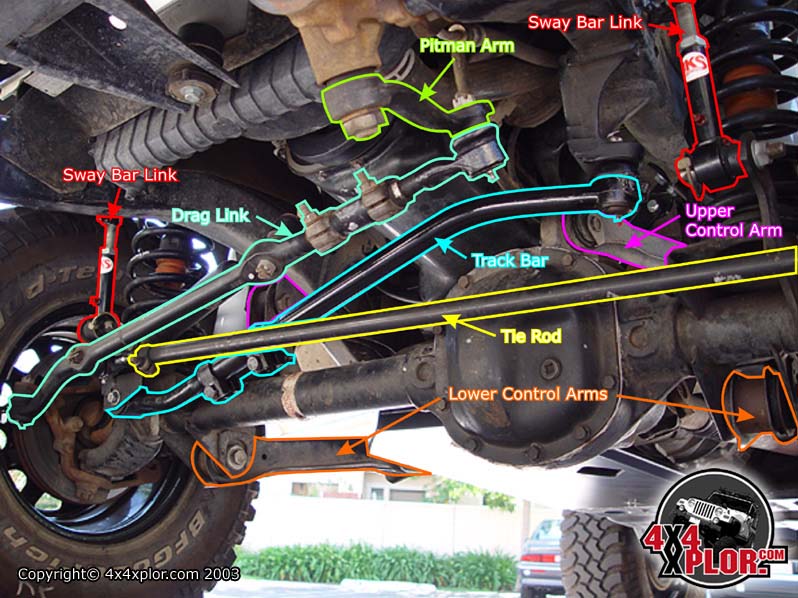
So wait, the track bar doesn't come stock with a shock absorber. That color coded pic is cool, but my XJ has a shock absorber, which I thought was standard.

CF Veteran
Joined: Aug 2011
Posts: 1,035
Likes: 0
From: Mt. Rainier, MD
Year: 1999
Model: Cherokee
Engine: 4.0
Ok...bumpsteer:
When you lift a vehicle and your drag link and track bar are out of parallel, you will get bumpsteer.
This is caused by the axle trying to re-center itself when weight is pulled off the front end. If, for example, you lift 3.5 inches and your trackbar is .75 to 1" out of center, it will try to recenter under the body of the truck everytime the weight goes up after hitting a bump....once the bump is over, the body of the truck is yanked back to the actual position of the track bar.
In a nutshell....the drag link is controlling the centering when you hit the bump, the track bar after the bump. They are not united in their mission unless they are in parallel.
I hope this is understandable.
From another site....:
You can also have a bump steer feeling when your jeep is actually doglegging (torsional twisting). This is very evident if you lift your jeep and do not center the axles or use drop brackets. After lifting, the front and rear both are torsioned towards the side of the jeep that the track bar attaches to the frame. As you know the track bars mount points are on different sides of the jeep in the front vs. the rear. I had this bumpsteer feeling after I put on the RC budget boost. It felt like the front and rear of the jeep would go in differing directions on a moderate to severe bump. Althought not technically bump steer, it is a similar feeling except for no real affect in the steering wheel.
To correct, I put on adjustable track bars which recentered the axels and took out most of the torsioning affect. Without brackets to reposition the track bar mount points, you will have more torsion with a lifted jeep due to the different geometry of the track bars vs. stock.
The other, more prominent cause is a lifted jeep having the front track bar and the drag link not on the same basic plane. With much lift at all, the planes are quite different. If the front compresses in a bump, the track bar travels one distance and the drag link travels a different distance. This then forces the drag link to affect the wheels the amount of the differing distance. see image below. Drop brackets on the track bar, drop pitman arm, or both are used to correct this issue.
When you lift a vehicle and your drag link and track bar are out of parallel, you will get bumpsteer.
This is caused by the axle trying to re-center itself when weight is pulled off the front end. If, for example, you lift 3.5 inches and your trackbar is .75 to 1" out of center, it will try to recenter under the body of the truck everytime the weight goes up after hitting a bump....once the bump is over, the body of the truck is yanked back to the actual position of the track bar.
In a nutshell....the drag link is controlling the centering when you hit the bump, the track bar after the bump. They are not united in their mission unless they are in parallel.
I hope this is understandable.
From another site....:
You can also have a bump steer feeling when your jeep is actually doglegging (torsional twisting). This is very evident if you lift your jeep and do not center the axles or use drop brackets. After lifting, the front and rear both are torsioned towards the side of the jeep that the track bar attaches to the frame. As you know the track bars mount points are on different sides of the jeep in the front vs. the rear. I had this bumpsteer feeling after I put on the RC budget boost. It felt like the front and rear of the jeep would go in differing directions on a moderate to severe bump. Althought not technically bump steer, it is a similar feeling except for no real affect in the steering wheel.
To correct, I put on adjustable track bars which recentered the axels and took out most of the torsioning affect. Without brackets to reposition the track bar mount points, you will have more torsion with a lifted jeep due to the different geometry of the track bars vs. stock.
The other, more prominent cause is a lifted jeep having the front track bar and the drag link not on the same basic plane. With much lift at all, the planes are quite different. If the front compresses in a bump, the track bar travels one distance and the drag link travels a different distance. This then forces the drag link to affect the wheels the amount of the differing distance. see image below. Drop brackets on the track bar, drop pitman arm, or both are used to correct this issue.
Additionally, the parallel that is talked about is the two points that the track bar mounts to, not the bar itself. Place a straight edge across the two bolts if you're really interested in seeing what that looks like. With 3.5" of lift you're fine, if bumpsteer is your problem then centering the axle is where to start.
Last edited by wormdrink; Sep 25, 2012 at 09:00 PM.
CF Veteran
Joined: Feb 2012
Posts: 2,574
Likes: 0
From: Laurel, MD
Year: 1998
Model: Cherokee
Engine: 4.0L
CF Veteran
Joined: Jan 2012
Posts: 8,272
Likes: 1
From: Baltimore, MD
Year: 1999
Model: Cherokee
Engine: 4.0 I6 HO
Originally Posted by wormdrink
Excellent lesson for the lad. Just to clarify Alec, the second example refers to a TJ. Still applicable to how an uncentered axle will effect your suspension, but with an XJ you won't suffer this condition.
Additionally, the parallel that is talked about is the two points that the track bar mounts to, not the bar itself. Place a straight edge across the two bolts if you're really interested in seeing what that looks like. With 3.5" of lift you're fine, if bumpsteer is your problem then centering the axle is where to start.
Additionally, the parallel that is talked about is the two points that the track bar mounts to, not the bar itself. Place a straight edge across the two bolts if you're really interested in seeing what that looks like. With 3.5" of lift you're fine, if bumpsteer is your problem then centering the axle is where to start.
CF Veteran
Joined: Aug 2011
Posts: 1,035
Likes: 0
From: Mt. Rainier, MD
Year: 1999
Model: Cherokee
Engine: 4.0
You will get a better measurement picking a spot at the height of your tire between the shock and the spring directly on the frame. Then measure to your choice of the inside tire edge or outside tire edge. Be careful if your tires have different size tread blocks to measure to the same spot on either side of the vehicle.
CF Veteran
Joined: Aug 2011
Posts: 1,035
Likes: 0
From: Mt. Rainier, MD
Year: 1999
Model: Cherokee
Engine: 4.0
'sup Ben?
F*ck no! I'm a tech lovin' geek, and since these youngsters can't use the search function on the forum or even google, I've got to nerd out. Preachin' to the choir.