


Factory ride height


Thread Starter
Senior Member
Joined: Jun 2012
Posts: 595
Likes: 0
From: Rome, GA
Year: 1990
Model: Cherokee
Engine: 4.0
 Factory ride height
I've seen something posted about this before but after searching for an hour using every key word I could think of, I can't find it.
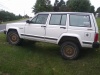
I need to know what the factory ride height measurement should be from the top of the rear axle housing (Dana 35) to the frame. I'm pretty sure mine are sagging badly because there's near zero arc.......almost completely flat and the rear eye is only about 1/4 inch from touching the frame. Mine measured 6.5 inches.
I called the local pick-n-pull and if there are any worth having, they'll sell me the leaf springs for $25 per side, which will allow me to buy a less expensive lift kit. I'll have to go out there next week and see for myself.
I need to know what the factory ride height measurement should be from the top of the rear axle housing (Dana 35) to the frame. I'm pretty sure mine are sagging badly because there's near zero arc.......almost completely flat and the rear eye is only about 1/4 inch from touching the frame. Mine measured 6.5 inches.
I called the local pick-n-pull and if there are any worth having, they'll sell me the leaf springs for $25 per side, which will allow me to buy a less expensive lift kit. I'll have to go out there next week and see for myself.

CF Veteran

Joined: Sep 2009
Posts: 8,567
Likes: 20
From: ☼ Blackhole Sun
Year: My Jeep is a GMC
How about this from another site (google "cherokee factory ride height"):
Originally Posted by NAXJA
The question arises periodically, how to measure lift height if the flares are gone and the fenders trimmed. A long, long time ago someone had a personal web site with a compilation of height measurements, both "clean" (hub to flares, no need to get dirty), and "dirty" (measured under the vehicle, from the axles to the frame. That link seems to have gone away.
Poking around in the back of the '85 Factory Service Manual the other day, I was surprised to find a section on suspensions that gives the factory's OFFICIAL measurements by the "dirty" method. For the benefit of anyone who is interested, here they are:
-------------------------------------------------------
Checking Front Ride Height
Measure front ride height with the vehicle unloaded (no luggage or passengers) and with the fuel tank full.
Place the vehicle on a level surface and measure the veryical distance between the top of the axle tube (A) and the underside of the frame sill (B). Refer to Figure 1 for driver's side measurement and Figure 2 for passenger side measurement. Be sure each measurement is taken from the top of the tube and not from the axle or shift motor housings.
With Standard or Soft Ride Suspension, vertical distance should be 17 cm (6-3/4 inches) plus or minus 13 mm (1/2 inch). With Heavy Duty Suspension, vertical distance should be 20 cm (7-3/4 inches) plus or minus 13 mm (1/2 inch).
Checking Rear Ride Height
Measure rear ride height with the vehicle unloaded (no luggage or passengers) and with the fuel tank full.
Place the vehicle on a level surface and measure the vertical distance between the top of the axle tube (C) and the underside of the frame sill (D) inboard of the jounce bumper (E).
With Standard or Soft Ride Suspension, vertical distance should be 15 cm (6 inches) plus or minus 13 mm (1/2 inch). With Heavy Duty Suspension, vertical distance should be 18 cm (7 inches) plus or minus 13 mm (1/2 inch).
-------------------------------------------------------------
The letters in each paragraph refer to diagrams, which I have no way of reproducing. Once you get underneath and look, though, the measurement points should be fairly obvious.
This section of the FSM also provides a listing of stock springs and spring codes, but it doesn't provide any specifications regarding spring rate for the various springs.
The springs are coded with a 2-letter code. In general, moving up one letter increases ride height by 1/2 inch. For example, stock (standard) front coils are coded FC through FP. If the right front has a spring coded FH and rides 1/2" too low, replacing that coil with one coded FJ would raise it 1/2". Typically, the factory used front coils with one letter code higher on the driver's side, to compensate for the weight of the driver.
The leaf springs were originally almost flat. I think most most peeps compare them to a progressive rate spring such as used in pick-ups, they are not.
Originally Posted by NAXJA
The question arises periodically, how to measure lift height if the flares are gone and the fenders trimmed. A long, long time ago someone had a personal web site with a compilation of height measurements, both "clean" (hub to flares, no need to get dirty), and "dirty" (measured under the vehicle, from the axles to the frame. That link seems to have gone away.
Poking around in the back of the '85 Factory Service Manual the other day, I was surprised to find a section on suspensions that gives the factory's OFFICIAL measurements by the "dirty" method. For the benefit of anyone who is interested, here they are:
-------------------------------------------------------
Checking Front Ride Height
Measure front ride height with the vehicle unloaded (no luggage or passengers) and with the fuel tank full.
Place the vehicle on a level surface and measure the veryical distance between the top of the axle tube (A) and the underside of the frame sill (B). Refer to Figure 1 for driver's side measurement and Figure 2 for passenger side measurement. Be sure each measurement is taken from the top of the tube and not from the axle or shift motor housings.
With Standard or Soft Ride Suspension, vertical distance should be 17 cm (6-3/4 inches) plus or minus 13 mm (1/2 inch). With Heavy Duty Suspension, vertical distance should be 20 cm (7-3/4 inches) plus or minus 13 mm (1/2 inch).
Checking Rear Ride Height
Measure rear ride height with the vehicle unloaded (no luggage or passengers) and with the fuel tank full.
Place the vehicle on a level surface and measure the vertical distance between the top of the axle tube (C) and the underside of the frame sill (D) inboard of the jounce bumper (E).
With Standard or Soft Ride Suspension, vertical distance should be 15 cm (6 inches) plus or minus 13 mm (1/2 inch). With Heavy Duty Suspension, vertical distance should be 18 cm (7 inches) plus or minus 13 mm (1/2 inch).
-------------------------------------------------------------
The letters in each paragraph refer to diagrams, which I have no way of reproducing. Once you get underneath and look, though, the measurement points should be fairly obvious.
This section of the FSM also provides a listing of stock springs and spring codes, but it doesn't provide any specifications regarding spring rate for the various springs.
The springs are coded with a 2-letter code. In general, moving up one letter increases ride height by 1/2 inch. For example, stock (standard) front coils are coded FC through FP. If the right front has a spring coded FH and rides 1/2" too low, replacing that coil with one coded FJ would raise it 1/2". Typically, the factory used front coils with one letter code higher on the driver's side, to compensate for the weight of the driver.
The leaf springs were originally almost flat. I think most most peeps compare them to a progressive rate spring such as used in pick-ups, they are not.
Last edited by Turbo X_J; Aug 22, 2012 at 08:26 PM.
Thread Starter
Senior Member
Joined: Jun 2012
Posts: 595
Likes: 0
From: Rome, GA
Year: 1990
Model: Cherokee
Engine: 4.0
Hmm.............so according to that, my 22 year old factory leaf springs are normal and not sagging? If so, that'll make my lift project much cheaper since I won't have to buy new or pick-n-pull ones.
CF Veteran
Joined: Jan 2012
Posts: 1,057
Likes: 2
From: Nazareth/Pen Argyl, Pennsylvania
Year: 1989
Model: Cherokee
Engine: 4.0L 242ci I6
Mine sags slightly in the back, but not too much for the average person to notice. My leafs are usually flat or slightly bent up. The shocks also play a role in the way the leafs look too though. I'm pretty sure I just need new shocks in the back to stiffen it up. Over speed bumps sometimes the front will compress and be fine, but the back will bounce once or twice. The shocks usually go before the actual leafs. Save up for a complete lift kit and do it all at once if you can. That's what I'm doing. It just sucks trying to save up with basically nothing to come out of it until the very end.

Thread
Thread Starter
Forum
Replies
Last Post
studmuffin
Cherokee Chat
8
Oct 5, 2015 01:54 PM
redrooster
Stock XJ Cherokee Tech. All XJ Non-modified/stock questions go here
7
Oct 2, 2015 12:35 AM
shadowmoses
Stock XJ Cherokee Tech. All XJ Non-modified/stock questions go here
6
Sep 30, 2015 01:34 PM
Currently Active Users Viewing This Thread: 1 (0 members and 1 guests)