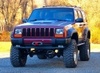
96 XJ here. Both my front fenders look like in the pictures (spots are rain drops) and a buddy just was telling me that if you take a blow torch and hold it far away and move it back and forth, then slowly toward the fender that it would 're-activate' the clear coat and make it look new again, getting rid of the white that I guess is caused by UV.
Is this true?
If so I guess I'd take the fenders off to do the job. Never heard of this before so thought I'd run it through you guys before attempting it.
Negative... The only thing taking a blow torch to those will reactivate is the money coming out of your wallet...Seriously, the clearcoat is an activated coating with a hardener and once it's dry there's no going back...When the clearcoat gets to the point you're at it needs to be stripped and repainted
Clear coats are the biggest scam in the industry. I hate that crap. I got 35 year old no clear coated car that look great, and new car with pelling clear coat. I hate that stuff. planned obsolescence. Yet most people put up with that failure prone crap.
Plastic parts oft require a different paint than used on steel body parts. Adhesion and flexing are issues.
Id not use a clear coat system on them also.
You migh try a plastic safe paint stripper.
Give the flare attaching nuts a good over night soak in penatrating oil. and brush off the threads to clean them before trying to remove. They can tend to stick, and break during removal.
You might find your local wrecker has used flares without layers of paint on them. That may save you time and money stripping the red paint.
My 1990 flares are molded grey and have a thin spray coating of silver, no clear coat. this is I believe factory. Body is factory color black.
I believe early xj have contrast color flares / body. Thus yours should NOT be red body color. perhaps black or silver is correct color, the lower part of doors should also have this contrast color, as I see that on may early bodied XJs.
I see the later updated more rounded body xj'swith body color flares, those flares are different style than early xj flares. I believe these flares are made of a more rigid plastic than the softer early flares. The early ones you can near fold in half, the late ones will crack first, not near as flexible.
I dont think the early flares take paint as well, or at least not regular body paint as used on the hood. You will need flexible plastic paint here on the early flares.
Well I got all 4 fenders off but not without breaking at least one bolt off each of the retention plates, of which each fender has 3.
Where do I find replacement plates? Not even sure what they're called or if they're even sold.
Welcome to the club, LOL.
I don't have any pictures handy, but what I did when I had the same issue was grind what was left of each stud flat with the bracket, drill it out, and tap it with the same size as as the original stud. Then I got some stainless pan-head machine screws (the pan head ones have pretty low profile heads), threaded them in from the back, and secured them with something like red Loctite, superglue, or JB weld (can't remember which) to keep them from backing out. I've had them on and off a couple of times since then, and they've held up great. Remember to put some anti-seize on all the threads of the new studs before you put the nuts back on.
I've taken a route suggested on a different forum where I sand up to 600 grit, as is, then a layer of high build colored primer (sanded), then 3 coats of color (matched), then 2-3 coats clear acrylic. Problem is, I ordered them from automotivetouchup.com and now they're saying there's a 2 week+ supply chain delay in shipping, and I can't wait that long.
Going with this method of restoration, what other supplier can I source these three products from in rattle cans?...
- high build red tinted primer
- matched color
- clear acrylic
Also, what's the difference between 1k and 2k acrylic clear?
Well I got all 4 fenders off but not without breaking at least one bolt off each of the retention plates, of which each fender has 3.
Where do I find replacement plates? Not even sure what they're called or if they're even sold.
I think you mean fender flares rather than fenders.
For the fender flare metal mounting brackets, you can grind off the busted stud head, and remove the remains. then use a screw of same diameter as stud in its place, weld it in place, or use a thin nut to secure it to the bracket so it wont spin when securing the flare. No need to replace the whole bracket. That's what I done did.
The difference between 1k and 2k is that 2k will have a catalyzed hardener added to the mix...There's a small button you put on the bottom of the can and push.. This will add the hardener to the mix then you shake just like a normal spray can... You can actually get a high build primer as well as the clearcoat mentioned in a 2k formula... The 2k will hold up much better than any 1k to the elements...If you want your supplies immediately you can get them at any auto body supply store in your area... They will have the 2k primer, will mix up the correct basecoat to match what you've got, and even put it in an aerosol can for you...They will have a 2k clearcoat in a spray can as well...P.S... Technically you would sand your flares with a 320 then shoot the 2k primer on that... Then you'd "sand up" to the 600 grit for the base and clearcoat.. You won't have the ability to go back and reshoot with the 2k unless you follow the directions and sand within the working range of the activated primer...You'd want to recoat any areas you sanded through... I typically use Sherwin Williams or PPG products from the auto body supply stores .. But be prepared paint isn't cheap, but then again nothing is these days...They will have a cheaper grade available so just ask them for the cheaper stuff you won't need the flagship, top of the line products for what you're doing..
I tried the blow torch on my black plastic flares. It worked but was pretty sketchy (as expected). I didn’t want to scorch them of course. Tried the heat gun and it works too but was really slow. The improvement just wasn’t worth it for me. Occasionally I will just give a light spray of tire shine and it does the trick.
Well I got my shipment from touchupdirect.com of 1 can aerosol primer, 2 cans of color, and 1 can 2k clear. I've sanded everything down with 220 grit (heading toward 600) trying to smooth out some of the divots that were easier to get to.
I was hoping to get a high build primer but the only thing this company offered is what they call their Aerosol Primer, so I'm not sure how well this stuff will fill the divots I'm still looking at.
So my question is...do I need to stick with the 220 grit I'm at now and continue smoothing out all these other divots, or will say 2 coats of this primer fill them in once sanded out?
I'm not looking for anything close to perfection here. Just good adhesion, color and decent finish. Nicks don't bother me much.