When you click on links to various merchants on this site and make a purchase, this can result in this site earning a commission. Affiliate programs and affiliations include, but are not limited to, the eBay Partner Network.
I recommend you don't be like me and just save up and get brown dogs.(TLDR: Others say Brown Dogs are the same result)
First the good. Others' reviews of mounts like these (like on youtube) mention that you need to grind the mounting bracket. Once the offending part of the casting is ground off, these fit nicely and firmly. They seem to hold the engine steady, and now I can move on to replacing a very cracked exhaust manifold - which cracked probably mostly, if not entirely, because the motor was moving around excessively in the engine bay. These fit directly into stock location after grinding. They also do not transmit overwhelming vibration into the cab above about 1500 RPM, or while idling under NO LOAD. If you drive a manual trans. then you'll have a lot less vibration, but still more than stock.
Now the not-so-good. The vibration is tremendous while idling at a stoplight under load (in gear). Every trim piece in the cabin rattles while the jeep is in gear sitting idle at a stop - again, it is only while in gear and stopped. The vibration is so loud I can no longer hear my Banks Monster Cat-Back exhaust while stopped - it's a flipping straight-through muffler! Grinding was required on the driver's side motor mount bracket. (Some mention grinding some of the rubber on the bushing away, but I think that may cause premature failure of the rubber.)
Strangely, my steering is now more accurate...?
I noticed immediately that when I took this out for a test drive, the slack in the center position of my steering is nearly gone (there used to be about 1-1/2" of steering wheel 'dead-zone' between giving steering input towards the left vs towards the right). Of particular note, my old driver's side motor mount was completely broken through, offering no support laterally, or as the motor torqued while accelerating - it was only supporting it against gravity and downshifting. The best I can figure is the whole motor is now acting as a brace between the 'frame rails'. That means the driver's side 'frame rail' has been supporting the majority of the steering stress, which makes sense since that's the side the steering box is located on; and it also makes sense why one main steering upgrade is the support brace (track bar brace) between 'frame rails' which crosses under the oil pan. And I will now also prioritize that item.
Last edited by cannothas; Jan 4, 2026 at 07:50 AM.
Reason: renaming track bar brace
Yep, that's what urethane does. If you get tired of it, get some stock motor mounts, and mostly fill the gap with urethane caulk. Try to leave a little gap between the urethane and the rubber mount.
As for the steering improvement, the engine can tie the two unibody rails together if the mounts are stiff enough. Do you have a track bar mount brace and/or a steering box brace?
I'm not sure what your instructions told you...But the brown dog mounts get the through bolts tightened down completely then backed off a touch {when you can spin the washer it's there} to keep those vibrations in check...
Prothane in general is a good company...But urethane is urethane...Not rubber..
Do you have a track bar mount brace and/or a steering box brace?
I do not, and now seeing how big a difference it makes, I know I need one. Maybe all XJs actually need it? (I've read other forum posts - memes really - where XJ drivers ask people who drive modern cars with tight steering, "what do you actually do here," referring to the way one just seems to 'sit there' in comparison to driving an XJ which is a very active effort to keep the thing on the road)
If there are only two options, I'll still take the option I chose, I'm invested in it now, I'm not removing them unless I have to, so I'll deal with it.
The thing I really don't want is for the movement of the motor to damage any further exhaust manifolds/headers. In my reading, there are basically this style of mount and the stock style mount. The stock style fail every few years, I'm not really OK with changing them that often. Is there anything that lasts a good long time but does not transmit as much vibration into the cabin? Should there be a 'next time' I may consider that option - and other readers may want to know.
I'm not sure what your instructions told you...But the brown dog mounts get the through bolts tightened down completely then backed off a touch {when you can spin the washer it's there} to keep those vibrations in check...
Prothane in general is a good company...But urethane is urethane...Not rubber..
No instructions were in the box. You never know with Amazon stuff, these could have been a return where someone took them out and then returned it and I got that box?
My motor mount bolts did not have washers on either side (should there be?). Maybe I back them off 1/4 turn just to see what happens? Right now they're gutentight.
Last edited by cannothas; Jan 4, 2026 at 08:08 AM.
A few of the XJ aftermarket shops make HD motor mounts using the LCA axle-side mount rubber bushing. These are going to produce less vibration but still hold the motor very firmly and not tear apart like factory motor mounts. Here's one example:
Good info on backing off nut slightly to rotate washers. Will have to go back and check mine. I have had 2 jeeps and several strokers in my almost 30 years of ownership...probably half a million plus between them. You want soft and quiet...stock mounts but not so durable. Then had brown dog poly...wow talk about vibration, probably had them too tight. Then went brown dog rubber..much better and almost nothing in Neutral. What I have learned is neither brown dog mount accommodates a transfer case drop used with a lift kit. The downward angle of the tranny alters the angle of mount rubber and probably stiffens them up more than they would with no drop. Stock takes the drop but wears them out faster. If they could make a mount with a pre-built angle shim it would reduce the stress on the insulating material and make them softer. Maybe they do by now...my current mounts are probably 8 -10 years old by now. They don't get much mtc or attention but will check on the tightness of the thru bolt the next warm day..thanks for the info
Been running the M.O.R.E. (Mountain Off Road Enterprise) mounts for about 10years with no issues. They use a regular LCA bushing. I have the rubber version.
Last edited by Outlaw Star; Mar 2, 2026 at 06:56 AM.
Aftermarket engine mounts almost always cater to the more extreme crowd, and since so many people have the mindset of "aftermarket is always better", there's a lot of complaints about vibrations from people that probably wanted something more in between the two.
There's an almost universal design choice among makers of poly mounts that makes them significantly worse for most users: The ears of the mount are almost always in direct contact with the entire outside face of the mount bushing. That creates something like a short circuit, a shorter and stiffer path for vibrations to pass through. See below for a visual example of what I mean. In this case, the bushing has actually been compressed so much that it's imprinted with the other half of the motor mount.
The vibrations from the engine can pass right through that shorter path, rather than letting the entire bushing do it's squishing.
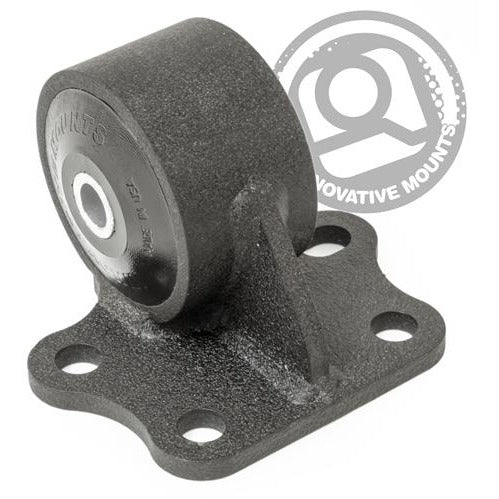
The only brand I've seen that tackles this issue is Innovative Mounts. They use a tapered bushing design that prevents this short circuit. On my Miata, I installed a set of poly mounts that were advertised as "street" mounts. They made my hood shake a half inch at idle. They never broke in and it never got better, I removed them and went back to stock. When I first sat in a car with Innovative mounts, I couldn't believe they were poly. I eventually traded mounts with that guy - he wanted stiffer mounts on his track only car, and I wanted softer mounts for my street/track car.
Here's a good picture of the taper bushing.
The thing that boggles my mind is that no one else has tried to address this issue. And you don't need a tapered bushing to do it. Simply having two thick washers act as a standoffs between the ears of the mount and the bushing would accomplish the exact same thing, without a custom taper bushing. All you have to do is make sure vibrations travel radially through the entire bushing, and that you don't squish the sides of it.
Another option is to partially fill the gap in stock mounts with urethane caulk. This will reduce tendency for the rubber to rip due to extreme displacement, but some gap will remain to prevent vibration transfer. This is what I intend to do when I eventually need to replace my motor mounts.
Don't get me wrong, but this one reads like oil threads. Replace "engine mounts" with "oil" and voila.
There is always lack of proof associated with the performance of oils, but without a doubt, there are clear differences in the characteristics of motor mount performance. IMost people fail to realized that HD mounts will cause significantly more NVH than stock. As someone already said, the hardcore won't care, but people who value street performance will be surprised.
I decided to run the SFR super soft urethane trans mount because I gambled that this would better anchor the driveline while minimally affecting NVH. It had zero effect on vibration, but there is definitely more noise transmission than the stock mount that was in good shape.
I've run HD mounts in other vehicles, and there's always been some sort of increase in NVH. People just need to find out what works for them.
There is always lack of proof associated with the performance of oils, but without a doubt, there are clear differences in the characteristics of motor mount performance. IMost people fail to realized that HD mounts will cause significantly more NVH than stock. As someone already said, the hardcore won't care, but people who value street performance will be surprised.
I decided to run the SFR super soft urethane trans mount because I gambled that this would better anchor the driveline while minimally affecting NVH. It had zero effect on vibration, but there is definitely more noise transmission than the stock mount that was in good shape.
I've run HD mounts in other vehicles, and there's always been some sort of increase in NVH. People just need to find out what works for them.
NVH is a main factor in why I went with M.O.R.E. ones instead of poly ones. It has a rubber bushing instead of harsh poly. Its actually the same bushing thats in the LCA's. So I can always replace it for cheap IF it ever fails.
I have Rusty's Offroad motor mounts on my XJ. They look every bit as robust as M.O.R.E. mounts but cost about $70 less.
My Jeep is driven almost exclusively on moderate offroad trails. It gets LOTS of 4WD low range. I got tired of changing motor mounts. The Rusty's mounts seem to be holding up really well. As others have mentioned the NVH is more pronounced but then the 4.0L isn't known for its smooth idle under any circumstances.



 Motor Mounts 'Upgrade'









 but this one reads like oil threads. Replace "engine mounts" with "oil" and voila.


