


Downieville, CA historical and wheeling

Thread Starter
CF Veteran
Joined: Aug 2008
Posts: 6,588
Likes: 495
From: Chico, CA
Year: 1986
Model: Cherokee
Engine: 4.3L with headers and full 3" exhaust system

Day 7
We went to the Kentucky Mine and Museum. This is a really cool place. After most of the mining had died down, a couple of guys decided to go into mining after WWI. They had day jobs, but gold fever got to them so they scrounged around and built a new ore processing structure from bits and pieces they found for free on the original site of the Kentucky Mine. It was not a rich mine as mines go. Only 200K in gold was pulled out. But it was just around the corner from the Sierra Buttes Mine which pulled out 70 million in 40 years. They were close, they knew it.


That water wheel ran this wee little compressor. Think it would fit under the hood? Our present day serpentine belts transfer about the same horsepower as that flat leather belt did
Inside the building.


A wee bull wheel coming off the water wheel
The upper part of the stamp. Each vertical shaft is a stamp and weighs 1,000# This was a ten stamp mill. The Sierra Butte Mine had 40 that ran 24/7

The cam shaft worked just like the one in the 4.0L. As it lifted the stamp, it spun it for even wear and to give it a grinding motion as it fell

The business end of the stamp. Those cast iron shoes had to be replaced periodically and was the only reason the stamp was shut down, unless there was a body clogging it up

This 8' water wheel ran the crusher and the stamps. These things are deceiving. They can generate a lot of horsepower. This one would probably go at least 80 hp. I turned it long enough to get a stamp to drop and make a lot of noise. It took about 60# of pull to operate one stamp. Each stamp operated at 75 cycles per minute.

After the ore was pulverized, it passed through a tight meshed screen and out on to the table. Tin sheets were coated with mercury. The mercury dissolved the gold and let the rest pass down to eventually be discarded. These sheets were later scraped and the amalgam heated to 675° and the mercury that boiled off was collected in a still and reused.
The gold fever tragedy here was that the two guys that built this mine were father and son. The father was 81 and worked the mill and the son did the mining. One day the son did not come home. He was found under rubble, the result of a blasting accident.
I want to say a few things about these water wheels. In about 15 years, all the trees in any mining area had been cut down for lumber or fuel for the boilers. Something had to be done or the mining would have to stop. They held a contest to see who could make the best water wheel. Up to this time, water wheels were the paddle type you see back east. A guy named Pelton, a millwright at one of the mines won the contest. He made a paddle that resembled two spoons side by side. Water under pressure, at least 50# was shot into the double spoon. The effect was that the spoons reversed the direction of the water. It was found later that these were 90% efficient, compared to 40% for a flat paddle. He patented this and they are still used today in many applications such as power generation in dams. They were so popular, many uses were found

This one was used to power a sewing machine. Others were used to power washing machines. So, in a mining town, you simply turned on the spigot to have your machine do your work, long before the electric versions were made
We went to the Kentucky Mine and Museum. This is a really cool place. After most of the mining had died down, a couple of guys decided to go into mining after WWI. They had day jobs, but gold fever got to them so they scrounged around and built a new ore processing structure from bits and pieces they found for free on the original site of the Kentucky Mine. It was not a rich mine as mines go. Only 200K in gold was pulled out. But it was just around the corner from the Sierra Buttes Mine which pulled out 70 million in 40 years. They were close, they knew it.
That water wheel ran this wee little compressor. Think it would fit under the hood? Our present day serpentine belts transfer about the same horsepower as that flat leather belt did
Inside the building.
A wee bull wheel coming off the water wheel
The upper part of the stamp. Each vertical shaft is a stamp and weighs 1,000# This was a ten stamp mill. The Sierra Butte Mine had 40 that ran 24/7
The cam shaft worked just like the one in the 4.0L. As it lifted the stamp, it spun it for even wear and to give it a grinding motion as it fell
The business end of the stamp. Those cast iron shoes had to be replaced periodically and was the only reason the stamp was shut down, unless there was a body clogging it up
This 8' water wheel ran the crusher and the stamps. These things are deceiving. They can generate a lot of horsepower. This one would probably go at least 80 hp. I turned it long enough to get a stamp to drop and make a lot of noise. It took about 60# of pull to operate one stamp. Each stamp operated at 75 cycles per minute.
After the ore was pulverized, it passed through a tight meshed screen and out on to the table. Tin sheets were coated with mercury. The mercury dissolved the gold and let the rest pass down to eventually be discarded. These sheets were later scraped and the amalgam heated to 675° and the mercury that boiled off was collected in a still and reused.
The gold fever tragedy here was that the two guys that built this mine were father and son. The father was 81 and worked the mill and the son did the mining. One day the son did not come home. He was found under rubble, the result of a blasting accident.
I want to say a few things about these water wheels. In about 15 years, all the trees in any mining area had been cut down for lumber or fuel for the boilers. Something had to be done or the mining would have to stop. They held a contest to see who could make the best water wheel. Up to this time, water wheels were the paddle type you see back east. A guy named Pelton, a millwright at one of the mines won the contest. He made a paddle that resembled two spoons side by side. Water under pressure, at least 50# was shot into the double spoon. The effect was that the spoons reversed the direction of the water. It was found later that these were 90% efficient, compared to 40% for a flat paddle. He patented this and they are still used today in many applications such as power generation in dams. They were so popular, many uses were found
This one was used to power a sewing machine. Others were used to power washing machines. So, in a mining town, you simply turned on the spigot to have your machine do your work, long before the electric versions were made
Thread Starter
CF Veteran
Joined: Aug 2008
Posts: 6,588
Likes: 495
From: Chico, CA
Year: 1986
Model: Cherokee
Engine: 4.3L with headers and full 3" exhaust system
Day 8
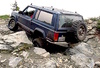
The mine took up more time than I thought, but well worth it. Since we spent the day at Sierra City, we thought we would take a little climb up Sierra Buttes. They are at 8600' elevation, about the tallest part of the Norther Sierras. There two ways to get up. We naturally took the 4WD road. It was a long 4000' climb in about 2 miles. That is steep, about a 40% grade. I had all the fans on and creeping slowly. Unfortunately, the camera seems to have lost some of the pics. But it was rocky, a bit off camber and narrow. There was for the most part nothing to stop you from going all the way to the bottom, thousands of feet below. Fortunately, the only people I met were three Land Rover Discoveries at the top near an intersection. They were nice enough to back up a hundred feed. The alternative was for me to back up at least a half mile to the next switchback. Once we got to that intersection, we were back in the trees. It was a grand view from up there, wish the pics survived
The mine took up more time than I thought, but well worth it. Since we spent the day at Sierra City, we thought we would take a little climb up Sierra Buttes. They are at 8600' elevation, about the tallest part of the Norther Sierras. There two ways to get up. We naturally took the 4WD road. It was a long 4000' climb in about 2 miles. That is steep, about a 40% grade. I had all the fans on and creeping slowly. Unfortunately, the camera seems to have lost some of the pics. But it was rocky, a bit off camber and narrow. There was for the most part nothing to stop you from going all the way to the bottom, thousands of feet below. Fortunately, the only people I met were three Land Rover Discoveries at the top near an intersection. They were nice enough to back up a hundred feed. The alternative was for me to back up at least a half mile to the next switchback. Once we got to that intersection, we were back in the trees. It was a grand view from up there, wish the pics survived
Thread Starter
CF Veteran
Joined: Aug 2008
Posts: 6,588
Likes: 495
From: Chico, CA
Year: 1986
Model: Cherokee
Engine: 4.3L with headers and full 3" exhaust system
Day 9
This was the last day for wheeling. My wife wanted to stumble around Downieville and visit the shops and stuff. I however was not without something to do.

Downieville is friendly to tourism, its only source of income now. At one time it was the fifth largest city in CA and was only ten votes shy of being the capital. But, I don't think the growth potential was good in a town on a 100% slope at the bottom of a canyon. I found this sign within the city limits. So I headed off down another road marked 4WD


This creek would have been diverted to run a water wheel in the mining days

I found this foundation

More evidence of mining

Spotted this nice looking MJ at a miners camp
After that, it was ice cream and back to camp and head home the next day
This was the last day for wheeling. My wife wanted to stumble around Downieville and visit the shops and stuff. I however was not without something to do.
Downieville is friendly to tourism, its only source of income now. At one time it was the fifth largest city in CA and was only ten votes shy of being the capital. But, I don't think the growth potential was good in a town on a 100% slope at the bottom of a canyon. I found this sign within the city limits. So I headed off down another road marked 4WD
This creek would have been diverted to run a water wheel in the mining days
I found this foundation
More evidence of mining
Spotted this nice looking MJ at a miners camp
After that, it was ice cream and back to camp and head home the next day

Thread
Thread Starter
Forum
Replies
Last Post
2heapjeeps
Stock Grand Cherokee Tech. All ZJ/WJ/WK Non-modified/stock questions go here!
13
Oct 4, 2015 10:52 PM
2heapjeeps
Stock Grand Cherokee Tech. All ZJ/WJ/WK Non-modified/stock questions go here!
2
Sep 7, 2015 11:30 PM
Currently Active Users Viewing This Thread: 1 (0 members and 1 guests)